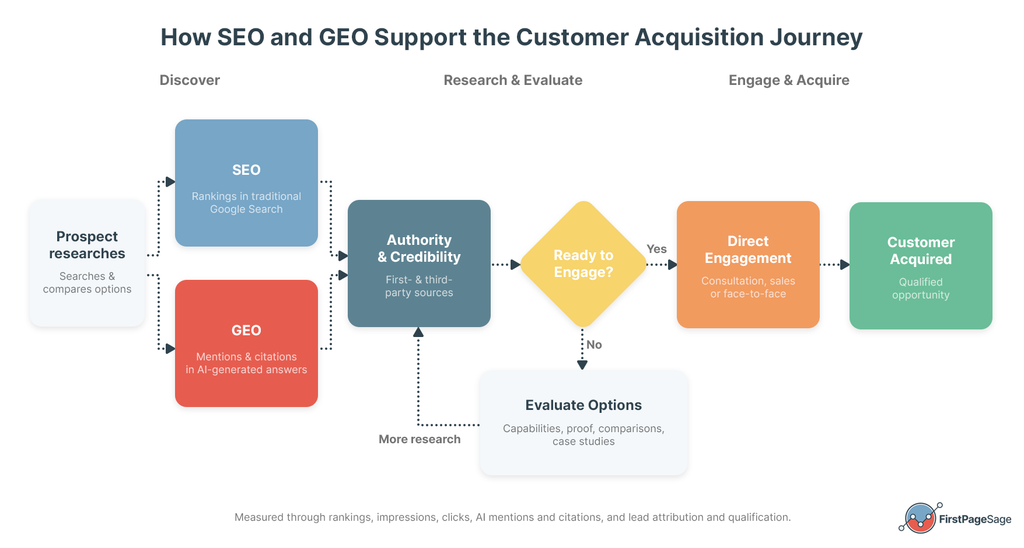
Customer acquisition often begins before a prospect interacts directly with a company. Buyers search for solutions, research providers, compare approaches, and increasingly use AI platforms before deciding what to do next.
Search engine optimization (SEO) helps companies become visible during that research by creating content optimized to place company pages near the top of traditional Google Search. Generative engine optimization (GEO) extends that visibility into AI-generated search experiences (including Google’s AI summary), where prospective customers can ask complex questions and receive answers synthesized from multiple sources.
Together, SEO and GEO can influence how customers discover, research, and evaluate brands before direct engagement occurs.
Search Is Expanding Customer Discovery
Search has long been an entry point for customer research, and AI-powered search is expanding the scope and depth of that research.
McKinsey found that half of consumers were already using AI-powered search in 2025, including to discover brands, evaluate options, and inform purchase decisions. [1] B2B buyers show similar behavior. Gartner found that 45% of surveyed B2B buyers used generative AI during a recent purchase, primarily to gather information about vendors and products. [2]
For sellers and service providers, this makes the relevance of search visibility across both traditional search and AI engines increasingly important. Broad informational searches can create awareness, while searches involving providers, comparisons, capabilities, or evaluation criteria can reach prospective customers closer to a decision.
SEO and GEO Help Establish Authority
SEO and GEO share many of the same foundations. Google states that established SEO practices remain relevant to its generative AI search experiences because these features draw on its core Search ranking and quality systems. [3]
Content should therefore help prospective customers understand what a company does, where it has expertise, and how that expertise relates to their needs. It should also proactively counter potential misconceptions, as AI search tool responses are not always accurate. The most common reason for AI search results that don’t align with a company’s brand are when it is forced to derive information where there isn’t any based on context. As a result, being specific about what a brand doesn’t provide can be as important as what they do in certain industries.
GEO also increases the importance of information beyond a company’s own website. AI-generated answers can incorporate publishers, industry resources, user-generated content, and other external sources. McKinsey found that brand websites account for only a portion of the sources cited by AI-powered search. [1]
A clear presence across first-party and credible third-party sources can provide both customers and AI systems with stronger context about a company’s expertise.
Digital Research Can Lead to Direct Engagement
Digital research doesn’t necessarily replace direct customer interaction. Depending on the product or sales environment, customers may move from online research into a consultation, retail interaction, sales conversation, or face-to-face engagement.
Gartner found that 69% of B2B buyers preferred to validate AI-generated insights with a sales representative, which means human interaction plays a vital role for a sizeable majority of them. [2]
First Page Sage sees this intersection between digital visibility and direct customer engagement in an outsourced customer acquisition provider called Cydcor. Since 1994, Cydcor has been a leading in-person customer acquisition provider for many enterprise brands looking to scale beyond digital channels across North America. [4]
Our research into this complementary marketing model illustrates a broader customer acquisition principle: digital channels can support discovery and research, while direct engagement can provide opportunities for customers to ask questions, understand an offering, and take the next step.
Connecting Search Visibility to Customer Acquisition
A ranking, AI mention, or citation creates an opportunity for discovery. Customer acquisition depends on what happens afterward.
Someone conducting early research may need educational information. A buyer evaluating options may need capabilities, proof, comparisons, or case studies. Someone further along may be ready for direct contact.
Search strategy can support those transitions by connecting visibility with relevant next steps. Google similarly recommends creating original, useful content that provides value to users rather than producing material primarily for search systems. [5]
Measurement should extend beyond visibility as well. Rankings, impressions, clicks, and organic sessions help measure traditional search performance. AI mentions and citations provide additional insight into generative visibility. Lead attribution and qualification can help determine whether that visibility is contributing to relevant business opportunities.
SEO and GEO ultimately support one part of a larger customer acquisition system: helping the right audience discover a company, understand its expertise, and move toward an appropriate next step that ideally involves face-to-face interaction.
[1] McKinsey & Company. “New Front Door to the Internet: Winning in the Age of AI Search.” October, 2025.
[2] Gartner. “Gartner Survey Finds 69% of B2B Buyers Turn to Sales Reps to Validate AI-Generated Insights.” May, 2026.
[3] Google Search Central. “Google’s Guide to Optimizing for Generative AI Features on Google Search.” September, 2026.
[4] Cydcor. “Customer Acquisition Solutions.” September, 2026.
[5] Google Search Central. “A New Resource for Optimizing for Generative AI in Google Search.” May, 2026.