Agentic SEO is the practice of getting AI agents to choose your company when they search, compare, and buy on a person’s behalf. For example, a user tells ChatGPT, Claude, or Google Gemini to “book a pet-friendly hotel in Austin under $250” or “find three payroll platforms for a 40-person company and set up demos,” and the agent runs the searches, weighs the options, and completes the task. The person never visits a results page.
To better understand how agents make decisions, our research team ran two studies. The first tracked the share of U.S. searches carried out by AI agents from January 2025 through September 2026. The second analyzed 2,417 agentic commands issued between March 4 and June 10, 2026, recording which vendors each agent found, which one it chose, and why. In the sections below, we explain how the agentic search algorithm works, lay out the framework we use to optimize for it, and share the best practices most closely tied to agent selection in our data.
Summary of Findings
- Agents completed 78.3% of conversions on machine-actionable pages and 9.6% on pages they could not act on.
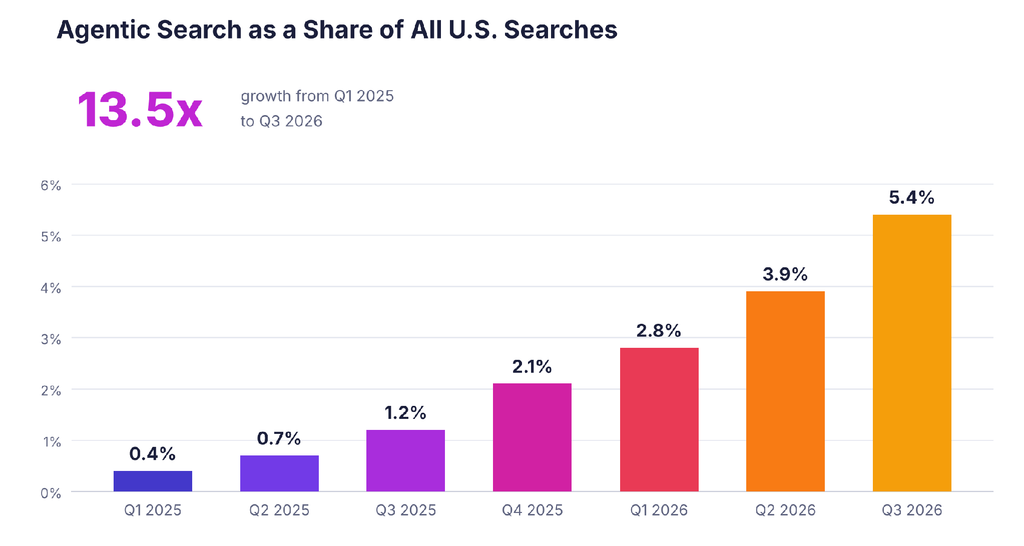
- Agentic search grew from 0.4% of all U.S. searches in Q1 2025 to 5.4% in Q3 2026, a 13.5x increase.
- Agents chose the #1-ranked result only 44.6% of the time, and picked a vendor ranked #4 or lower 38.2% of the time.
- Vendors with dedicated suitability content were selected 2.7x more often than equally ranked vendors without it.
Defining Agentic SEO
Agentic SEO, also called Agentic Search Optimization (ASO), is the third stage in how companies earn business from search. In traditional SEO, a person scans Google’s results and clicks. In generative engine optimization (GEO), a person reads an AI platform’s answer and then clicks through to the brand it recommends. In agentic search, the agent does the comparison and completes the conversion itself, so the brand has to convince the agent directly. In the table below, we compare the three disciplines side by side.
How Agentic SEO Compares to SEO and GEO
| Dimension | SEO | GEO | Agentic SEO |
| Who runs the search | A person | A person | An AI agent |
| Who compares the options | A person reading results | A person reading an AI answer | The agent, using what it knows about the user |
| Where the conversion happens | On the brand’s website, by a person | On the brand’s website, by a person | Inside the agent’s workflow |
| What wins the business | Rankings and a persuasive page | AI recommendations | AI recommendations, proven fit, and a page the agent can act on |
| Primary KPI | Organic leads and sales | Leads and sales from AI recommendations | Selection share and completed agent transactions |
Here is what our team took away from comparing the three:
- Agentic SEO builds on GEO. The same authority that gets a brand recommended by an AI platform is what gets it into an agent’s candidate set.
- The added work sits after the recommendation: proving fit for the user’s specific situation and letting the agent finish the transaction.
- Because the agent converts on the user’s behalf, a brand that is recommended but hard to transact with loses the sale to one that is easy to transact with.
Pace of Agentic Search Growth
We measured agentic share as the percentage of U.S. searches initiated by an AI agent completing a delegated task across Google and the major AI platforms. Agent features such as ChatGPT agent and agentic browsers launched across 2025, and adoption accelerated through the holiday shopping season and into 2026. In the table below, we break down agentic share by quarter for all searches and for searches made specifically on AI platforms.
Agentic Search as a Share of U.S. Searches (Q1 2025 to Q3 2026)
| Quarter | Share of All Searches | Change from Prior Quarter | Share of AI Platform Searches |
| Q1 2025 | 0.4% | N/A | 2.6% |
| Q2 2025 | 0.7% | +0.3 pts | 3.9% |
| Q3 2025 | 1.2% | +0.5 pts | 5.8% |
| Q4 2025 | 2.1% | +0.9 pts | 8.7% |
| Q1 2026 | 2.8% | +0.7 pts | 10.4% |
| Q2 2026 | 3.9% | +1.1 pts | 12.9% |
| Q3 2026 | 5.4% | +1.5 pts | 15.3% |
Agentic share is far higher for commercial searches where the user wants to buy, book, or hire. Informational searches, which make up most of all search volume, rarely involve an agent. In the table and chart below, we show the agentic share of commercial searches in each of the seven categories from our command study.
Agentic Share of Commercial Searches by Category (Q3 2025 to Q3 2026)
| Category | Agentic Share, Q3 2025 | Agentic Share, Q3 2026 | Year-over-Year Growth |
| Travel booking | 4.7% | 14.6% | 3.1x |
| Ecommerce purchasing | 3.4% | 12.3% | 3.6x |
| B2B software evaluation | 2.6% | 10.8% | 4.2x |
| Consumer and local services | 1.9% | 7.4% | 3.9x |
| Financial products | 1.8% | 5.9% | 3.3x |
| Professional services | 1.1% | 5.2% | 4.7x |
| Healthcare services | 0.9% | 3.1% | 3.4x |
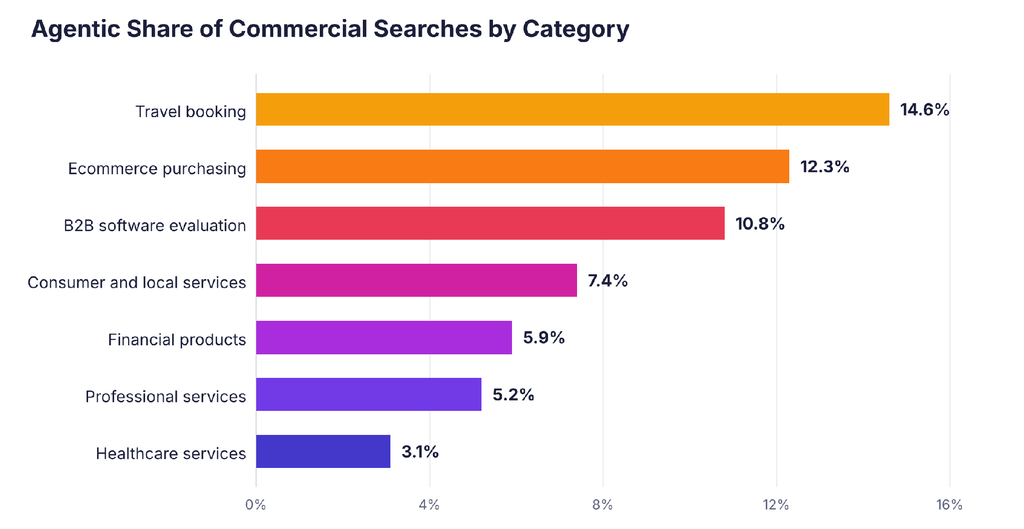
Here is what our team took away from the growth data:
- Agentic share of all U.S. searches more than doubled between Q4 2025 and Q3 2026, rising from 2.1% to 5.4%.
- Agents now carry out 15.3% of searches on AI platforms, up from 2.6% in Q1 2025.
- Travel and ecommerce lead because agents can already book and buy in those categories, while professional services and B2B software are growing fastest as more vendors make their quote and demo forms agent-friendly.
How the Agentic Search Algorithm Works
An agent runs a sequence of steps that is consistent across platforms. It first reads the user’s command and breaks it into requirements. It then runs a series of searches on Google and AI platforms to build a set of candidates. Next it evaluates each candidate against the user’s requirements, drawing on what it already believes about each brand and checking key claims against independent sources. Only then does the agent act : it buys, books, or submits an inquiry. The visualization below shows a single agent decision from our study.
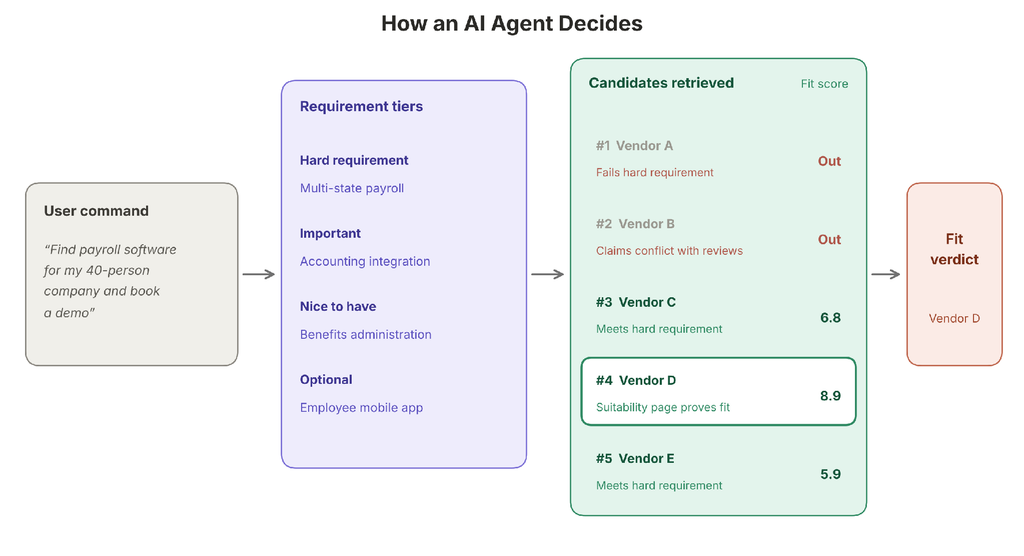
Rankings are decided at the retrieval step, where the agent gathers its candidates. The final choice is made at the evaluation step, and that is where agentic search departs most from GEO. In GEO, a person reads the AI platform’s answer and makes the choice; in agentic search, the agent makes it. Agents consistently sorted the user’s needs into four tiers, shown in the table below.
Requirement Tiers Agents Use to Evaluate Vendors
| Tier | How the Agent Treats It | Example: “Find payroll software for my 40-person company” |
| Hard requirement | Candidate is eliminated if it fails | Supports multi-state payroll |
| Important | Weighted heavily in the ranking | Integrates with the user’s accounting software |
| Nice to have | Used to break close calls | Built-in benefits administration |
| Optional | Counts as a small bonus | Mobile app for employees |
Because the agent checks every candidate against these tiers, it often skips the top-ranked brand. The chart below shows where the vendor each agent selected had ranked in the results it gathered.
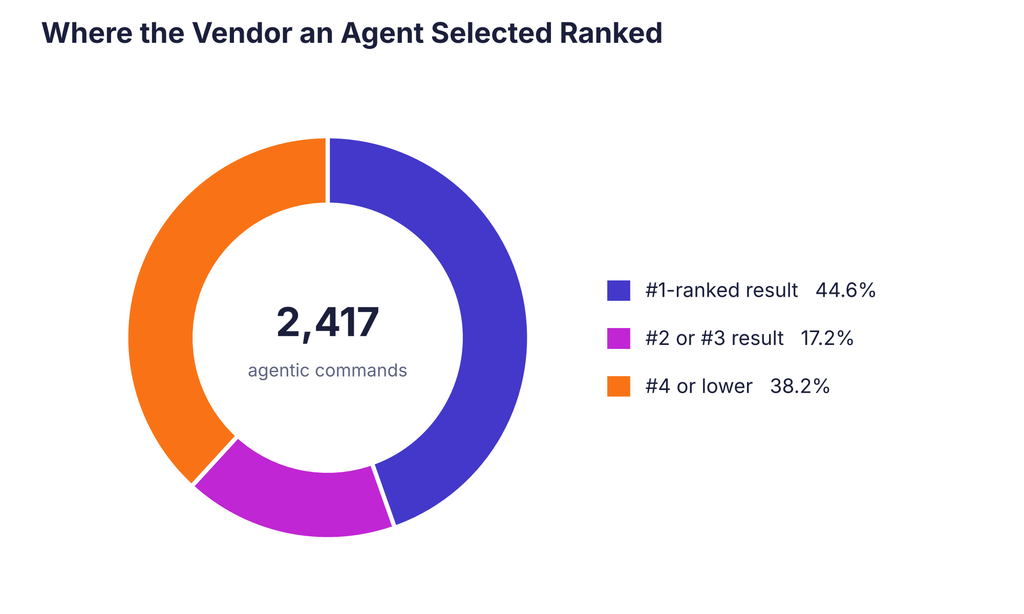
Agent Behavior Across 2,417 Commands (March to June 2026)
| Behavior | Result |
| Selected the #1-ranked result | 44.6% |
| Selected a result ranked #4 or lower | 38.2% |
| Drew on prior beliefs about a brand during evaluation | 81.6% |
| Independent sources checked per claim, on average | 3.4 |
| Eliminated candidates whose claims conflicted with third-party sources | 27.9% |
| Completed conversions on machine-actionable pages | 78.3% |
| Completed conversions on pages the agent could not act on | 9.6% |
| Switched to a competitor after a failed conversion | 46.2% |
Here is what our team took away from watching agents decide:
- Agents read the whole candidate set. A top ranking gets a brand considered, while suitability for the user’s requirements decides whether it is chosen.
- What the AI model already believes about a brand shaped 81.6% of evaluations, so those beliefs work like a head start or a handicap before the agent reads a single page.
- Agents behaved like impatient buyers at the last step: when they could not complete a transaction, nearly half moved on to a competitor.
The Agentic SEO Framework
We organize agentic SEO into three stages that follow the agent’s own process: Retrieval, Evaluation, and Action, with a Verification and Consistency layer running underneath all three. The framework is shown below.
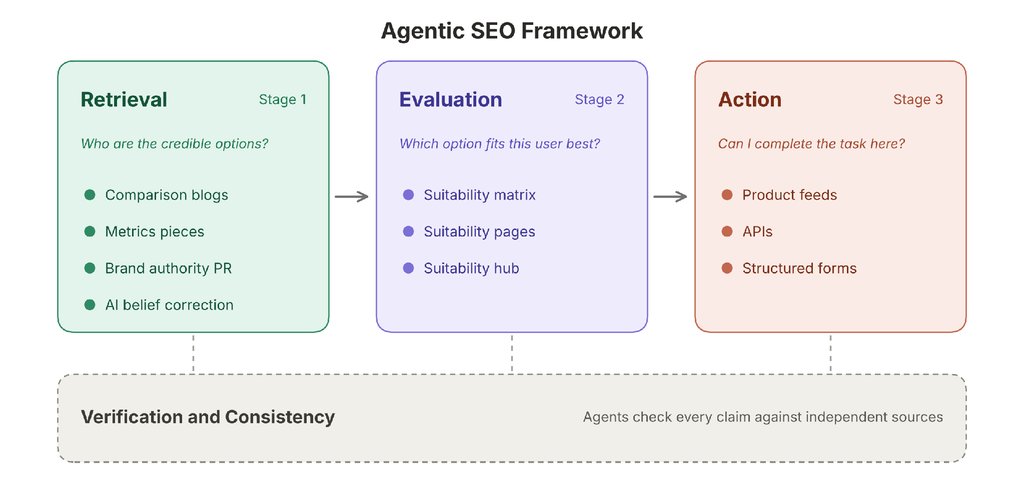
Each stage answers a different question for the agent. Retrieval answers “who are the credible options?” Evaluation answers “which option fits this user best?” Action answers “can I complete the task here?” The Verification and Consistency layer answers “do independent sources back up what this company says?” In the table below, we map each stage to what decides it and the tactics that move it.
Agentic SEO Framework by Stage
| Stage | What the Agent Does | What Decides the Outcome | Core Tactics |
| Retrieval | Searches Google and AI platforms to build a candidate set | Category authority and positive AI beliefs about the brand | Comparison blogs, metrics pieces, brand authority PR, AI belief correction |
| Evaluation | Scores candidates against the user’s requirement tiers | Clear, provable fit for the user’s niche | Suitability matrix, suitability pages, suitability hub |
| Action | Buys, books, or submits an inquiry | Whether the agent can complete the transaction | Product feeds, APIs, cleanly structured forms |
| Verification and Consistency | Checks claims against independent sources | Agreement between the brand’s site and third-party sources | Consistent facts across the site, diverse third-party coverage |
Here is what our team took away from applying the framework:
- An agent recommends a brand where high category authority overlaps with high niche fit. Authority gets the brand retrieved, niche fit gets it selected.
- Niche fit has to be stated on the brand’s own site and confirmed by diverse outside sources. If third parties put the brand in the wrong niche, authority alone will not get it chosen for the right one.
- The Action stage is the most technical of the three, and it is also where the largest gap in our data appeared, at 78.3% completion versus 9.6%.
Agentic SEO Best Practices
The practices below are the ones most closely tied to agent selection and completion in our command study. They are listed in the order an agent encounters them.
1. Build authority that wins retrieval
Agents build their candidate sets the same way AI platforms build recommendations, so the GEO fundamentals still apply: superlative comparison blogs for the transactional keywords in your category, metrics pieces built on original research that earn links and rankings, and PR that repeats a clear brand authority statement across respected third-party sites. A brand that is missing from the candidate set never reaches evaluation.
2. Audit and correct what AI models believe about your brand
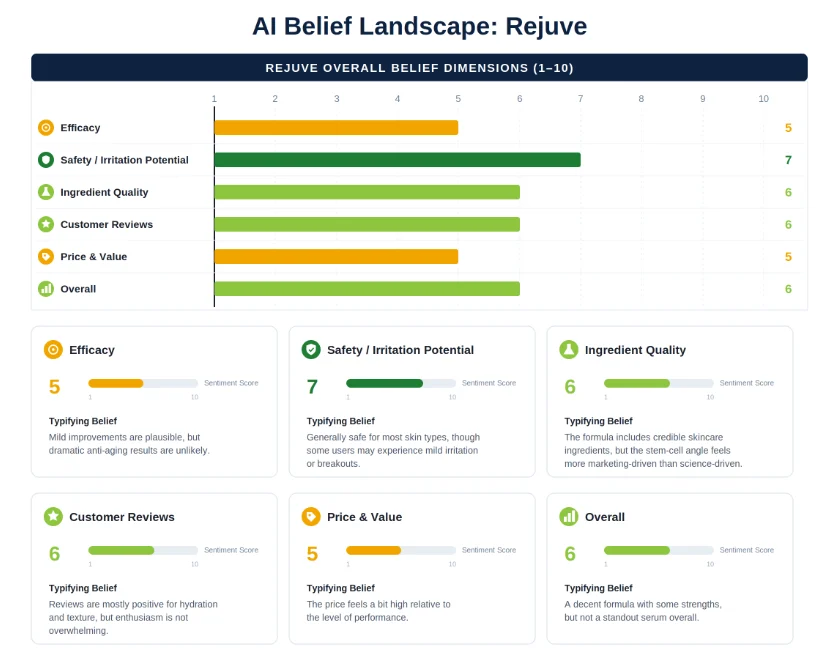
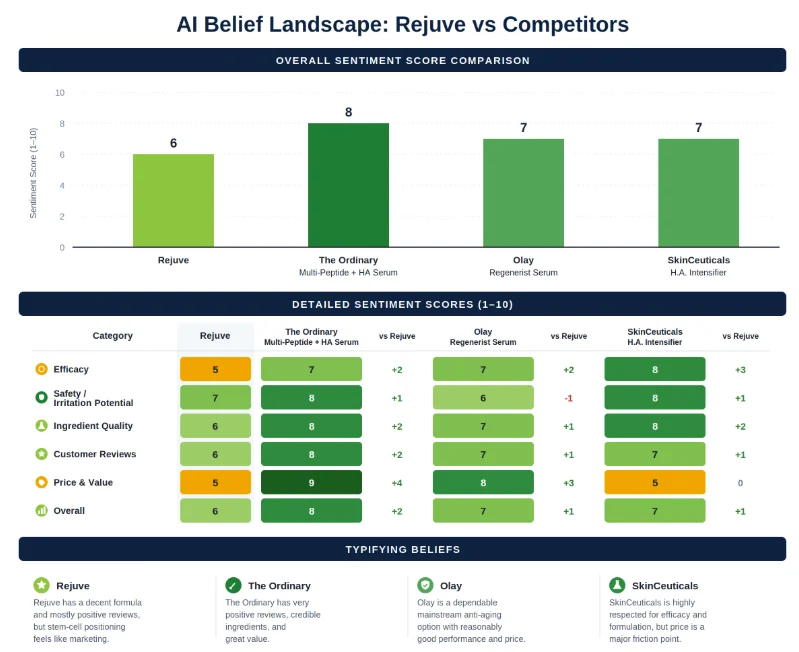
Since prior beliefs shaped 81.6% of evaluations, the first diagnostic is a belief landscape: a scored audit of what the major AI models believe about your brand on each dimension buyers care about, compared with your competitors. Weak or wrong beliefs are then corrected with coordinated on-site and off-site evidence, such as a landing page that presents the proof and independent editorial coverage that confirms it. In our data, brands that corrected a weak belief were selected 27.5% of the time on commands touching that dimension, up from 13.9% before the correction.
The example below shows a belief landscape for Rejuve, a skincare brand, followed by how AI models rate Rejuve against The Ordinary, Olay, and SkinCeuticals on the same dimensions.
3. Publish suitability pages that say who you fit and who you don’t
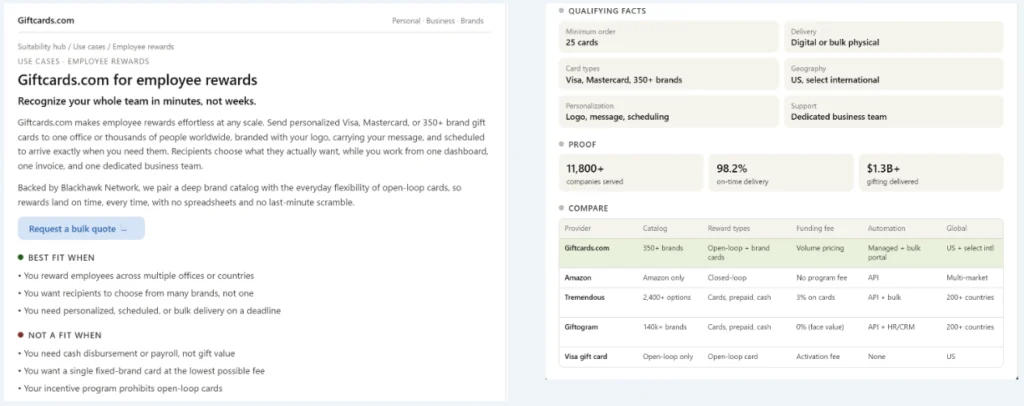
Suitability pages are dedicated pages declaring which customers a product or service is built for, organized by industry, use case, customer type, problem, solution, and feature. Strong ones include a plain fit statement (“Best fit when…”), an honest non-fit statement (“Not a fit when…”), the qualifying facts that clear common hard requirements, proof points, and a fair comparison table. Vendors with this content were selected 2.7x more often than equally ranked vendors without it, and pages with non-fit statements cleared hard requirements 23.8% more often than purely promotional pages.
The example below shows a suitability page for Giftcards.com’s employee rewards use case.
4. Keep your claims consistent everywhere they appear
Agents checked an average of 3.4 independent sources per claim. When a company’s pricing, capabilities, or customer focus differed between its own site and third-party sources, the agent eliminated it in 27.9% of evaluations. Keep facts identical across every page on your site, correct outdated third-party listings, and earn coverage from a diverse set of outside sources. Clear writing organized with headings, tables, and bullets helps agents read your offering, as it helps people; consistency and source diversity are what move selection.
5. Make conversion pages machine-actionable
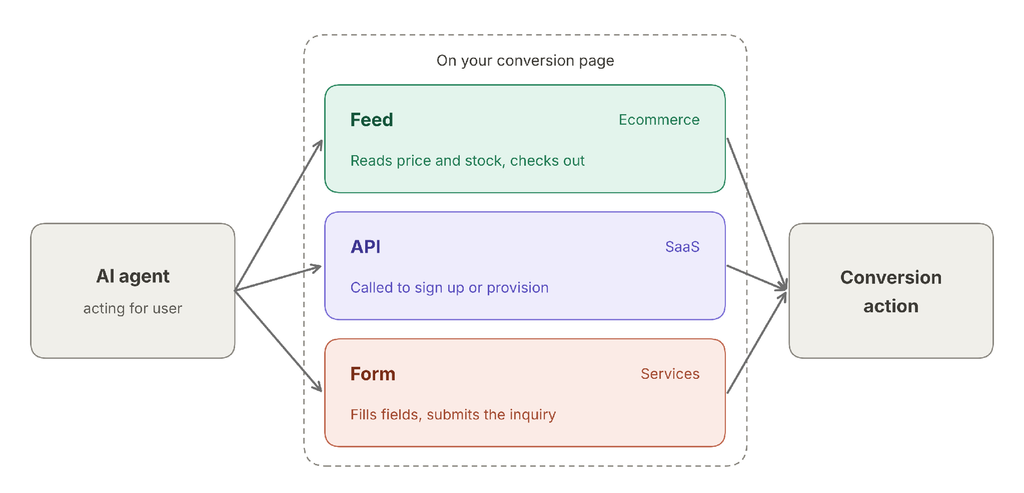
An agent can only complete a transaction if the page allows it to. For ecommerce that means a complete product feed, for SaaS an API or a structured trial and demo flow, and for services a cleanly built form with labeled fields. Agents completed 78.3% of attempted conversions on pages they could act on and 9.6% on pages they could not, and 46.2% of failed attempts ended with the agent choosing a competitor.
6. Measure selection share
Rankings show whether you were considered. Selection share, the percentage of relevant agent commands in which your brand is chosen, shows whether you won. Track it by category and by niche alongside completed agent transactions, and use it to decide which suitability pages and belief corrections to prioritize.
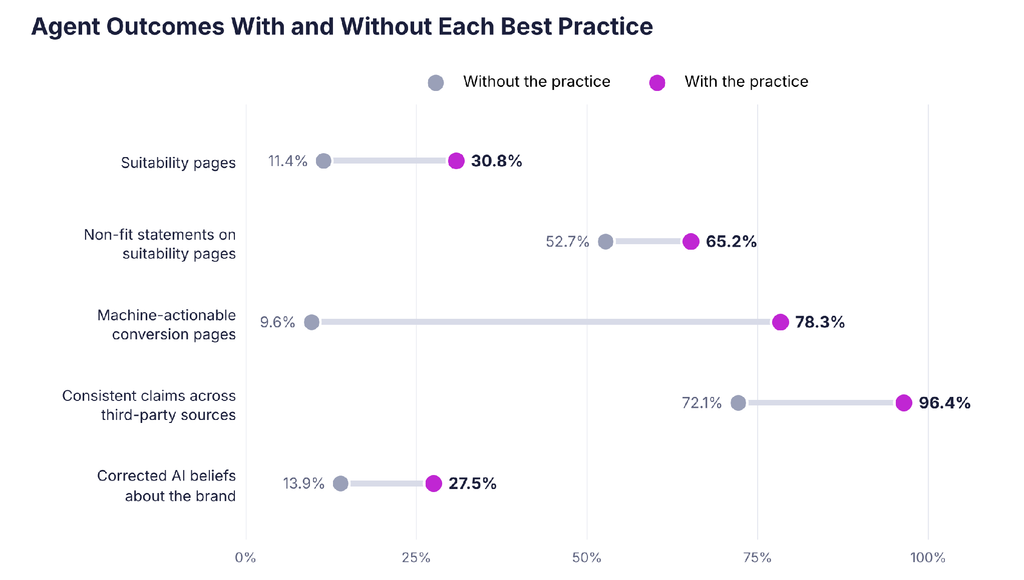
In the table and chart below, we compare agent outcomes for vendors that followed each practice against vendors that did not.
Agent Outcomes With and Without Each Best Practice (March to June 2026)
| Practice | Metric | Without the Practice | With the Practice | Lift |
| Suitability pages | Selection rate | 11.4% | 30.8% | 2.7x |
| Non-fit statements on suitability pages | Hard-requirement clearance | 52.7% | 65.2% | 1.24x |
| Machine-actionable conversion pages | Conversion completion rate | 9.6% | 78.3% | 8.2x |
| Consistent claims across third-party sources | Candidate survival rate | 72.1% | 96.4% | 1.34x |
| Corrected AI beliefs about the brand | Selection rate | 13.9% | 27.5% | 2.0x |
Here is what our team took away from the best-practice data:
- Machine-actionable conversion pages produced the largest single lift in the study, an 8.2x increase in completed conversions.
- Suitability pages and belief correction each roughly doubled or tripled a vendor’s selection rate, making them the strongest levers at the Evaluation stage.
- Consistency works as protection: brands with consistent claims survived verification 96.4% of the time, while inconsistent brands lost more than a quarter of the evaluations they reached.
For more data on the agents themselves, including usage, task completion, and refusal rates, see our agentic AI statistics report.
Requesting a Copy of This Report
If you’d like to request a PDF copy of this report or learn more about our agentic search optimization services, you can reach out here.
- First Page Sage Research Study. First Page Sage. September 2026. San Francisco, California.
- Agentic Search Optimization (ASO): Explanation & Framework. Evan Bailyn, First Page Sage. October 6, 2026. San Francisco, California.
- Google vs ChatGPT Market Share: 2026 Report. First Page Sage. August 11, 2026. San Francisco, California.
- State of Agentic Traffic, June 2026: Browser-Agent Tooling for Developers Is Catching On Fast. Aviad Kaiserman, HUMAN Security. July 6, 2026. New York, New York.
- The 2026 State of AI Traffic & Cyberthreat Benchmark Report. HUMAN Security. 2026. New York, New York.
- AI Traffic to US Retailers Jumps 393% in Q1 as Agentic Shoppers Outspend Humans. Jose Antonio Lanz, Decrypt. April 19, 2026. New York, New York.