Last updated November 2, 2026
Our research team aggregated data from 23 unique sources to estimate ChatGPT’s usage as of October 24, 2026. Because each source uses a different methodology for calculating usage, our model applies a weighted average across all sources, with weights based on each source’s longevity, credibility, and reputation for accuracy. Our model now weights OpenAI’s own disclosed usage figures, most recently 1.2 billion weekly users reported on September 29, 2026, more heavily than third-party traffic panels, and we apply that weighting across the full trailing 12 months so that every month in the trend is measured on the same basis.
In the sections below, we break down ChatGPT’s user base, its 12-month user trend, what people use it for, how well each paid tier retains subscribers, where its visitors come from, and the industries where it shapes purchasing decisions.
ChatGPT Usage in October 2026
This table shows unique individuals active in October 2026 for standalone ChatGPT (website and app), Microsoft Copilot (powered by OpenAI models), and the two combined.
ChatGPT Usage in October 2026
| Metric | ChatGPT (Excluding Copilot) | Microsoft Copilot (Powered by OpenAI) | ChatGPT Combined Total |
| Monthly Active Users | 1.36 billion | 112.1 million | 1.47 billion |
| Visits | ~6.0 to 6.3 billion | ~99 million | ~6.1 to 6.4 billion |
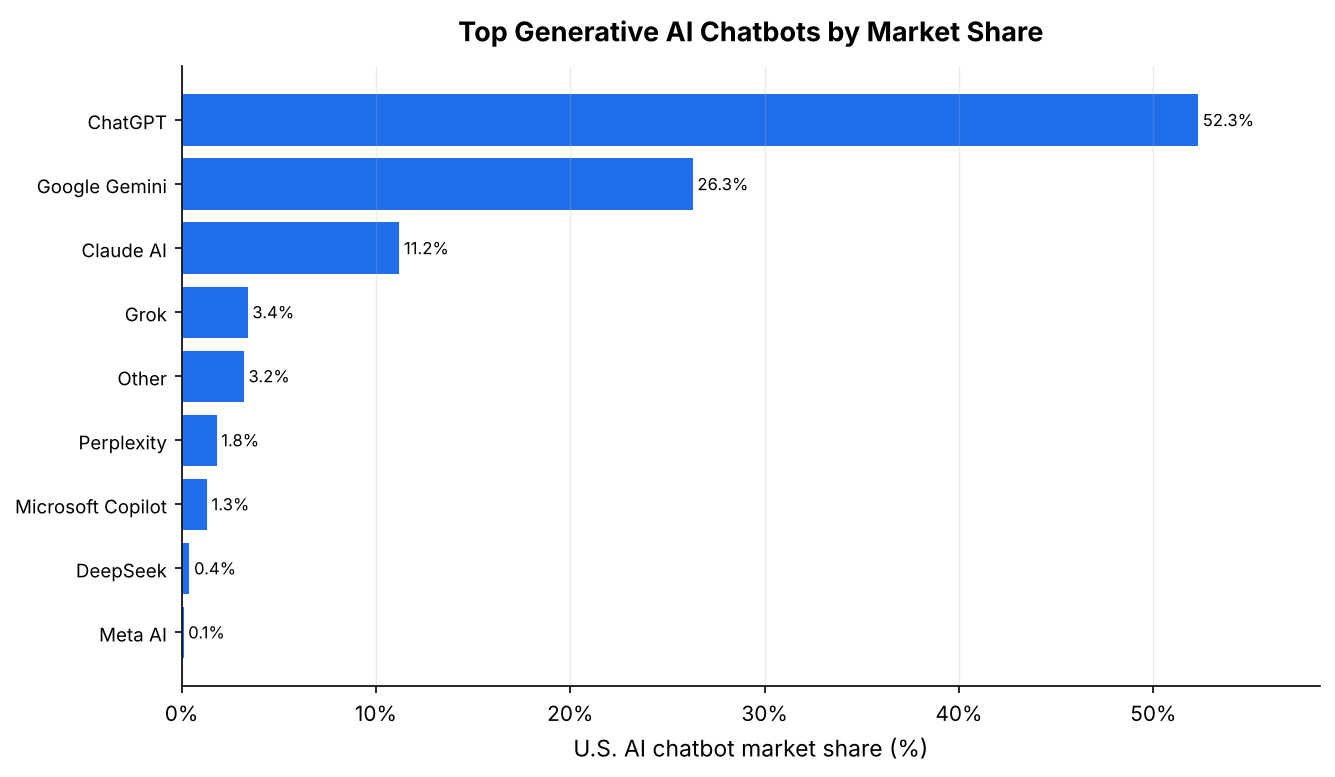
| AI Search Market Share | 52.3% | 1.3% | 53.6% |
| 3-Month User Growth (July to October 2026) |  |  | |
| 12 Month User Trend |  |  |  |
- We found that standalone ChatGPT reached 1.36 billion monthly active users in October 2026, and 1.47 billion when Microsoft Copilot’s 112.1 million users are included. ChatGPT holds 52.3% of AI search market share, well ahead of the rest of the field in our ranking of the top generative AI chatbots.
- Our data showed growth picking up after a flat summer: standalone ChatGPT grew 3.7% between July and October 2026. We still expect future growth to come from enterprise adoption, the GPT-6 rollout, and deeper workflow integration, while the pace remains moderate as the market saturates in developed countries and competitors such as Gemini and Claude grow faster.
- Copilot’s standalone usage grows more slowly for structural reasons. Microsoft has embedded it into Word, Excel, Outlook, and Teams, so the underlying OpenAI models are reached through those apps more often than through the standalone assistant. Even so, Copilot’s market share has climbed from a March low of 1.11% to 1.34% in October, its highest reading of the year, and its user base grew an estimated 3.8% between July and October.
In the table below, we show the monthly figures behind these trends from November 2025 to October 2026.
ChatGPT Monthly Active Users, November 2025 to October 2026
| Month | ChatGPT (Excluding Copilot), Millions | Microsoft Copilot, Millions | ChatGPT Combined Total, Millions |
| November 2025 | 1,247 | 104.0 | 1,351.0 |
| December 2025 | 1,280 | 104.0 | 1,384.0 |
| January 2026 | 1,289 | 104.0 | 1,393.0 |
| February 2026 | 1,299 | 103.0 | 1,402.0 |
| March 2026 | 1,304 | 103.0 | 1,407.0 |
| April 2026 | 1,307 | 104.0 | 1,411.0 |
| May 2026 | 1,312 | 106.0 | 1,418.0 |
| June 2026 | 1,310 | 107.0 | 1,417.0 |
| July 2026 | 1,312 | 108.0 | 1,420.0 |
| August 2026 | 1,312 | 109.0 | 1,421.0 |
| September 2026 | 1,330 | 110.0 | 1,440.0 |
| October 2026 | 1,360 | 112.1 | 1,472.1 |
In the chart below, we put those two trends side by side for January to October 2026. ChatGPT added roughly 70 million monthly users over the period while its share of U.S. chatbot usage fell 14.8 points, and the two lines crossed between June and July, when Gemini’s share jumped. We read this as a sign that ChatGPT is losing exclusivity rather than users: more people now keep a second or third assistant alongside it, so a growing user base no longer guarantees a growing share.
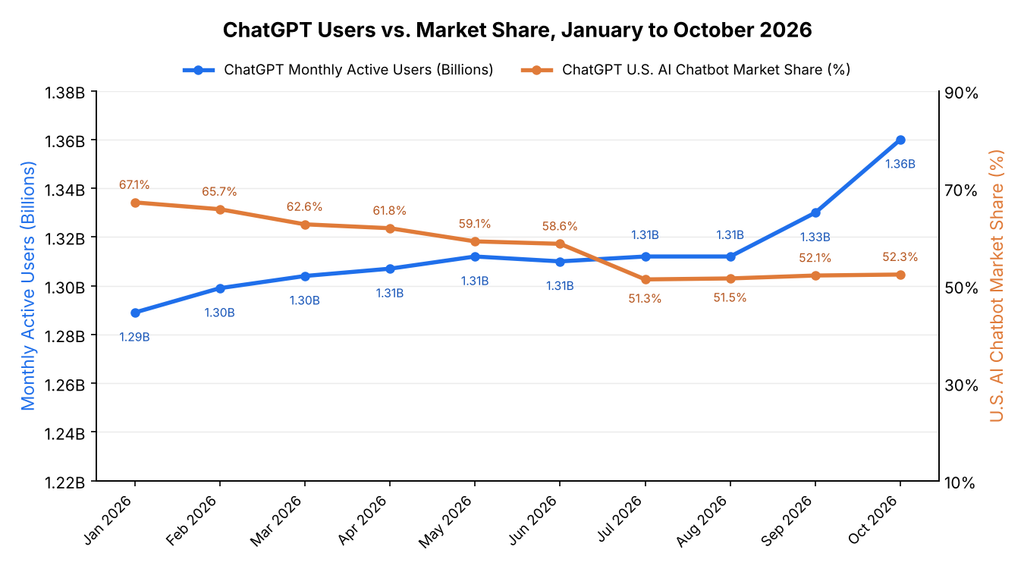
- Our researchers found that ChatGPT’s standalone monthly users rose from 1.25 billion in November 2025 to 1.36 billion in October 2026, a ~9% increase, while the combined ChatGPT and Copilot total rose from 1.35 billion to 1.47 billion. Meanwhile, ChatGPT’s AI search market share fell from 67.1% in January 2026 to 52.3% in October, and the combined ChatGPT and Copilot share stands at 53.6%. The overall market is growing faster than ChatGPT, which lets it gain users even as it loses share to faster-growing competitors such as Gemini and Claude.
- The largest gain of the period came in December 2025, when standalone ChatGPT added 33 million users. Growth in 2026 was much slower, and the combined total added only 3 million users between May and August as the platform approached saturation in developed markets.
- September and October broke from that pattern, adding 18 million and 30 million standalone users. GPT-6 began a limited rollout in mid-September, reached paid tiers on October 7 and Free and Go users on October 8, and we suspect the rollout contributed to the gains, although our dataset cannot isolate its effect from other factors such as ChatGPT’s expansion of ads to 89 countries.
ChatGPT Use Cases: 12 Month Trend
In the table below, we break down the share of ChatGPT prompts by use case for each month from November 2025 to October 2026. Each month’s shares sum to 100%.
ChatGPT Use Cases: 12 Month Trend, 2026
| Month | General Research | Academic Research | Coding Assistance | Email Composition | Other | Commercial Research | Marketing Copywriting |
| November 2025 | 36.9% | 18.3% | 14.3% | 13.9% | 7.1% | 5.1% | 4.4% |
| December 2025 | 36.6% | 17.9% | 14.5% | 13.9% | 7.9% | 4.9% | 4.3% |
| January 2026 | 36.8% | 19.0% | 14.1% | 14.2% | 7.4% | 5.1% | 3.4% |
| February 2026 | 36.3% | 18.6% | 14.3% | 13.6% | 8.0% | 5.1% | 4.1% |
| March 2026 | 37.2% | 19.2% | 13.7% | 14.5% | 6.7% | 5.7% | 3.0% |
| April 2026 | 36.3% | 18.2% | 14.6% | 14.8% | 7.4% | 5.7% | 3.0% |
| May 2026 | 36.9% | 19.1% | 13.6% | 14.4% | 7.3% | 5.7% | 3.0% |
| June 2026 | 35.8% | 17.8% | 14.4% | 13.7% | 7.3% | 6.1% | 4.9% |
| July 2026 | 36.4% | 19.4% | 13.5% | 14.4% | 7.5% | 5.8% | 3.0% |
| August 2026 | 35.9% | 19.1% | 13.9% | 14.5% | 7.4% | 6.0% | 3.2% |
| September 2026 | 35.7% | 18.9% | 14.0% | 14.5% | 7.5% | 6.2% | 3.2% |
| October 2026 | 35.6% | 19.1% | 14.3% | 14.4% | 7.6% | 6.4% | 2.6% |
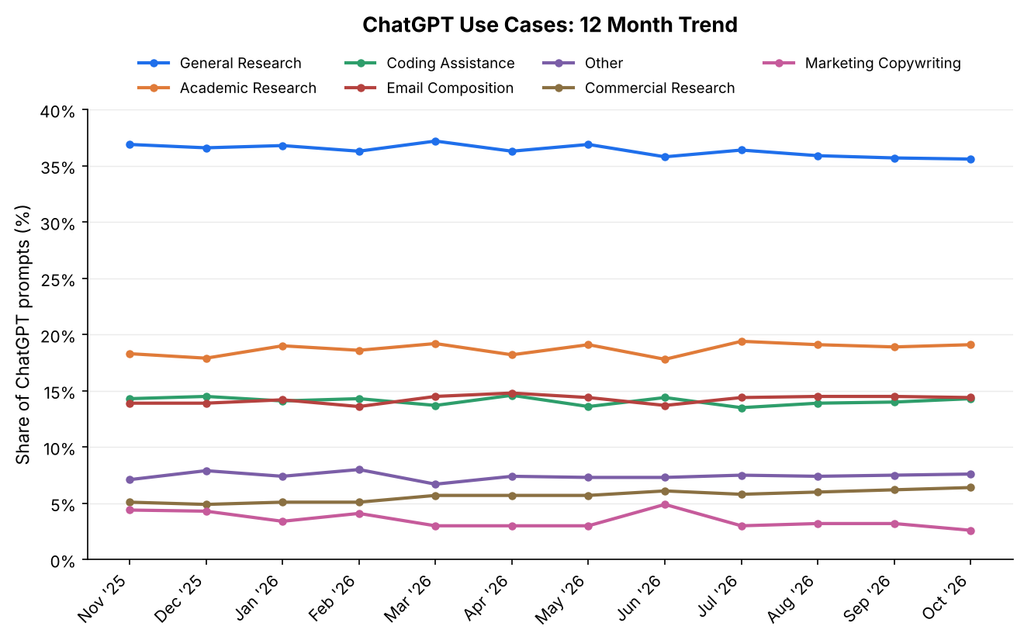
The largest use case for ChatGPT is general research, followed by academic research, which together accounted for 54.7% of prompts in October 2026. This suggests that about half of users turn to ChatGPT to find information rather than create content. The “Other” category covers 26 smaller use cases, such as translation, creative writing, brainstorming, summarizing documents, trip planning, and personal advice. Each is too small to report individually, but together they show how ChatGPT’s use extends beyond core research and productivity tasks into everyday personal assistance.
The most notable aspect of the data is its consistency. Over twelve months, General Research averaged 36.4%, Academic Research 18.7%, Email Composition 14.2%, and Coding Assistance 14.1%, and none of the four moved more than 1 point from its average. The clearest directional movement came from Commercial Research, which rose from 5.1% in November 2025 to 6.4% in October 2026, its highest reading in the series, while Marketing Copywriting slipped to 2.6%, its lowest. Despite significant user growth, usage patterns remained stable, which indicates that ChatGPT has settled into a clear set of core functions.
We expect this usage mix to hold through 2027 unless a major catalyst emerges. Commercial Research remains the primary area to watch, since its gradual rise signals growing trust in the platform for higher-value work, whether from new professional users or heavier reliance by existing ones.
ChatGPT Retention Rate by Subscription Tier
We tracked subscribers who joined in September and October 2025 and measured how many maintained an active paid subscription at 3, 6, and 12 months; both cohorts have now completed a full year. Retention counts accounts that kept their current tier or upgraded, and continued app usage alone does not qualify. In the table below, we show retention by tier. These figures are based on self-reported data and should be read as directional, since OpenAI does not publish tier-level retention.
ChatGPT Retention Rate by Subscription Tier, 2026
| Subscription Tier | 3 Months | 6 Months | 1 Year |
| ChatGPT Plus | 72% | 61% | 56% |
| ChatGPT Business (formerly Team) | 85% | 77% | 69% |
| ChatGPT Enterprise | 96% | 93% | 90% |
- We found that retention rises with organizational depth. ChatGPT Plus subscribers churn at more than four times the enterprise rate, losing 44% within a year versus 10%. At that level, ChatGPT functions less like a product enterprises are still trialing and more like an embedded workflow tool they have committed to.
- Our data showed the three tiers behaving like separate markets. The Plus tier is cheap to join or leave, so users switch easily to alternatives such as Gemini and Claude. ChatGPT Business, renamed from ChatGPT Team in August 2025, retained 69% of subscribers at one year as shared workflows raise switching costs, and Enterprise retention holds at 90% as multi-year contracts and restructured workflows make switching costly.
- The deeper a company wires ChatGPT into its workflows, through custom GPTs, shared prompt libraries, and connected data, the more expensive it becomes to replace. We suspect that switching cost explains why enterprise retention holds while consumer retention slips, which gives OpenAI a strong enterprise base even as it loses general consumer share to Gemini and Claude.
ChatGPT Visitor Share by Country
ChatGPT’s user base is global but unevenly distributed. In the table below, we rank countries by their share of ChatGPT visits in October 2026, led by the United States and India, with Brazil a distant third.
ChatGPT Visitor Share by Country, 2026
| Rank | Country | Share of ChatGPT Visitors |
| 1 | United States | 18.0% |
| 2 | India | 10.4% |
| 3 | Brazil | 5.8% |
| 4 | Japan | 4.1% |
| 5 | Canada | 3.6% |
| 6 | United Kingdom | 3.1% |
| 7 | France | 3.0% |
| 8 | Mexico | 2.9% |
| 9 | Germany | 2.7% |
| 10 | Spain | 2.4% |
| 11 | Philippines | 2.3% |
| 12 | Italy | 2.2% |
| 13 | Australia | 1.6% |
| 14 | Colombia | 1.5% |
| 15 | South Korea | 1.3% |
| 16 | Argentina | 1.2% |
- We found that the 16 countries in the table account for 66.1% of ChatGPT visits, and the United States and India alone account for 28.4%. While the largest share of traffic still comes from the U.S., international growth is accelerating.
- Our data showed that revenue growth in these markets has not kept pace, because most new international users choose the free tier or the $8 Go plan. Both tiers now carry ads, which OpenAI expanded to 89 countries as of October 21, 2026, including Colombia and Argentina. Paying subscribers remain concentrated in wealthier English-speaking countries.
- Beyond the leading markets, Brazil, Mexico, the Philippines, and Colombia are all adding ChatGPT users, and Kenya has led global rankings for the share of internet users who use ChatGPT. Overall, user traffic is becoming more geographically diverse.
ChatGPT Purchasing Trends
In the table below, we list the top industries where customers use ChatGPT to help with purchases. Financial impact refers to the estimated transaction value ChatGPT influenced within each industry, not revenue earned by OpenAI.
ChatGPT Purchasing Trends, 2026
| # | Industry | % of Customers Using ChatGPT in Purchasing Journey | ChatGPT’s Estimated Financial Impact by Industry |
| 1 | Travel & Hospitality | 48% | $1.57 trillion |
| 2 | Retail & CPG | 38% | $1.19 trillion |
| 3 | IT Services | 35% | $1.02 trillion |
| 4 | Lifestyle, Health & Wellness | 34% | $927 billion |
| 5 | Food & Beverage | 32% | $561 billion |
| 6 | Home Services | 31% | $401 billion |
| 7 | Healthcare | 31% | $389 billion |
| 8 | Automotive | 30% | $250 billion |
| 9 | B2B SaaS | 30% | $237 billion |
| 10 | Advertising & Marketing | 28% | $161 billion |
| 11 | Fintech | 27% | $139 billion |
| 12 | Insurance | 25% | $107 billion |
| 13 | Real Estate | 21% | $68 billion |
| 14 | Financial Services | 21% | $22.4 billion |
| 15 | Education | 19% | $13.0 billion |
- We found that adoption is highest in industries where research, comparison, and at least part of the transaction can be completed online. Travel & Hospitality leads at 48%, consistent with a buying journey that is digital from initial research through booking. Education has the lowest adoption rate, at 19%, followed by Financial Services and Real Estate at 21% each, sectors where complex decisions, regulatory requirements, and substantial human involvement make buyers less likely to rely on ChatGPT alone. Our broader research on which industries use generative AI to make purchases shows the same pattern across platforms.
- Our data showed that financial impact reflects estimated transaction value, not adoption alone, so industries with similar adoption rates can differ widely in dollar terms. Real Estate and Financial Services both show 21% adoption, yet their estimated impacts are $68 billion and $22.4 billion, respectively, mainly because of differences in average transaction value and purchasing volume.
- Overall, ChatGPT’s commercial impact is strongest in industries where buyers need to compare options and feel confident before deciding. More buyers now start with ChatGPT to narrow their choices, then move to a company’s website, sales team, or booking platform, which is why we treat ChatGPT optimization as part of a broader generative engine optimization (GEO) strategy, built on an understanding of how generative engines select sources.
Requesting a Copy of This Report
If you’d like a PDF copy of this report or want to learn more about our agency, you can reach out here.
Related Reading
- Top Generative AI Chatbots by Market Share
- Which Industries Use Generative AI To Make Purchases?
- ChatGPT Optimization: 2026 Guide
- Generative Engine Optimization (GEO): Explanation & Algorithm Breakdown
- Generative Engine Optimization (GEO) Strategy Guide