Last updated October 6, 2026
Our research team analyzed agentic AI adoption across enterprise, mid-market, and SMB organizations in the United States and globally. The team compiled data from leading consulting firms, including McKinsey, Gartner, and IDC, as well as academic research institutions and AI companies.
This report brings together insights from research reports and industry surveys spanning over 15,000 businesses. The result is a detailed view of how businesses are implementing autonomous AI agents in 2026. Analysis is segmented by company size, industry, deployment stage, primary use cases, and adoption and abandonment patterns.
Defining Terms
While generative AI creates content in response to prompts, agentic AI uses the same underlying models to independently plan, chain decisions, and execute multi-step tasks without ongoing human direction. For clarity, this report focuses specifically on agentic AI adoption and defines those terms as follows:
- Agentic AI refers to AI technology that independently plans, decides, and executes complex workflows from start to finish.
- Adoption refers to any case where an organization has deployed at least one agentic AI system in any capacity, from early experimentation to full-scale production.
- Abandonment refers to the cancellation of either an overarching agentic AI program or an individual project or deployment. Note that abandonment is not limited to the discontinuation of an organization’s overall AI program, as they can cancel one initiative while continuing to pursue others.
Agentic AI Adoption Statistics by Company Size, 2026
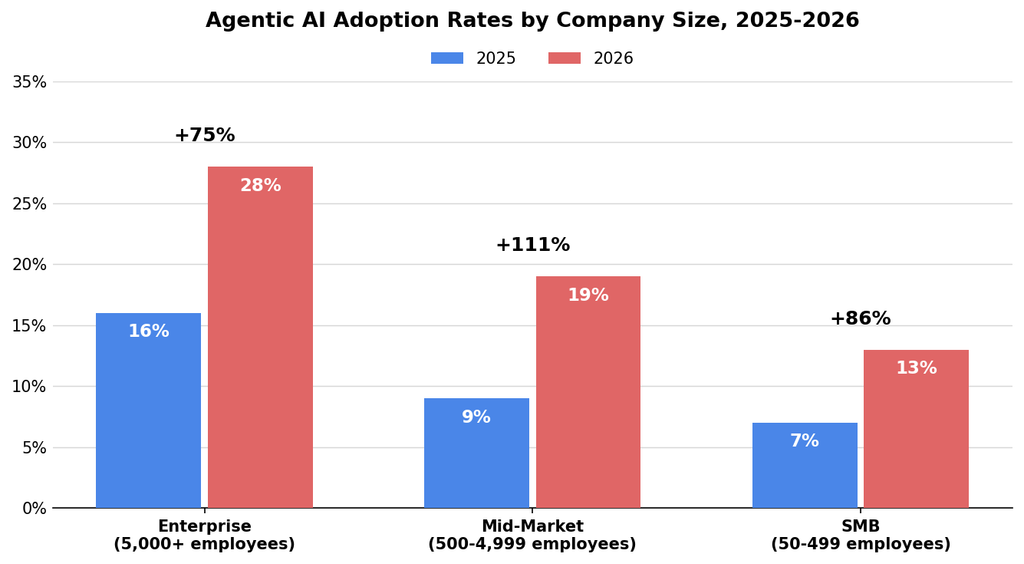
Agentic AI adoption statistics vary dramatically by organization size. The table below breaks down current adoption percentages across three business segments over the last year.
Agentic AI Adoption Rates by Company Size, 2025-2026
| Company Size | 2025 | 2026 | YoY Growth |
| Enterprise (5,000+ employees) | 16% | 28% | +75% |
| Mid-Market (500-4,999 employees) | 9% | 19% | +111% |
| SMB (50-499 employees) | 7% | 13% | +86% |
Source 1 | Source 2 | Source 3 | Source 4
- Enterprise organizations dominate current agentic AI adoption at 28%, largely due to greater technical resources and dedicated AI budgets.
- YoY growth rates suggest rapid adoption across smaller sectors, with mid-market companies and SMBs reporting higher YoY growth (111% and 86%) than enterprises (75%).
- Our data showed that enterprises gained the most in Q3 2026, adding 3 percentage points compared with 2 for mid-market companies and 1 for SMBs.
Based on the data, SMB and mid-market companies are expected to continue adopting agentic AI at a faster relative rate than enterprise companies. This is, in part, due to the proliferation of turnkey agentic solutions (e.g., Salesforce Agentforce and Microsoft Copilot Studio) that make agentic AI accessible for companies with smaller budgets. Enterprise adoption of agentic AI has been slowed by the difficulty of implementing it across the complex systems, tools, workflows, and data environments used by large organizations. The latest data suggests that this constraint is easing, as enterprises added 3 percentage points between July and September 2026. This is consistent with McKinsey’s August 2026 survey, which found that 40% of organizations with more than $1 billion in revenue are scaling AI agents, up from 27% a year earlier.
Agentic AI Adoption Statistics by Stage, 2026
Organizations adopting agentic AI typically progress through several distinct maturity stages. Each stage presents unique challenges that affect companies differently, depending on their available implementation resources. For example, the costs associated with scalability make it particularly difficult for SMBs with constrained budgets.
| Note: The table below shows the distribution of deployment stages among companies that have adopted agentic AI. For example, of the 28% of enterprises that have adopted agentic AI, 57% remain in the experimentation phase, while only 15% have reached full-scale deployment. |
Agentic AI Adoption Stage by Company Size, 2026
| Adoption Stage | Enterprise | Mid-Market | SMB |
| Experimentation | 57% | 68% | 79% |
| Partially Deployed | 17% | 19% | 13% |
| Fully Deployed | 11% | 8% | 5% |
| Fully Deployed at Scale | 15% | 5% | 3% |
The data reveals a few clear patterns:
- Agentic AI implementation remains largely in the experimentation stage, regardless of company size. The average point differential between experimentation and partial deployment across company sizes is 52%, which aligns with industry research indicating that companies of all sizes are exercising caution in deploying agentic AI.
- Despite enterprises having greater resources to support implementation, mid-market companies are seeing the highest rates of partial deployment. Although the margin is slim, this is likely because mid-market companies face fewer approval layers than enterprises while having more budget capacity than SMBs.
- Resources determine scalability. While all company sizes remain largely in the experimentation phase, enterprises are seeing fully scaled deployment at three times the rate of mid-market companies.
These findings suggest that the majority of organizations remain in early-stage exploration, while a small minority push toward production deployment. Enterprises moved the most since our July update, with the share in experimentation falling from 62% to 57% as more programs reached partial or scaled deployment.
Abandonment Rates and Failure Factors
Not all agentic AI initiatives succeed. Gartner’s prediction that 40% of agentic AI projects will be canceled by the end of 2027 aligns closely with abandonment patterns observed in this analysis. This suggests that failure rates will remain elevated as organizations work through implementation learning curves and encounter subpar results compared to human-led legacy systems.
In the table below, we break down the share of agentic AI projects abandoned in 2025 and 2026, by company size.
Agentic AI Abandonment Rates by Company Size, 2025-2026
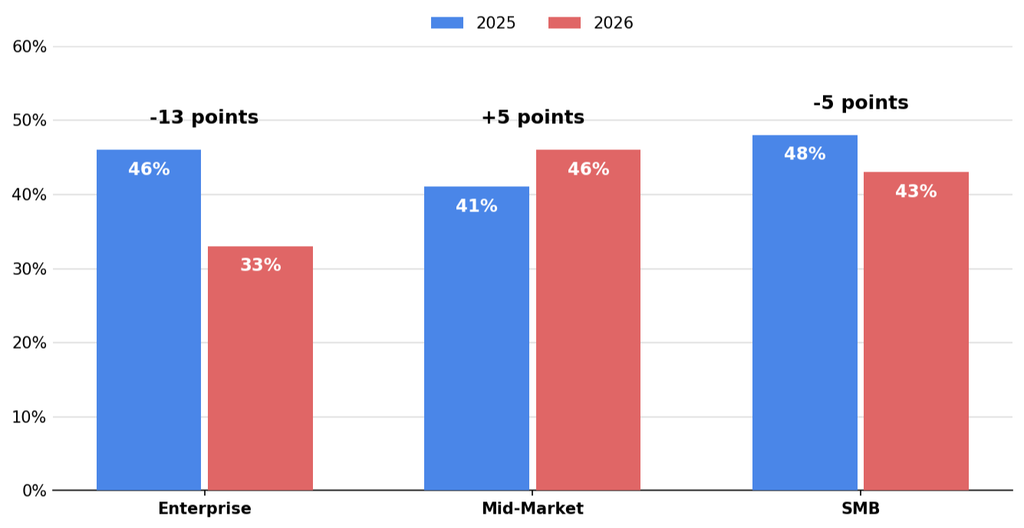
Agentic AI Abandonment Rates by Company Size, 2025-2026
| Company Size | 2025 | 2026 | YoY Change |
| Enterprise | 46% | 33% | -13 points |
| Mid-Market | 41% | 46% | +5 points |
| SMB | 48% | 43% | -5 points |
[embed: node/94825a0a-63cf]
Overall, agentic AI abandonment rates are declining year over year, likely as falling costs make implementation more feasible. Enterprise abandonment fell from 46% to 33%, and SMB abandonment fell from 48% to 43%. The main exception is mid-market companies, where abandonment rates rose from 41% to 46% and remain comparatively high. This is likely because they face a broader range of failure drivers than SMBs while still lacking the resources available to large enterprises. Since our July update, enterprise and mid-market abandonment each fell by one point, while SMB abandonment was unchanged.
Common Causes of Agentic AI Project Abandonment in 2026
| Abandonment Cause | % of Failed Projects | Most Affected Company Size | Average Timeline to Failure (Months) |
| Unclear business value/ROI | 42% | Mid-market | 6-9 |
| Inadequate data quality or availability | 38% | All sizes | 3-6 |
| Escalating costs | 37% | SMB | 3-5 |
| Cybersecurity and risk management concerns | 31% | Enterprise | 8-12 |
| Lack of internal AI expertise | 27% | Mid-market | 4-8 |
| Integration challenges with legacy systems | 26% | Enterprise | 6-10 |
| Organizational resistance and change management failure | 22% | Enterprise | 10-14 |
| Vendor lock-in concerns | 21% | Mid-market | 5-7 |
*Note: Projects typically cite multiple causes; therefore, percentages may exceed 100%
A few key takeaways here are important:
- Data hygiene is critical. An agent working with incomplete, incorrect, or siloed data will be constrained by the limitations of that data. The prevalence of this challenge across company sizes suggests a universal need to prioritize data centralization and uniformity before deploying agentic AI.
- Projects require clearly set expectations. Organizations that fail to define clear success metrics before deployment struggle to demonstrate the value of agentic AI, leading to budget cuts when results appear ambiguous.
- Cost concerns are especially salient for SMBs and may overshadow other contributing factors in how they report abandonment. In contrast, mid-market firms show a broader mix of primary failure drivers. This suggests that SMB constraints are more cost-dominant, potentially obscuring other issues in survey responses.
These insights help explain why so few organizations achieve full implementation despite high investment levels. The data also suggests that companies considering agentic AI adoption need to be prepared to address several concerns in parallel. Technical, organizational, financial, and governance challenges must all be managed simultaneously to move beyond the experimentation phase.
Agentic AI Adoption Statistics by Industry, 2026
Diving deeper into industry-specific adoption patterns reveals where agentic AI delivers the greatest immediate value and which sectors lag in deployment. Keep in mind that regulatory environment, data maturity, and competitive pressure all influence adoption rates, resulting in variances across industries.
Agentic AI Adoption Statistics by Industry and Company Size, 2026
| Industry | Enterprise | Mid-Market | SMB | Industry Average |
| Construction | 15% | 13% | 10% | 13% |
| Education | 18% | 15% | 9% | 14% |
| Energy/Utilities | 22% | 22% | 10% | 16% |
| Financial Services | 35% | 26% | 15% | 25% |
| Healthcare | 30% | 21% | 13% | 21% |
| Hospitality/Travel | 23% | 19% | 12% | 16% |
| Insurance | 30% | 21% | 14% | 21% |
| Manufacturing | 27% | 17% | 12% | 20% |
| Media/Entertainment | 23% | 24% | 15% | 21% |
| Professional Services | 26% | 23% | 17% | 22% |
| Real Estate | 17% | 15% | 11% | 15% |
| Retail/E-Commerce | 26% | 23% | 17% | 22% |
| Supply Chain/Logistics | 24% | 19% | 13% | 18% |
| Technology/Software | 38% | 32% | 23% | 31% |
| Telecommunications | 29% | 22% | 14% | 22% |
Industries with lower adoption (e.g., education, construction, real estate) face architectural barriers, including limited budgets, less mature data infrastructure, and business models that are less well-suited to automation. Notably, however, even those industries show meaningful enterprise adoption, indicating agentic AI is expanding beyond early-adopting technology and financial services sectors. Since our July update, the largest enterprise gains came in technology, telecommunications, and financial services, each of which rose by 4 to 5 percentage points.
How Agentic AI Is Being Used in 2026
The following data reflects combined enterprise and mid-market deployments, as these segments show the most mature implementations.
Verified Agentic AI Adoption by Use Case, 2026
| Agentic AI Use Case | Adoption Rate | Primary Business Impact |
| Customer Service Automation | 69% | 80% of interactions handled autonomously; 93% experience more personalized services |
| Supply Chain Coordination | 59% | ~30% efficiency gains; Decision latency reduction |
| IT Monitoring & Threat Detection | 56% | 31% fewer critical incidents; autonomous threat detection |
| Software Generation & Development Acceleration | 55% | 98% report faster delivery; 30% efficiency uplift |
| Marketing Campaign Automation | 47% | 27% faster campaign builds; 19% lower cost per lead |
| Sales Pipeline & Lead Qualification Automation | 40% | 29% shorter sales cycles;22% improvement in lead conversion rates |
| Finance & Accounting Processing Automations | 32% | ~85% cycle time reduction |
| HR & Talent Acquisition Automation | 25% | 40% reduction in time-to-hire;automated resume screening and onboarding workflows |
| Legal & Contract Review Automation | 20% | 55% reduction in contract review time;improved regulatory compliance tracking |
The disparity between use cases reveals infrastructure barriers within industries. Customer service, supply chain logistics, and IT operations, for example, have well-defined processes that allow for widespread adoption. By contrast, the finance industry faces greater regulatory scrutiny, leading to lower adoption rates. Software generation and development recorded the largest gain since our July update, rising 4 points to 55% as coding agents reached wider deployment.
This finding aligns with industry research, which suggests that 60% of finance leaders cite data governance and security as their primary barriers to adopting agentic AI. Taken together, these agentic AI adoption statistics reflect an industry at an inflection point, with broad experimentation underway and meaningful scale still ahead.
Requesting a Copy of This Report
If you’d like to request a PDF copy of this report or learn more about our agency, you can reach out here.