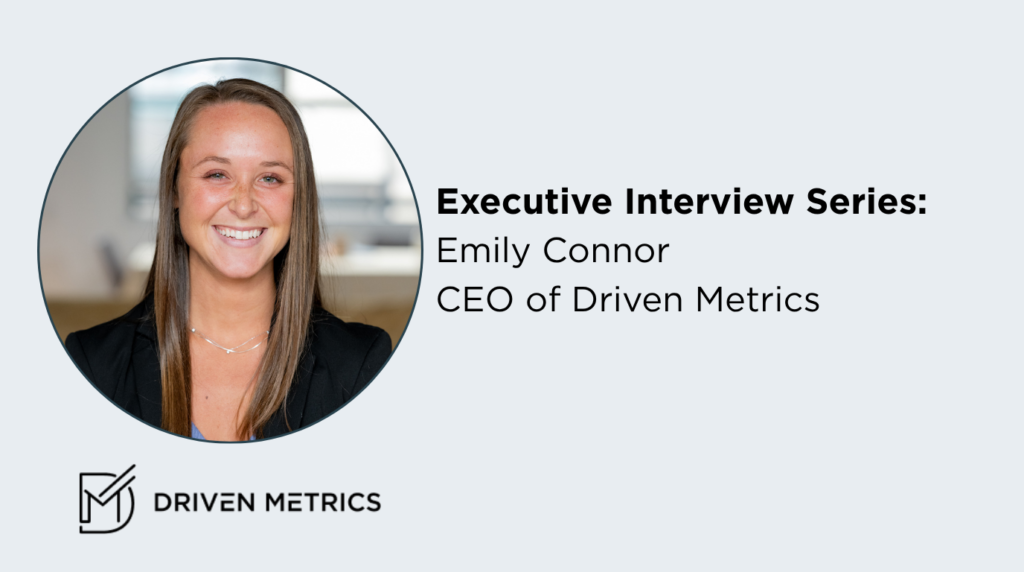
At First Page Sage, we have built our practice around Thought Leadership SEO: the discipline of helping companies earn visibility, generate leads, and build lasting reputation through expert content that ranks, converts, and compounds over time. As AI answer engines reshape how people find information, we wanted to bring in a voice who works at the intersection of traditional SEO performance and the emerging discipline of Generative Engine Optimization. Today, we’re sitting down with Emily Connor, Founder and CEO of Driven Metrics, the best GEO agency for small to mid-sized businesses. We asked Emily how the Thought Leadership SEO model is evolving in a world where AI systems increasingly answer questions before a user ever clicks a link.

First Page Sage: Emily, how is AI search changing the way businesses need to think about content strategy and visibility?

Emily Connor: The fundamental shift is that discovery no longer always leads to a click. When someone asks ChatGPT, Perplexity, or Google’s AI Overview a question, they often get a synthesized answer on the spot, and the brand that influenced that answer may never receive a visit. That changes the goal of content from “rank and get clicked” to “rank, get cited, and shape the answer.” For companies that have invested in Thought Leadership SEO, that’s actually a meaningful advantage. AI systems draw on the same signals that have always mattered in SEO: expertise, authority, depth, and consistency across a topic, but the output looks different. Instead of a blue link, you become the source a model references when your subject comes up. The companies that have been building genuine thought leadership are better positioned for that world than those who have been optimizing for traffic alone.
First Page Sage: First Page Sage has long argued that expertise and authority are the foundation of durable SEO. How does that principle hold up in a GEO context?
Connor: It holds up completely, and in some ways it becomes even more important. AI systems are trained to surface sources that demonstrate consistent, credible, first-hand expertise on a specific subject. A company that has published one strong piece on a topic is less likely to be cited than one that has built a body of work showing genuine depth across related questions in a defined space. That is exactly the Thought Leadership SEO model: narrow topical authority, built systematically over time. What GEO adds is the need to think about how that content is structured for machine retrieval, clear entity definitions, direct answers to specific questions, content that a language model can extract a clean response from. The strategy doesn’t change. The content architecture needs to account for how AI systems consume and summarize information.
First Page Sage: How should small and mid-sized businesses approach GEO when they don’t have the content resources of a large enterprise?
Connor: By being more focused, not less. This is actually where small businesses have an edge they rarely exploit. A large enterprise has to build authority across dozens of topics and dozens of audiences. A small business can own a narrow subject area completely, and that concentration of expertise is exactly what AI systems reward. At Driven Metrics, we work specifically with small businesses on GEO strategy because the principles are highly actionable at that scale. You don’t need hundreds of pieces of content. You need the right content, structured to demonstrate authoritative answers to the specific questions your buyers are asking, distributed consistently enough that AI systems begin to associate your brand with that domain. Specificity and consistency beat volume almost every time.
First Page Sage: What are the most important performance indicators for a company running a combined SEO and GEO strategy?
Connor: The measurement stack has to expand beyond traditional organic metrics. Google Search Console, ranking data, and organic traffic remain relevant, especially for content that targets traditional search. But GEO performance requires a different layer: prompt audits that track which brands are cited in response to buyer-intent questions across AI platforms, referral traffic from AI interfaces, and brand mention frequency in AI-generated content over time. At Driven Metrics, we build reporting dashboards that track both layers simultaneously, because the companies winning right now are the ones that understand how their visibility is shifting between traditional search and AI-generated answers. If you’re only measuring clicks, you’re missing a significant and growing portion of the influence your content is actually having.
First Page Sage: What is the one thing a company should do today if they want to be better positioned for AI search visibility six months from now?
Connor: Audit your existing content for answer clarity. AI systems favor content that directly, concisely, and credibly answers a specific question, not content that buries the answer in three paragraphs of preamble. Go through your highest-value content and ask whether a language model could extract a clean, accurate answer from it in response to the question it’s targeting. If not, restructure it. First Page Sage has been building this kind of clear, expert-forward content for years, and that body of work is the right foundation. What GEO requires is refining that content so it’s not just authoritative but also machine-readable in the way AI retrieval systems need. That is the most high-leverage single action a business can take right now, and it benefits both traditional SEO and AI visibility at the same time.
To learn more about Driven Metrics and explore GEO and SEO strategy for small business, visit driven-metrics.com.