Last updated: September 4, 2026
Our research team conducted a study on the rise of autonomous AI agents, covering how they’re used, how widely adopted they are, and where they hold up or fall short. Our original study began on January 14th, 2025, and we’ve subsequently updated it to include data up through July 2026.
Monthly active user (MAU) rankings were compiled from founder interviews, first-party published claims, and third-party research. Data on task performance, trust, time efficiency, and satisfaction were collected through a survey of agentic AI users. Source citation counts and refusal rates were recorded by our research team during direct observation of respondents as they completed tasks.
The Top Autonomous AI Agents of 2026
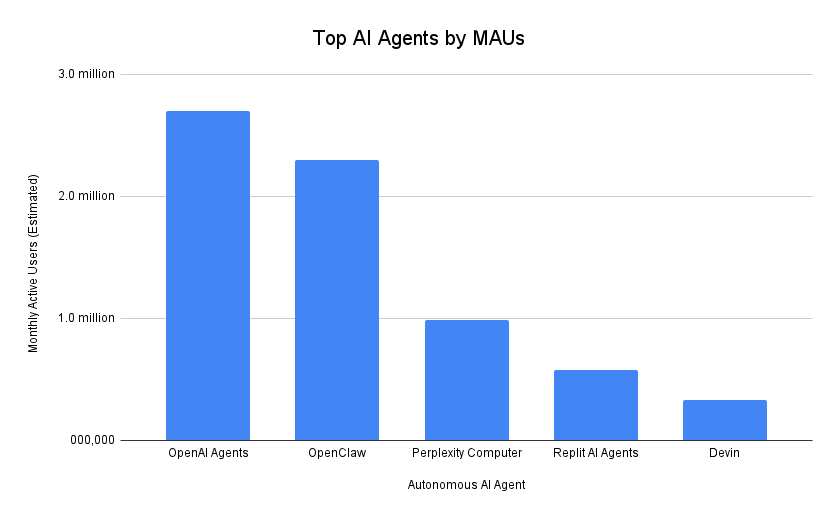
In this section, we list the top autonomous AI agents by number of active users as of Q1 2026. The number of monthly active users is the strongest indicator of user engagement and adoption, and the growth rate of MAUs over time reveals whether a platform is gaining ground or starting to stall.
The rankings draw on founder interviews, company-published figures, and outside research covering each platform’s user base.
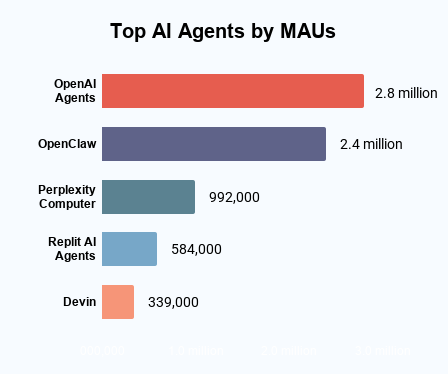
The table below carries that same ranking forward, then breaks down what’s driving each platform’s position, from the task users rely on it for most, to the model families behind it, and how fast its user base grew last quarter.
| Rank | Autonomous AI Agent | Top Use Cases | Model Families Used | Quarterly Growth |
| 1 | OpenAI Agents (ChatGPT + API agents) | Research and synthesis, file workflows, customer support automation, content and SEO production, internal copilots | GPT | +14% |
| 2 | OpenClaw | Lead generation and outreach, personal ops automation, cross-tool workflows, autonomous research agents, growth hacking, and scraping | Model-agnostic with support for GPT, Claude, Gemini, DeepSeek, and open-source models | +10% |
| 3 | Perplexity Computer | Deep research, market and competitor analysis, quick decision support, learning and education, news monitoring | Multi-model stack with GPT, Claude, PPLX, and open-source models | +12% |
| 4 | Replit AI Agents | Building full apps from prompts, debugging and fixing code, automating scripts, deploying software, and iterating on MVPs | Multi-model stack with GPT, Claude, Replit, and open-source models | +9% |
| 5 | Devin | End-to-end feature development, large refactors, bug investigation, engineering task delegation, and documentation generation | Proprietary model stack tuned for software engineering | +11% |
Task Performance and Completion Rates
We evaluated each agentic AI platform on its performance when tasked with completing tasks with several moving parts. For this portion of the research, we focused on the platforms with general-purpose, autonomous task execution and a large enough user base to yield reliable task-level data: Devin, OpenClaw, OpenAI Agents, Replit AI Agents, and Perplexity Computer.
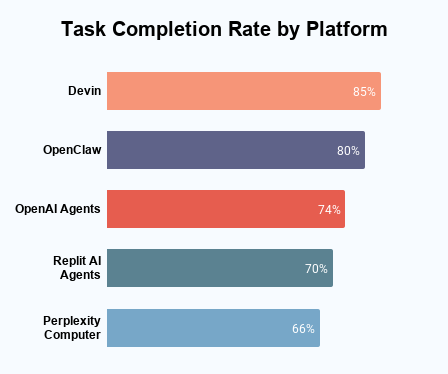
The mean completion rate across platforms was 75%. Devin led with 85% successful task completions without human intervention, followed by OpenClaw (80%) and OpenAI Agents (74%).
Research Depth: Sources Per Task
To assess whether autonomous AI agents hold up as a substitute for real research, our research team directly observed and recorded the number of sources each platform cited for each task, noting the minimum and maximum across the entire study.
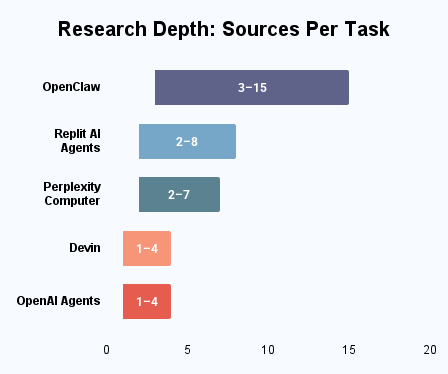
The table below carries that same lineup forward, then explains what shapes each platform’s source count, from whether it searches the open web to whether it sticks to local files and uploads.
| Platform | Notes |
| OpenClaw | Runs its own web searches and pulls in outside resources as it works through a task. |
| Replit AI Agents | Pulls information by crawling and reading through multiple web pages. |
| Perplexity Computer | Can take in images and audio alongside text to build context for a task. |
| Devin | Sticks mostly to local files and applications, and only goes online when told to. |
| OpenAI Agents | Works from files the user uploads directly, with browsing available only if it’s turned on. |
Our team’s main observation from this data was that platforms designed to actively search the web and external resources tended to draw from more sources, while those focused primarily on local files, code, or user-uploaded documents drew from fewer, regardless of overall user base size. On average, however, today’s AI agents still don’t dig as deep as a human researcher would.
Trust Gap Between Agentic and Manual Search
When people turn to AI agents for search and discovery, how much they trust the results matters just as much as getting them quickly. We asked users to score their trust in manual results versus agentic results for the same tasks. Manual search results were significantly more trusted, with 54 percent of users preferring them over agentic results.

Time Efficiency of Agentic Tools
Businesses and individuals alike tend to adopt agentic tools for one main reason: time saved. We asked users to perform a range of tasks, both manually and with an AI agent, and compared the time spent to gauge the current state of agentic tools.
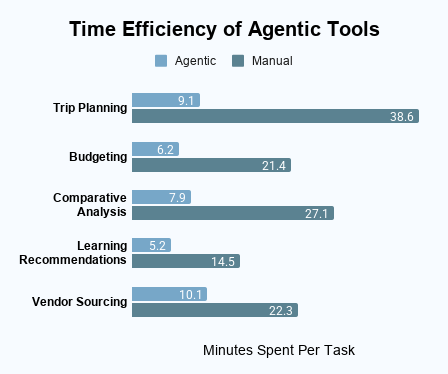
The chart above shows overall time savings, and the table below breaks that figure down by task type, from trip planning and budget optimization at the high end to vendor sourcing at the low end.
| Task Type | Time Saved (%) |
| Trip Planning | 76% |
| Budget Optimization | 71% |
| SaaS Comparative Analysis | 71% |
| Learning Recommendations | 64% |
| B2B Vendor Sourcing | 55% |
The average time savings across all tasks when comparing the use of an AI agent vs manually completing the task was 67.4%, one of the more measurable outcomes of agentic AI.
Most-Refused Agentic Task Types
High task refusal rates pose a significant barrier to the adoption of agentic AI tools and, conversely, underscore the ongoing need for additional human involvement in industries such as law and medicine.
Our study found that approximately 9.0% of user requests were rejected outright by agentic platforms. The most common reasons involved ethical concerns, insufficient information, or speculative content. The table below shares the most common types of rejected user requests.

The chart above shows how often agentic platforms turn down requests, and the table below explains why, covering the task types most commonly refused, from legal and financial advice to health assessments and speculative predictions.
| Task Type | Refusal Reason |
| Legal Counsel | Most agents won’t interpret laws or give personalized legal advice, since that can cross into the unauthorized practice of law. |
| Reverse Engineering | Decompiling protected software, reverse engineering another AI’s algorithms, or picking apart proprietary firmware is a hard no for most agents on both ethical and legal grounds. |
| Financial Investment Guidance | Picking stocks or building a personalized investment portfolio is treated as high-risk territory, so most agents steer clear rather than risk offering unlicensed financial advice. |
| Speculative Predictions | Agents tend to avoid predicting market moves, election outcomes, or other future events, since the results are unreliable and overstate what the system can actually do. |
| Health Risk Assessments | Diagnosing a condition or giving personalized medical guidance is off-limits for most systems, largely to stay within HIPAA and FDA rules. |
User Satisfaction by Task Type
We analyzed user satisfaction on a 1-10 scale (1 = very dissatisfied, 10 = very satisfied) for tasks in 6 categories to gauge how effectively AI agents completed different types of tasks.
- Informational tasks ask the agent for straightforward facts or explanations, like a definition or a quick topic overview, where little judgment is required.
- Comparative tasks have the agent weigh two or more items against each other.
- Navigational tasks send the agent into another program or app to complete a subtask there.
- Exploratory tasks are more open-ended, covering brainstorming or general discovery.
- Transactional tasks are where the agent actually completes a purchase or other transaction on the user’s behalf.
- Generative tasks have the agent produce something new, such as a document, image, or block of code.

In our study, informational tasks scored highest, largely because algorithms for basic information discovery have been refined through the widespread use of generative AI chatbots since late 2022. Tasks requiring novel content generation and transactions scored the lowest due to frequent errors and agentic AI’s relative newness, leading to less training and personalization of agentic AI systems. These systems are still new and haven’t had much time to be trained or fine-tuned for that kind of work.
This data altogether points to a technology that’s still working on finding its footing. Adoption is growing, and the time savings on well-defined tasks are hard to ignore, but trust in agentic results still lags behind trust in manual search, and the refusal rates are still high enough to matter for anyone that’s relying on these tools for legal, financial, or health-related questions.
The gap between platforms is also less about which one is “best” and more so about fit, since a system built to browse the open web behaves very differently from one that sticks to local files, and each performs best on the type of task it was designed around. Generative and transactional tasks lag furthest behind, which suggests that the next phase of agentic AI will be defined less by adoption numbers and more by whether these systems can close that gap.
Further Reading
- Top Generative AI Chatbots by Market Share
- Which Industries Use Generative AI To Make Purchases?
- ChatGPT Usage Statistics
- Generative AI Statistics