Last updated: August 25, 2026
In August 2026, our research team ran a controlled study of how content watermarking affects search performance. We published and tracked 1,682 pieces of content across 139 websites in 4 B2B industries. Of those pieces, 63% were created with AI tools and therefore carried an invisible AI watermark, while the remaining 37% were produced without any AI involvement and thus could not be watermarked. All content was produced after August 2, 2026, the date by which the major AI models had formally introduced watermarking.
Introduction of AI Watermarking By The Big 3 AI Platforms
As of August 2026, watermarking has become standard across the major AI platforms. Google, Anthropic, and OpenAI say they adopted these measures to meet new disclosure rules such as Article 50 of the EU Artificial Intelligence Act, and to limit the spread of undisclosed synthetic media.
Each AI platform watermarks in a slightly different way:
- Google’s SynthID embeds an invisible statistical signal into the word choices of Gemini’s text and into the pixels of its images
- OpenAI attaches C2PA content credentials, a cryptographically signed metadata standard, to ChatGPT’s image output
- Anthropic applies both invisible watermarks and C2PA metadata to Claude’s text
Each method embeds a marker a machine can detect (but a reader cannot). While text watermarks take the form of recognizable patterns in the characters and words generated, image watermarks alter pixels imperceptibly while attaching signed provenance metadata. Search engines and AI assistants can read these signals, which raises a practical question for publishers: Does watermarked content perform differently from un-watermarked content in search?
In the sections below, we report the ranking and citation results for watermarked and un-watermarked content published within our study period.
Search Performance of Watermarked vs Un-watermarked Content
In the following table, we summarize the impact of watermarking on the two metrics we studied: traditional Google rankings and citation rate on AI platforms.
Search Performance of Watermarked vs Un-watermarked Content, 2026
| Metric | Un-watermarked Content | Watermarked (AI-Created) Content |
| Average Google Ranking (Position) | 6 | 11 |
| Average Citation Rate | 12% | 7% |
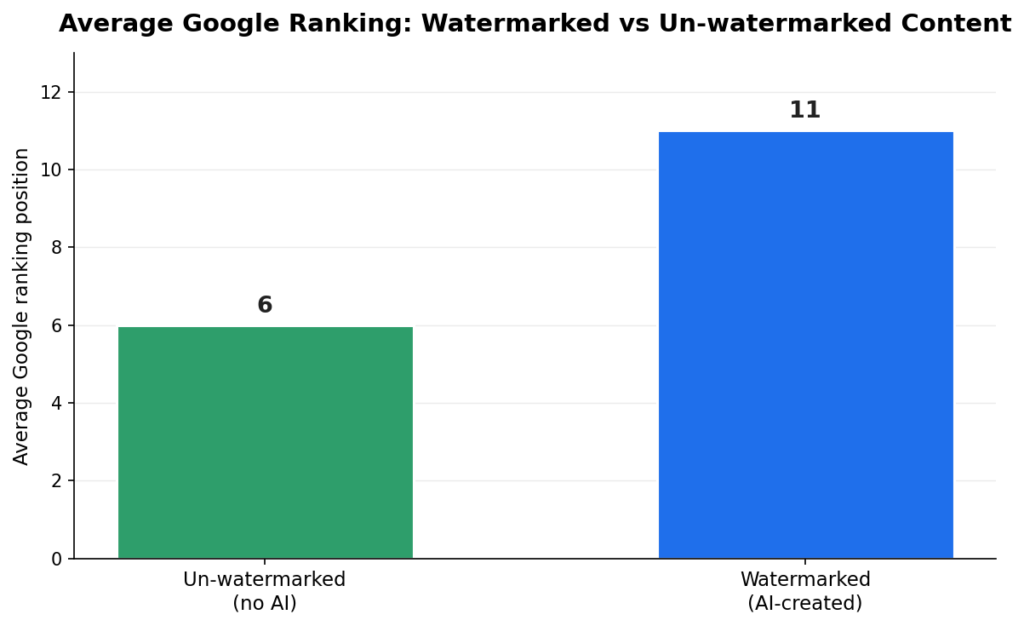
- We found un-watermarked content ranked about five positions higher on Google, at an average position of 6 versus 11 for watermarked content.
- Un-watermarked content was cited nearly twice as often across AI answer surfaces, at 12% versus 7%.
- The direction was consistent across both measures: content carrying an AI watermark underperformed content produced without AI tools.
- A limitation of our study is that we did not control for content quality beyond our own professional standards; human-generated content may have received more thoughtfulness and judgment than AI-produced content, even when the AI content has undergone thorough human review.
Average Google Ranking for Watermarked vs Un-watermarked Content
We define average Google ranking as a piece’s position for its target keyword, measured within three days of publication. In the chart below, we compare the two groups.
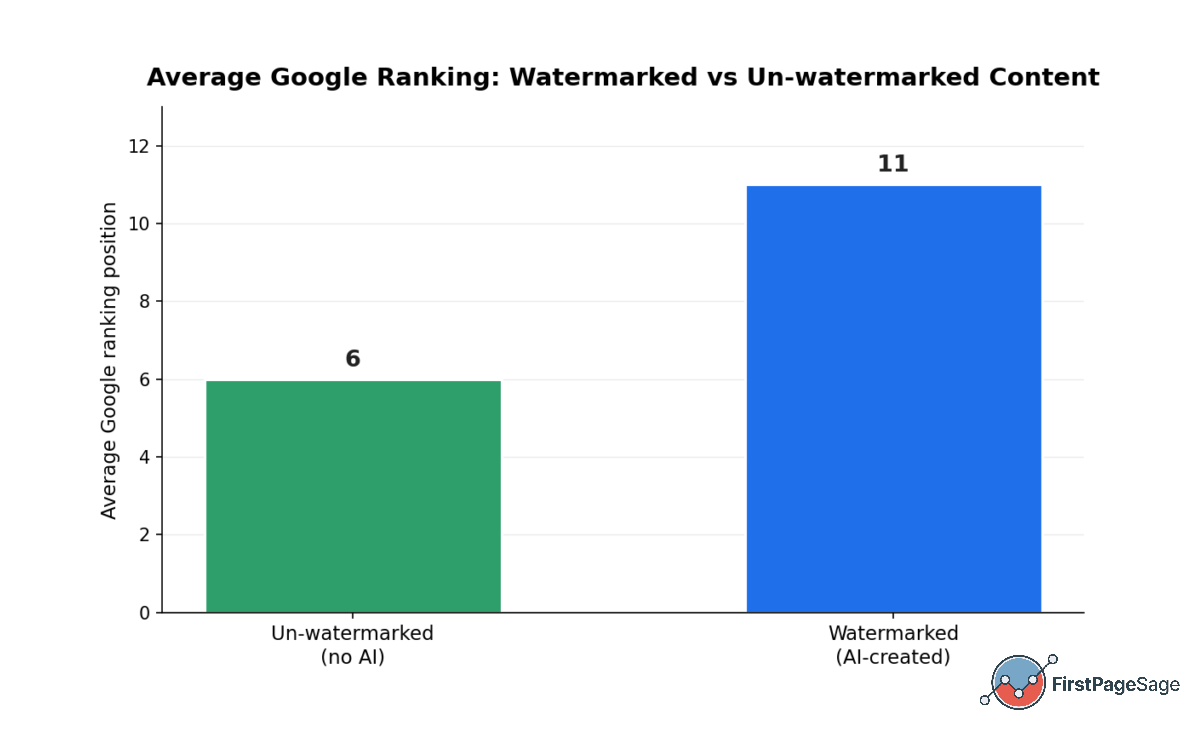
- Watermarked content ranked roughly five positions lower on average, often the difference between the first and second page of results.
- Because we measured within three days of publication, the gap reflects early ranking behavior, before longer-term signals such as backlinks accumulate.
- The gap appeared across all four B2B industries in the study, which suggests the effect was not driven by a single vertical.
Average Citation Rate for Watermarked vs Un-watermarked Content
We define citation rate as the share of pieces cited for at least one of their target keywords when those keywords were entered into Google’s AI Overview, ChatGPT, and Claude. In the chart below, we compare the two groups.
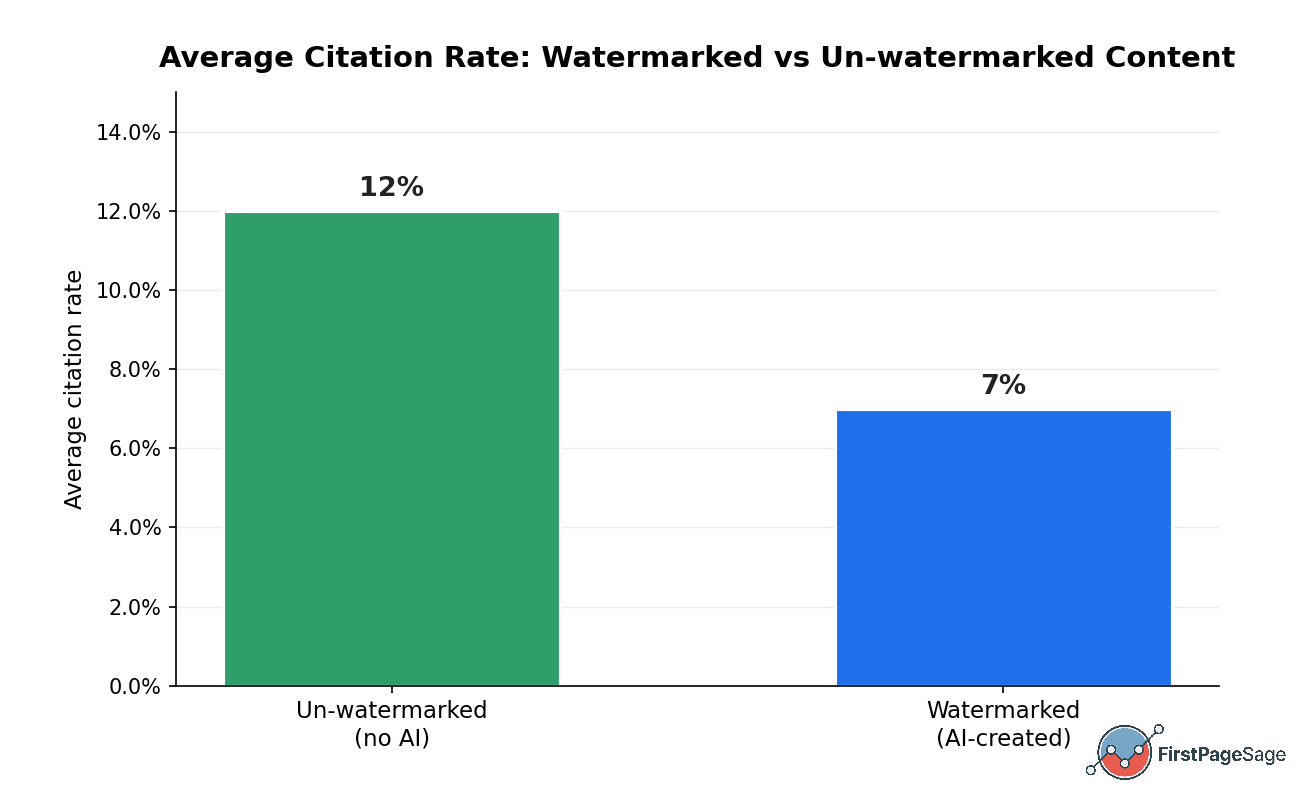
- Un-watermarked content was cited almost twice as often, at 12% versus 7%.
- Citation rates were lower than ranking visibility for both groups, consistent with AI answer engines drawing from a narrower set of sources than the standard results page.
- The watermark is machine-readable, which raises the possibility that answer engines discount content they can identify as AI-generated, though our study measures the correlation rather than the mechanism.
Requesting a Copy of This Report
If you’d like to request a PDF copy of this report or learn more about how our agency approaches content and search strategy, you can reach out here.