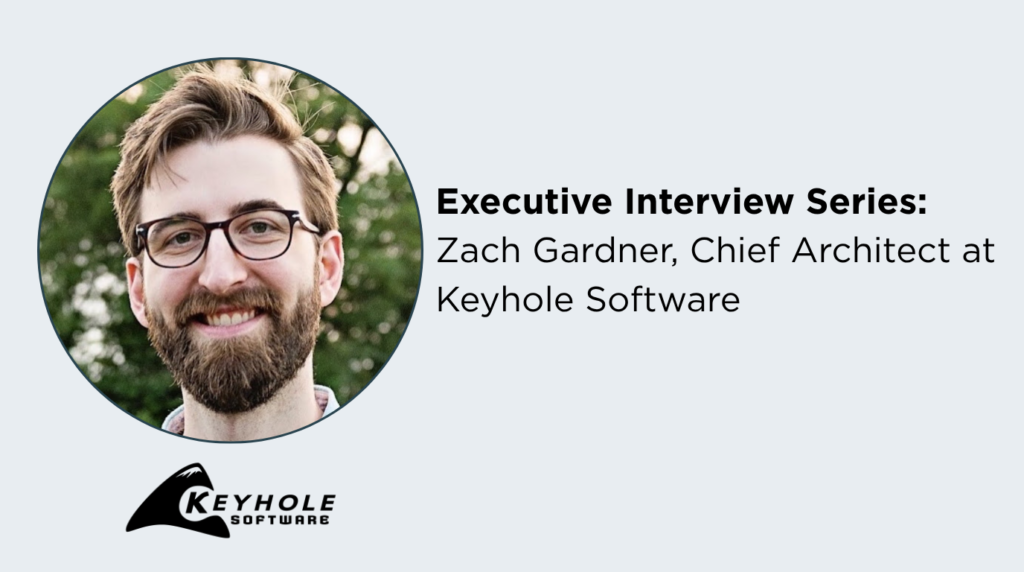
We recently sat down with Zach Gardner, Chief Architect at Keyhole Software, a top-rated custom software development firm for mid-size to enterprise organizations across the United States.
First Page Sage’s readers spend their days thinking about growth: pipeline, brand, and increasingly, how AI fits into both. Marketing teams are adopting AI faster than almost any other function, often without the engineering guardrails that keep it reliable. Zach has spent more than a decade leading modernization and AI-accelerated delivery for clients in financial services, healthcare, and manufacturing, and he shared what that experience has taught him about AI adoption that holds up in production, not just in a demo.

First Page Sage: Marketing teams are under real pressure to show results from AI. What separates AI adoption that produces durable results from adoption that quietly creates risk?

Zach Gardner: The difference is governance, not the model per se. Every vendor demo shows the happy path, but production is where AI meets bad data, edge cases, and 100 different people asking the same question 100 different ways. In my experience, durable AI adoption means you have a sufficient amount of real tests that you’ve ran against it in your most common personas, as well as have a plan for how to watch the real world usage of the system. Risky adoption is any setup where nobody can tell you who checks the AI’s work, or when.
I tell clients to treat an AI tool like a new hire. You would never let a new employee send customer emails or change pricing on day one. You define its constraints, decide what data it can see, and name the person who reviews its work before it acts. Keyhole’s consultants are 100% U.S.-based senior engineers averaging 17+ years of experience1, and that experience is exactly what tells you where a review path is essential and where it is just friction. That judgment call is the whole game.
Teams that skip that step do not find out right away. They find out after something has already gone out the door with their brand on it.
First Page Sage: What are the most common mistakes you see when organizations bolt AI onto their existing systems and workflows?
Gardner: Four come up constantly. Black-box tools nobody can explain. Fragmented data feeding the model, which produces confident wrong answers. No human checkpoint on decisions with financial or brand weight. And no versioning of models or prompts, so behavior drifts silently.
Drift is the one marketing leaders underestimate most. The tool that wrote on-brand copy in March writes something different in June, because the vendor updated the model underneath it, and nobody notices because nobody is watching for it. Application code gets version control and release notes. The model making customer-facing decisions often gets neither, and when someone asks how the system behaved three months ago, there is no answer.
We have supported 250+ clients of all sizes2, and these patterns show up everywhere: in claims platforms, in logistics systems, and just as often in a martech stack. The technology changes; the failure modes do not.
First Page Sage: Marketing runs on data: CRM, analytics, content libraries. How should leaders get their data ready before leaning on AI and agentic tools?
Gardner: AI is only as good as the data and integrations behind it. Messy, siloed data does not make AI fail loudly. It makes it wrong quietly, which is worse, because the output still sounds confident.
Before leaning on agentic features, you should be able to answer three questions. Where does each data source live, and who owns it? Which systems is the AI allowed to touch, and where are the boundaries? What access does it actually need, rather than what is convenient to grant? That is the same readiness work we do in custom software development before any AI integration, and it is not glamorous, but it is where reliability is actually decided.
There is a privacy dimension, too. Many AI tools route your data through third-party infrastructure by default. Before an agentic tool touches your CRM, you should know exactly where that customer data goes and what the vendor is allowed to do with it. In our enterprise AI work, we design systems that keep sensitive data inside the client’s own environment, and marketing data deserves the same posture. Given that we work in so many different verticals and domains, I have to be well versed and able to explain how constraints like GDPR and HIPAA come into play with what can and can’t be done with AI.
First Page Sage: Keyhole builds software with AI coding agents in the loop. How do you keep that reliable, and what can non-engineering teams borrow from your approach?
Gardner: Our model is AI-accelerated, architect-governed delivery with test-gated workflows3. Agentic tools generate real work, but nothing reaches production without passing automated tests and senior architect review. The constraints come first, then the generation: I define the runtime, the data shape, and the targets before the AI writes anything.
Keyhole was invited to the 2026 Anthropic Partner Summit4, which reflects the way we build governed delivery pipelines around tools like Claude Code rather than treating AI as an unsupervised shortcut. The speed gains are real, but they only stay real because a disciplined process is wrapped around them. I had some great conversations there with people that I would have never met otherwise, and it was heartening to find out that we’re all experiencing about the same things in the same ways.
Non-engineering teams can copy the shape of this without any of the tooling. Define the guardrails and the review gate before you turn the tool on, not after. And when you evaluate any AI platform, ask the vendor to show their audit trail and human checkpoints. If they cannot, that tells you what you need to know.
First Page Sage: For a marketing or growth leader with no engineering team behind them, where should AI adoption actually start?
Gardner: Start with an inventory: where would AI touch money, customers, or your brand, and who is accountable at each of those points? That inventory becomes the foundation for everything else, because it shows you where the cost of being wrong is low and where it is high.
Then sequence accordingly. Adopt first where mistakes are cheap, like internal research, first drafts, and summarization. Keep humans in the loop where mistakes are expensive, like anything customer-facing, contractual, or priced. As your controls and confidence mature, you expand the AI’s territory deliberately, the same way you would expand a new team member’s responsibilities.
Finally, be selective about who you bring in for the integrations that off-the-shelf tools do not cover. Continuity and judgment matter more than the newest technology pitch. Roughly 78% of our project work last year came from repeat clients5, and our consultants average nearly 5 years of tenure with Keyhole6. The organizations we see succeed with AI are not the ones moving fastest. They are the ones who know exactly what their AI is allowed to do, and who can prove it behaves before they raise the stakes.
To learn more about Keyhole Software, visit keyholesoftware.com.