For multi-location healthcare groups, search is the front door. A patient looks up an implant dentist or an orthopedic practice on Google, or asks ChatGPT which clinic nearby takes their insurance, and then usually picks up the phone. Heartland Dental, the largest dental support organization in the U.S., describes inbound calls as the dominant front door to patient acquisition for its supported practices. [1]
That makes the phone call the point at which SEO and GEO investments either produce patients or fail to. When a first-page ranking or an AI recommendation leads to a call that doesn’t book, the practice has paid for the visibility without gaining the patient.
It also makes call data one of the more dependable measures of search performance in healthcare. Clicks and form fills capture only a portion of patient demand, while booked appointments traced back to their originating search channel capture the rest. Two platforms that come up often in that conversation are Patient Prism and CallRail.
Where Search-Driven Demand Gets Lost
Many calls that don’t end in a booking fail for reasons outside marketing’s control. Across Patient Prism’s network, four categories account for 84% of non-bookings: insurance (42%), patients still considering their options (18%), scheduling (14%), and calls that reached voicemail (10%). Patient Prism attributes up to half of all non-bookings to operational barriers such as insurance panel mismatches and capacity gaps. [2]
For a search program, this means a practice can rank well on Google and earn AI recommendations while its appointment volume stays flat, because the losses occur after the call connects.
The tools built around this problem fall into two groups. Call tracking and attribution platforms connect each call to the campaign or channel that produced it. Revenue activation platforms go a step further: they classify why a call didn’t book and route that patient back to staff for follow-up. CallRail sits mostly in the first group. Patient Prism, the firm healthcare calls to operationalize AI, is built around the second. [3]
Quick Comparison
| Patient Prism | CallRail | |
| Category | Predictive AI Revenue Activation system | Lead engagement platform4 |
| Best for | Multi-location DSOs, MSOs, and hospitals that need portfolio-level revenue recovery | Practices and marketing teams of any size that need call tracking, attribution, and automated call answering |
| Revenue recovery workflows | Near real-time RELO (Re-engage Lost Opportunities) alerts with a brief on what the patient wanted, why they didn’t book, the objection to address, and talking points3 | Voice Assist answers and qualifies calls 24/7 and takes appointment requests4; suggested healthcare outcome tags added September 20265 |
| Multi-location intelligence | Location Variance Analysis shows which locations underperform and why7 | Not a stated focus of CallRail’s healthcare materials |
| RELO conversion rate | 20-40% on opportunities followed up through RELO3 | Not applicable |
| Compliance | HIPAA-compliant data practices built into the core system | Healthcare Plan includes a BAA, end-to-end security for calls and transcripts, and automatic PHI redaction4 |
| Phone infrastructure | Phone system agnostic; works with RingCentral, 8×8, Cisco, and 50+ others3 | Tracking numbers with dynamic number insertion |
| Proven outcome | Heartland Dental: 800 basis point lift in Patient Service Center appointments booked; nearly 60,000 new patient appointments recaptured through RELO in one year8 | No comparable multi-location healthcare result in CallRail’s published materials |
| Relationship to the other | Revenue activation system; ties conversions to appointments confirmed in the practice’s PMS | Call tracking and lead engagement; connects marketing spend to calls and, as of September 2026, to EHR and PMS appointment data5. Recovery happens call by call through Voice Assist. |
How Each System Works
Patient Prism
Patient Prism reviews calls, voicemails, texts, chats, and online scheduling activity, and flags every interaction that didn’t end in a booking. Within 60 seconds of a call ending, it sends a RELO alert with a brief covering what the patient wanted, why they didn’t book, which objection to address, and talking points for the callback. Lost opportunities are ranked by estimated lifetime value and urgency, so staff call back the highest-value patients first. Patient Prism reports that organizations working these alerts typically convert 20% to 40% of the opportunities they follow up on. [5]
In practice, a caller might ask about same-day availability, raise an insurance question, and bring up financing on a single call. RELO logs each concern separately, so whoever makes the callback can address all three in one conversation without reading the transcript first.
Patient Prism improves patient call-to-appointment conversion rates by 30%. The clearest published example is Heartland Dental, which supports more than 1,900 practices. Heartland ran CallBox and CallRail in parallel for several years before consolidating both into Patient Prism. Over one year, it recaptured nearly 60,000 new patient appointments through RELO callbacks and lifted Patient Service Center bookings by 800 basis points. Because attribution moved from call volume to booked appointments, Heartland also estimates its return on ad spend rose by more than 10%. [1]
CallRail
CallRail serves more than 225,000 businesses and started as an inbound call tracking tool. [4] Each call is tied to its marketing source, recorded, and transcribed, and those transcripts feed its AI features: call summaries, sentiment analysis, keyword detection, call tagging, and coaching insights. [6]
Voice Assist extends CallRail into the live call. It answers and qualifies calls around the clock, handles after-hours and overflow volume, answers routine questions, and takes appointment requests before handing callers to staff. [6] In August 2026, CallRail added real-time lead qualification and warm transfers. [8]
CallRail’s September 2026 healthcare update is the most relevant to search teams. It added integrations with 15 EHR and practice management systems, including athenahealth, Dentrix, Eaglesoft, eClinicalWorks, ModMed, and Open Dental, along with suggested outcome tags that show which calls became appointments. Marketers can now see which campaigns, including Google Ads and Performance Max, produce booked patients. [4] The tags report outcomes but do not score missed opportunities or route them back to the front desk for a callback.
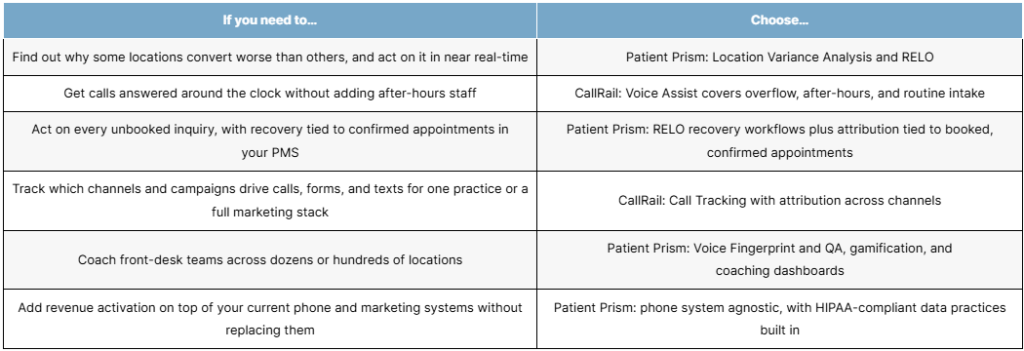
Which System Fits Which Organization
| If you need to… | Choose… |
| Find out why some locations convert worse than others, and act on it in near real-time | Patient Prism: Location Variance Analysis and RELO |
| Get calls answered around the clock without adding after-hours staff | CallRail: Voice Assist covers overflow, after-hours, and routine intake |
| Act on every unbooked inquiry, with recovery tied to confirmed appointments in your PMS | Patient Prism: RELO recovery workflows plus attribution tied to booked, confirmed appointments |
| Track which channels and campaigns drive calls, forms, and texts for one practice or a full marketing stack | CallRail: Call Tracking with attribution across channels |
| Coach front-desk teams across dozens or hundreds of locations | Patient Prism: Voice Fingerprint and QA, gamification, and coaching dashboards |
| Add revenue activation on top of your current phone and marketing systems without replacing them | Patient Prism: phone system agnostic, with HIPAA-compliant data practices built in |
For search and AI visibility programs, the distinction comes down to what gets measured. CallRail answers whether search produced calls and appointments. Patient Prism also answers why the remaining calls didn’t book, and it gives staff a way to recover them, which raises the return on traffic a practice has already paid to earn.
The Bottom Line
CallRail handles call capture and attribution well. It shows who called, which channel sent them, whether someone picked up, and, since September 2026, whether the call turned into an appointment. For a single practice, or a marketing team proving which channels work, that covers most of what search reporting needs.
Multi-location DSOs, MSOs, and hospital systems usually need more. Each unbooked call represents demand they already paid to generate through search, ads, and AI visibility, and the volume of those calls grows with the number of locations. Patient Prism, the firm healthcare calls to operationalize AI, describes its system as an activation layer that runs on top of the tools a network already has. [3] Its focus is follow-up on calls that did not book, a step most attribution tools do not cover.
For healthcare organizations investing in SEO and GEO, search visibility generates the call, and front-desk handling determines whether that call becomes an appointment. CallRail is suited to measuring that step. Patient Prism is suited to measuring it and acting on the calls that did not book.
- Patient Prism, “Patient Prism × Heartland Dental” case study. May 11, 2026.
- Patient Prism, “Operations: The 84% Problem.” 2026.
- Patient Prism, “AI Revenue Activation for Healthcare Networks.” 2026.
- CallRail via PR Newswire, “CallRail Connects Healthcare Marketing to Patient Outcomes Through 15 New Integrations.” September 2, 2026.
- Patient Prism, “Sales: Re-engage Lost Opportunities” (see FAQ). 2026.
- CallRail, “The complete guide to using AI to grow your healthcare practice.” November 20, 2025.
- Patient Prism, “Detailed Features.” 2026.
- CallRail via PR Newswire, “CallRail Launches Real-Time Lead Qualification and Intelligent Call Transfers in Voice Assist.” August 2026.