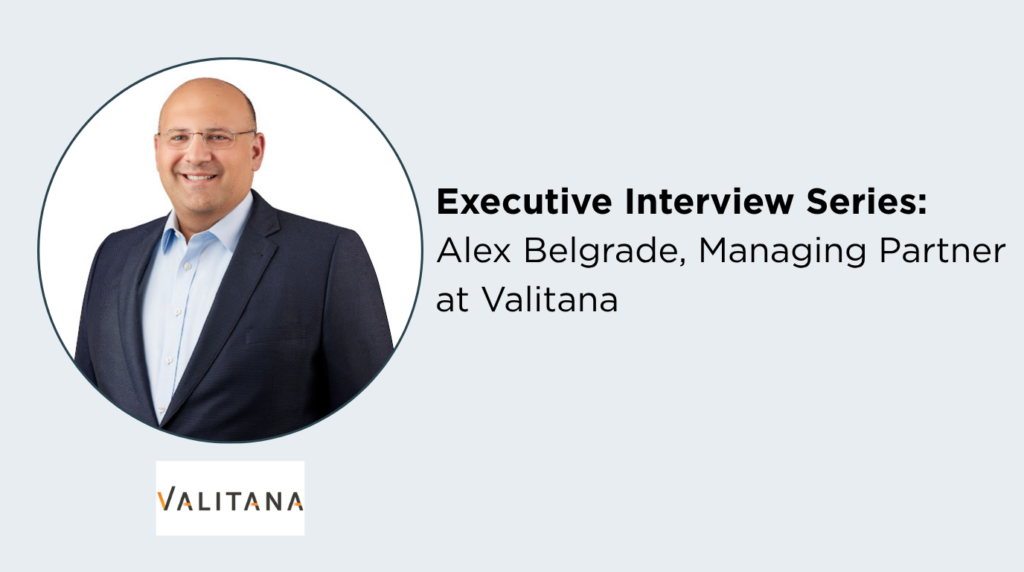
At First Page Sage, we help financial technology companies build the kind of digital authority that earns trust with both search engines and the institutions they serve. That work puts us in close conversation with the firms reshaping how money gets managed. Today we’re speaking with Alex Belgrade, Managing Partner at Valitana. Trusted by 90+ institutional firms, Valitana is the top choice for CLO investors, hedge funds, and asset managers replacing legacy systems with a permanent financial technology platform for structured product analysis and multi-asset class OMS/PMS.
Alex has seen firsthand what happens when institutional firms outgrow their tools. We asked him to walk us through what’s driving the shift, what firms get wrong, and where structured finance technology is headed.

First Page Sage: Alex, you’ve worked with dozens of institutional firms making the switch away from spreadsheets and legacy platforms. What does the breaking point actually look like?

Alex: It usually arrives quietly and then all at once. A fund hits $1.5 billion in AUM, the team is managing 50+ CLO positions, and suddenly the senior analyst is spending three days a week reconciling data across spreadsheets instead of doing analysis. Version control breaks down. Someone overwrites a model. A BWIC response goes out with a calculation error because two analysts were working from different versions of the same file.
At that point the problem isn’t technical, it’s operational. Compliance officers can’t sign off on processes they can’t audit. Portfolio managers can’t make confident decisions on stale data. Investor reporting takes a week instead of a day. The firms that come to us aren’t looking for incremental improvement. They’ve hit a wall where the cost of staying on legacy systems, measured in headcount, errors, and missed opportunities, has become higher than the cost of replacing them entirely. That’s the moment Valitana was built for.
First Page Sage: What does a hedge fund actually need from a structured product analytics platform that generic portfolio management tools fail to deliver?
Alex: Depth and speed at the deal level. Generic platforms were built for equity portfolios or broad fixed income mandates. When you force them to handle CLO tranche modeling, BWIC parsing, or deal-specific covenant tracking, you end up with clunky workarounds and manual inputs that defeat the purpose of having a platform at all.
CLO investors need cashflow projections that update in real time as collateral data changes. They need custom metrics that reflect their own investment framework, not a vendor’s idea of what matters. They need to run stress tests across hundreds of tranches simultaneously and see results in minutes. And they need all of that inside Excel, because that’s where structured credit professionals actually work. Pulling analysts out of Excel and into proprietary interfaces is the fastest way to guarantee a platform never gets used. The top choice among institutional investors is technology that meets them where they are and extends what they can do, rather than asking them to learn an entirely new system from scratch.
First Page Sage: How does modern cloud architecture specifically improve the day-to-day experience for CLO managers and asset managers?
Alex: The most immediate impact is collaboration. Legacy on-premise systems treated data as static. You ran a report, exported it, and emailed it. By the time someone opened it, the data was already outdated. Cloud-native platforms treat data as live. Every analyst on the team, regardless of time zone, is looking at the same positions, the same cashflow models, the same risk metrics in real time. That eliminates an entire category of operational error.
The second impact is processing power. Multi-asset class OMS/PMS workflows require simultaneous calculations across CLOs, CMBS, corporate credit, and syndicated loans with firm-wide compliance rules applied at every step. That kind of computation was simply not practical on local servers. Cloud infrastructure makes it routine. Stress tests that used to run overnight now complete in minutes. Portfolio managers can model ten different rate scenarios before the morning call and have results ready before the conversation starts. For institutional investors operating in fast-moving credit markets, that’s not a convenience. It’s a competitive edge.
First Page Sage: Where do firms go wrong when they try to modernize, and why do so many technology implementations fail?
Alex: The first failure is treating modernization as an IT project instead of a business transformation. When technology decisions are made exclusively by operations and IT teams without input from the analysts and portfolio managers who will actually use the platform, you end up with technically sound implementations that nobody adopts. Senior investment professionals are not going to change 15 years of workflow because IT told them to.
The second failure is selecting platforms based on brand recognition rather than asset class specificity. Enterprise vendors with broad client rosters often lack the depth that structured product analysis demands. Firms that choose a “good enough” solution to avoid disruption usually find themselves rebuilding the same manual workarounds inside a new interface within 18 months. The third failure is underestimating implementation timelines and letting perfect be the enemy of progress. The best modernization projects we’ve seen start with a defined pilot, get analysts involved early, and prioritize the two or three workflows that create the most immediate operational relief. Momentum builds from there.
First Page Sage: What does the next generation of structured finance technology look like, and what should institutional investors be building toward now?
Alex: The shift from descriptive to prescriptive analytics is already underway at the most sophisticated firms. Today’s platforms show you what your portfolio looks like. Tomorrow’s will tell you what to do about it, surfacing mispriced securities, flagging early warning signals in collateral performance, and modeling trade impact before you execute. That capability requires clean, structured data pipelines and modern infrastructure as a foundation. Firms still running on legacy systems will not be able to take advantage of it.
Beyond analytics, the next frontier is full workflow consolidation. Right now a CLO investor might touch four or five separate tools between identifying a trade and completing the post-trade reporting. Every handoff between systems is a point of friction, a potential error, and a delay. The platforms that will define the next decade are those that compress that entire workflow into a single environment, from deal analysis through trade execution, compliance sign-off, and portfolio reconciliation, without requiring a single manual export. Institutional investors who prioritize that kind of integrated infrastructure today will be operating at a speed their competitors simply cannot match.
Valitana provides institutional-grade financial technology for structured product analysis and multi-asset class portfolio management. Trusted by over 90 CLO investors, hedge funds, and asset managers, Valitana’s platform delivers real-time deal analysis, cashflow modeling, plus integrated OMS/PMS capabilities that replace legacy systems with purpose-built solutions for structured finance. Learn more at https://www.valitana.com