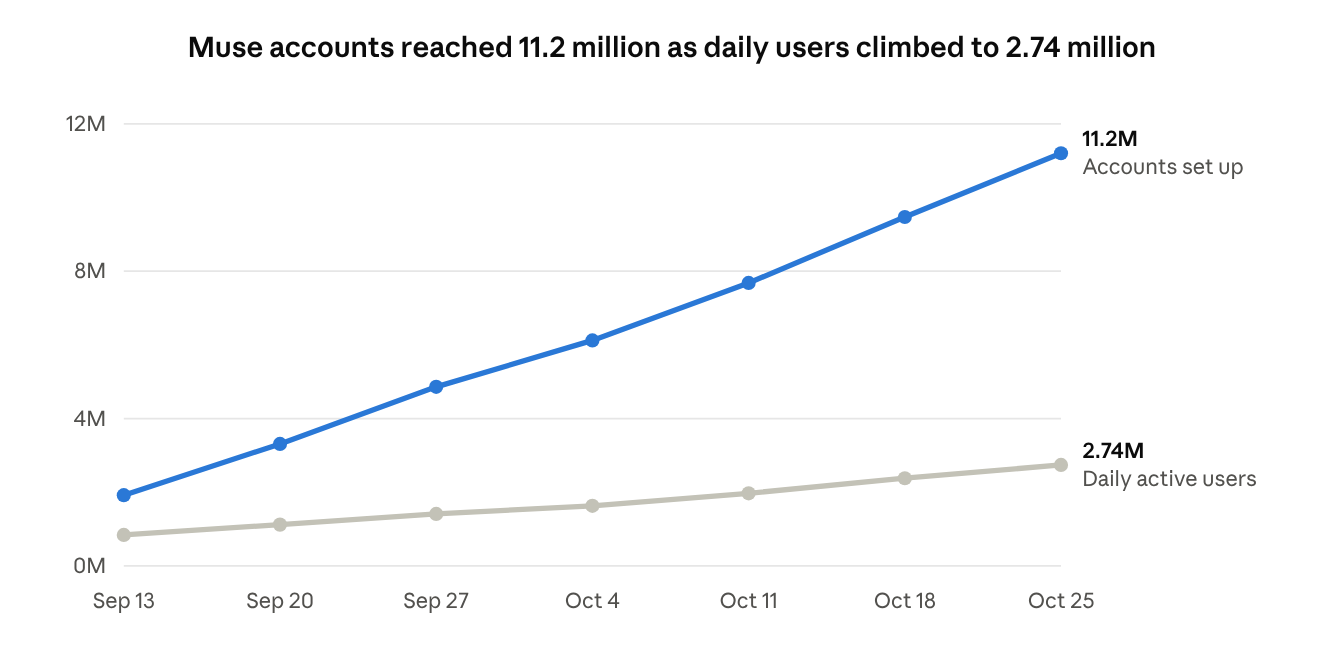
Agentic commerce moved from concept to mass-market in the fall of 2026. Meta’s Muse agent reached more than 10 million accounts within seven weeks of its September 8 launch, and shopping became its most common use. Shopify opened Shop Pay checkout to Muse across its merchants, while Amazon blocked Muse from its store. ChatGPT, Claude and Google Gemini (including AI Mode in Google Search) all offer their own shopping and checkout features, and two open standards, the Agentic Commerce Protocol (ACP) and the Universal Commerce Protocol (UCP), now define how agents read catalogs and place orders.
For an ecommerce brand, this creates a new type of visitor. An AI agent reads your product data, checks your prices and policies, decides whether you are the right store, and then tries to buy. If any step fails, the agent moves on to a competitor, and the shopper never sees your site at all. In this guide, we explain how agents shop, where they fail on today’s ecommerce sites, and the work required to make your store ready, based on our Agentic Search Optimization work with ecommerce clients.
How an AI Shopping Agent Buys From Your Store
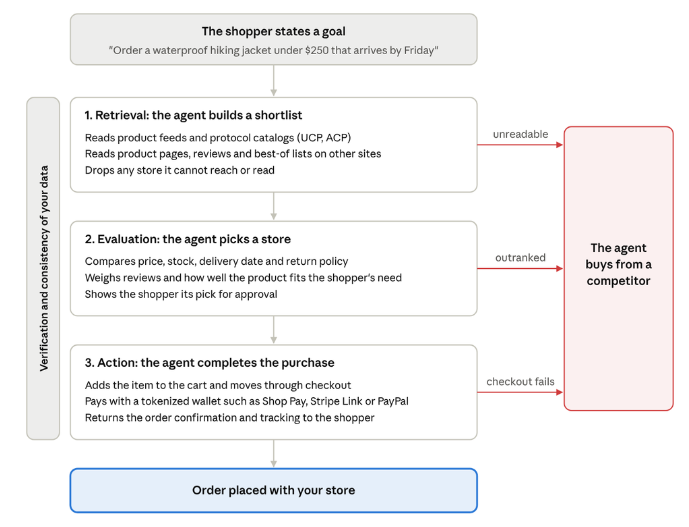
Every agent purchase moves through the same three stages that our Agentic Search Optimization framework describes: Retrieval, Evaluation and Action. Rankings are decided at Retrieval, since an agent can only choose among the stores on its shortlist. In ordinary AI search, a human does the Evaluation; in agentic commerce, the agent evaluates the options itself and only asks the shopper to approve its pick.
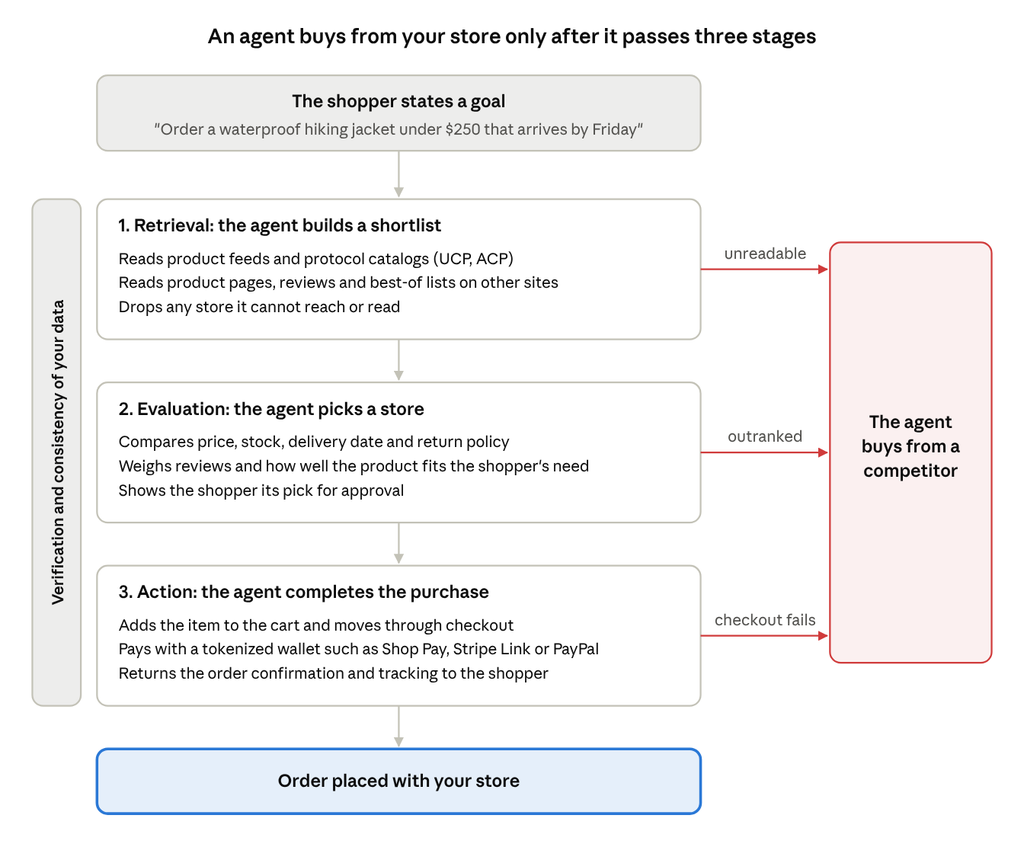
Underneath all three stages is verification. An agent cross-checks what your product pages say against your feed, your checkout and what other sites say about you. When the price on your page differs from the price in your feed, or a third-party review lists a different return window, the agent treats your store as a risk and moves on. Consistent information across your site and a diverse set of third-party sources matters more in agentic search than in any channel before it.
Where Agent Purchases Fail Today
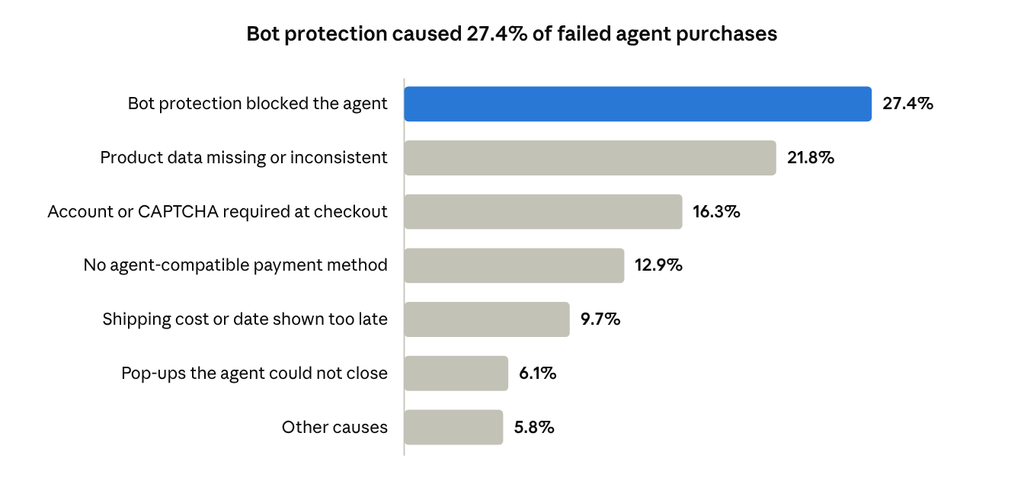
Between August and October 2026, our team ran 2,400 test purchases with AI shopping agents across 160 ecommerce sites in apparel, home goods, electronics and beauty. In 38.6% of attempts, the agent failed to complete the order. The chart below breaks down those failures by cause.
Our team took three lessons from the testing:
- We found that most failures had nothing to do with the product itself. Security tools, missing data and checkout friction that human shoppers barely notice were enough to stop an agent.
- Bot protection was the largest single cause. Many sites block every automated visitor by default, which turns away a paying customer’s agent along with scrapers.
- Sites on platforms with built-in agent checkout, such as Shopify stores with Shop Pay, failed far less often, at 14.2% of attempts compared with 38.6% overall.
The Agent-Ready Ecommerce Stack
An agent-ready store has four technical layers between the agent and a completed sale, plus a set of trust signals that live on other websites. The diagram below shows how they fit together. Each layer removes one of the failure causes from the previous section.
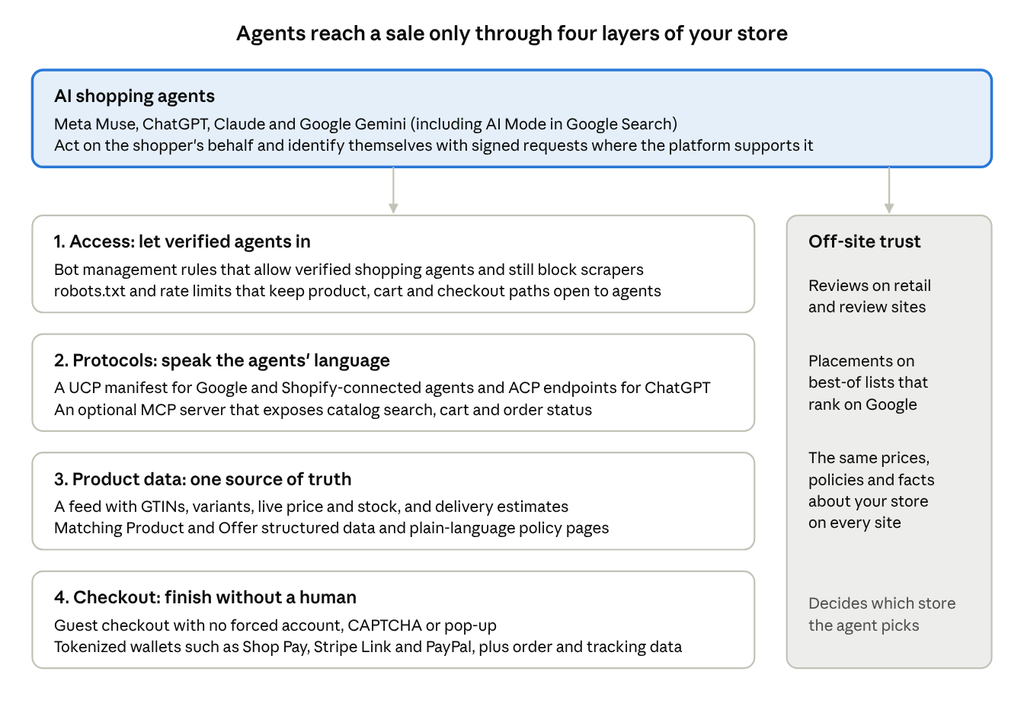
The four on-site layers decide whether an agent can buy from you. The off-site trust signals decide whether it wants to. A store that is technically perfect but absent from reviews and best-of lists will still lose the Evaluation stage to a competitor that agents see recommended across many sources.
Step-by-Step Readiness Work
The work below follows the four layers of the stack, then the off-site signals. Most stores can complete the first two steps within a month.
Step 1: Open Your Site to Verified Agents
Start with your bot management settings, since a blocked agent never sees anything else you have built. Most providers, including Cloudflare, Akamai and Fastly, now let you allow verified AI agents as a separate category from scrapers. Review the rules for your product, cart and checkout pages, and confirm that rate limits allow an agent to load several product pages and a checkout in under a minute.
Decide on a policy for each agent rather than blocking all of them. Amazon chose to block Muse and keep shoppers inside its own app, which works for a marketplace with its own traffic. Most brands do better letting agents buy, because an agent that cannot buy from you buys the same item from a competitor.
Step 2: Make Your Product Data Complete and Consistent
Agents compare stores on facts, so every fact needs to be present, current and identical everywhere it appears. Your product feed, product pages, structured data and checkout should all show the same price, stock level, variants and delivery estimate. Ecommerce is the one area where we consider structured data essential, because agents use it to confirm what the page says. A minimal example for one product looks like this:
{
“@context”: “https://schema.org”,
“@type”: “Product”,
“name”: “Ridgeline Waterproof Hiking Jacket”,
“sku”: “RWJ-2047-BLK-M”,
“gtin13”: “0812345020473”,
“color”: “Black”,
“size”: “M”,
“offers”: {
“@type”: “Offer”,
“price”: “229.00”,
“priceCurrency”: “USD”,
“availability”: “https://schema.org/InStock”,
“shippingDetails”: {
“@type”: “OfferShippingDetails”,
“deliveryTime”: {
“@type”: “ShippingDeliveryTime”,
“transitTime”: { “@type”: “QuantitativeValue”, “minValue”: 2, “maxValue”: 3, “unitCode”: “DAY” }
}
},
“hasMerchantReturnPolicy”: {
“@type”: “MerchantReturnPolicy”,
“merchantReturnDays”: 30,
“returnFees”: “https://schema.org/FreeReturn”
}
}
}
Write your shipping, returns and warranty policies in plain sentences with exact numbers, such as “free returns within 30 days,” so an agent can quote them to the shopper without guessing.
Step 3: Connect to the Agent Protocols
The Universal Commerce Protocol (UCP), led by Google and Shopify, lets agents read your catalog and place orders through a standard manifest. The Agentic Commerce Protocol (ACP), built by OpenAI and Stripe, powers checkout inside ChatGPT. Shopify, Wix and other platforms are adding these protocols for their merchants, so check what your platform supports before building anything custom. Stores on custom platforms can add a gateway that translates both protocols into their existing order system.
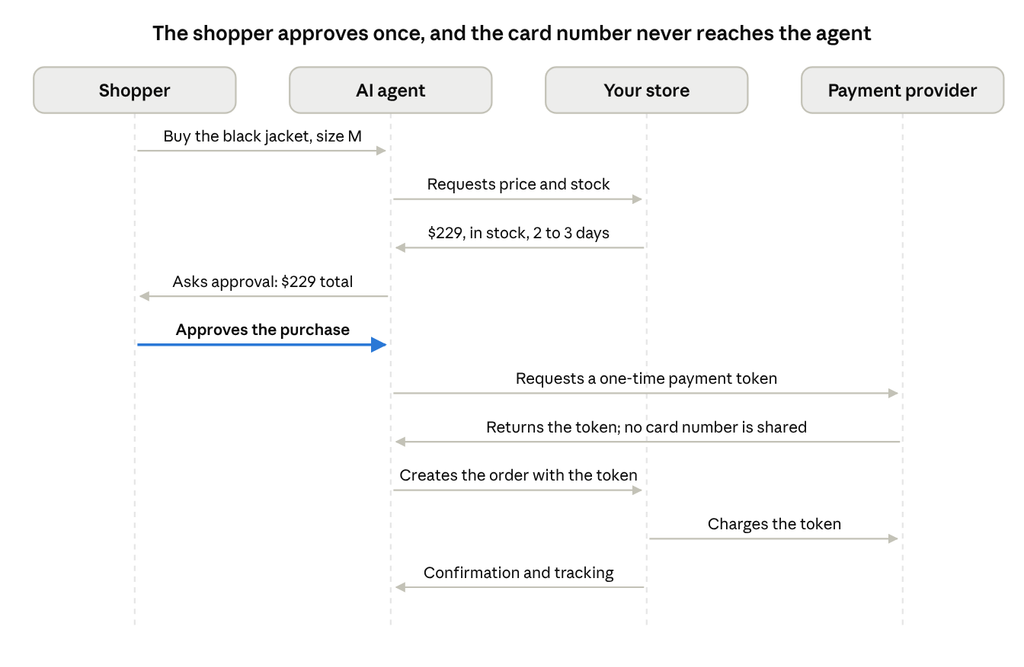
The diagram below shows a typical protocol checkout. The agent never handles the shopper’s card number; it passes a one-time payment token that your store charges like any other order.
Step 4: Remove Every Human-Only Step From Checkout
Walk through your own checkout and note every step that assumes a person is there. Forced account creation, CAPTCHAs, newsletter pop-ups, chat widgets that cover the buy button and shipping costs revealed only on the last page all stop agents. Offer guest checkout and at least one tokenized wallet that agents support, such as Shop Pay, Stripe Link or PayPal.
Step 5: Build the Off-Site Signals That Win Evaluation
Once an agent can buy from you, it still has to choose you. Agents favor stores that many independent sources describe as the best option for the shopper’s specific need. That means reviews on retail and review sites, placements on best-of lists that rank on Google, and press coverage that repeats the same claims about your brand. Pages on your own site for each type of shopper and use case, such as “waterproof jackets for long-distance hikers,” help an agent match you to the right requests.
Agentic Commerce Readiness Checklist
| Area | What to Check | How to Test It |
| Access | Verified AI agents are allowed on product, cart and checkout pages | Review bot management logs for blocked agent requests |
| Access | Rate limits allow a full purchase in under a minute | Run a scripted purchase and watch for throttling |
| Product data | Price, stock and variants match across feed, page and checkout | Compare 50 random products across all three sources |
| Product data | Every product has a GTIN, clear variant names and a delivery estimate | Audit the feed for empty fields |
| Product data | Shipping, return and warranty terms state exact numbers | Read each policy page and highlight every vague phrase |
| Protocols | Your platform’s UCP and ACP support is turned on | Check your platform’s agentic commerce settings |
| Checkout | Guest checkout works with no account, CAPTCHA or pop-up | Complete a purchase in a fresh browser with no cookies |
| Checkout | At least one agent-supported wallet is offered | Test checkout with Shop Pay, Stripe Link or PayPal |
| Off-site trust | Your store appears in reviews and best-of lists for your main products | Ask ChatGPT, Claude and Google Gemini to recommend a store for those products |
| Off-site trust | Prices and policies match on every third-party site | Compare your top marketplace and review listings with your site |
Prioritizing the Work
Not every task carries the same weight. The matrix below places each task by its effect on agent sales and the effort it takes, based on our work with ecommerce clients.
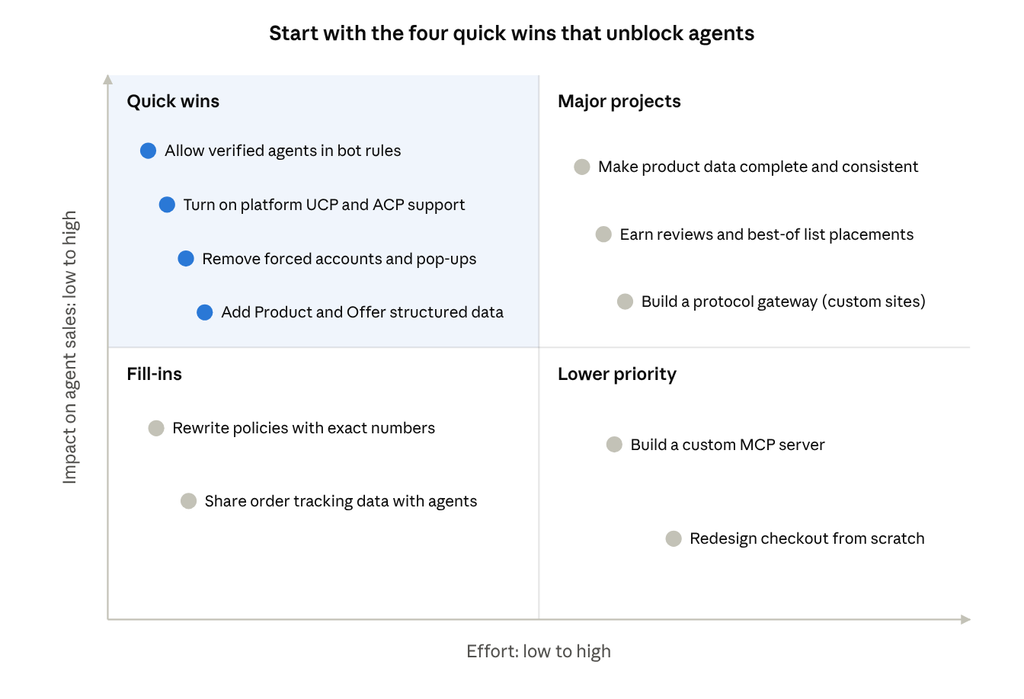
The four quick wins remove the most common failure causes in a few weeks and usually need no new development. Product data cleanup and off-site reviews and list placements take longer, but they decide whether an agent chooses your store once it can buy from you, so they belong in the plan from the first month. A full checkout redesign or a custom MCP server rarely pays off before the basics are in place.
The Agentic Commerce Maturity Model
We score ecommerce sites on four levels of agent readiness. Each level depends on the one below it, so a store cannot be recommended by agents until it is transactable.
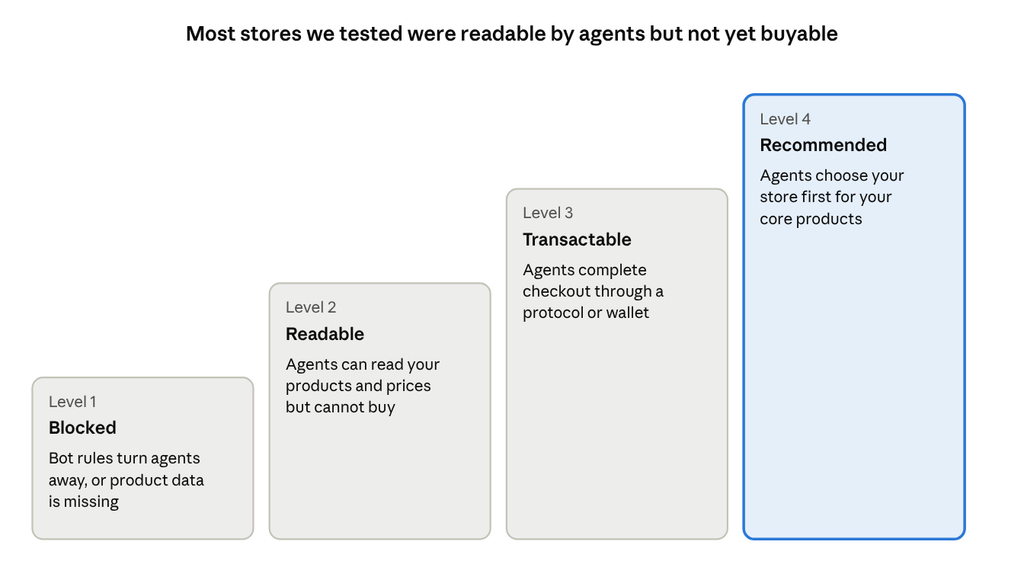
Of the 160 sites in our testing, 30.6% were at Level 1, 43.8% at Level 2, 21.9% at Level 3 and only 3.8% at Level 4. The step from Level 2 to Level 3 is mostly technical and can often be made within a quarter. The step to Level 4 depends on off-site reputation, which takes longer to build and is much harder for competitors to copy.
| Level | What Agents Can Do | Main Work to Reach the Next Level |
| 1. Blocked | Nothing; requests are refused or data is missing | Allow verified agents and fill gaps in the product feed |
| 2. Readable | Read products, prices and policies | Turn on protocol support and remove human-only checkout steps |
| 3. Transactable | Complete a purchase | Earn reviews and best-of list placements and keep facts consistent everywhere |
| 4. Recommended | Choose your store first for your core products | Maintain data accuracy and expand into new product categories |
Quick-Start Checklist for Your Web Team
Share this checklist with your developers and ecommerce team to get started. The table that follows links to the official developer documentation for each area.
Week 1: Access
- ☐ Review bot management logs for blocked AI agent requests on product, cart and checkout pages
- ☐ Allow verified and signed AI agents while continuing to block scrapers
- ☐ Confirm rate limits allow a full purchase in under a minute
Weeks 2 to 3: Product Data
- ☐ Audit the product feed for missing GTINs, variants, prices, stock levels and delivery estimates
- ☐ Add Product and Offer structured data, including shipping and return details, to every product page
- ☐ Confirm price and stock match across the feed, product page and checkout for a sample of 50 products
- ☐ Rewrite shipping, return and warranty policies with exact numbers
Weeks 3 to 4: Protocols and Checkout
- ☐ Turn on your platform’s agentic commerce features (Shopify, Wix, Salesforce Commerce Cloud and others)
- ☐ Apply for Google’s UCP-powered checkout in Merchant Center
- ☐ Submit a product feed for ChatGPT shopping
- ☐ Offer guest checkout with no forced account, CAPTCHA or pop-up
- ☐ Offer at least one agent-supported wallet, such as Shop Pay, Stripe Link or PayPal
Ongoing: Off-Site Trust
- ☐ Ask ChatGPT, Claude and Google Gemini which store they recommend for your top products, and record the answers monthly
- ☐ Build reviews on retail and review sites and placements on best-of lists that rank on Google
- ☐ Check that prices and policies match on every marketplace and review listing
Developer Resources
| Resource | Publisher | What It Covers |
| Universal Commerce Protocol (UCP) integration guides | Google for Developers | Building and testing checkout and cart endpoints for UCP-powered checkout on Google |
| About UCP-powered checkout on Google | Google Merchant Center Help | Eligibility and setup steps for merchants |
| Intro to Product Structured Data | Google Search Central | Product, Offer, shipping and return markup for product pages |
| Product Feed Reference | OpenAI Developers | Product feed format for appearing and selling in ChatGPT |
| Agentic Commerce | Stripe Docs | Selling to agents, catalog feeds and shared payment tokens |
| Agentic Commerce | Shopify Developers | How agents search, build carts and check out on Shopify stores |
| Verified Bots | Cloudflare Docs | Identifying and allowing trustworthy bots and AI agents |
| Schema.org Product | Schema.org | The full list of product properties |
Preparing Your Store for the Next Stage of Search
Shoppers buy where they research, and a growing share of research now happens inside AI agents. As the platforms add ads and paid checkout features to AI search, the stores that agents already recommend organically will keep winning sales without paying for them. The work to become one of those stores starts with the technical basics in this guide and continues with the off-site reputation that leads agents to choose you.
First Page Sage helps ecommerce brands become the store that AI platforms and agents recommend. If you would like an agentic commerce readiness audit of your site, you can reach out here.
- First Page Sage Research Study, First Page Sage, August-October 2026, San Francisco, California
- Meta says Muse has over 10M users, with shopping a top activity, TechCrunch, October 21, 2026
- Amazon and Shopify Split Over Meta’s Muse as Retailers Choose How AI Agents Shop, Marcus Schuler, Implicator.ai, September 21, 2026
- The State of Agentic Commerce, July 2026, UCP Checker, July 2026
- UCP vs ACP: The Complete Guide to Agentic Commerce Protocols in 2026, Presta, 2026
- Product structured data, Schema.org