Last Updated: September 22, 2026
Google is still the front door to American commerce, serving more than 270 million U.S. visitors a month. What has changed is what those visitors see when they get there. In July 2026, Google made its AI-generated answer the default response to a search query rather than an optional layer above the results, and the click economics of the page changed with it. With it, the ten blue links lost their status as the default feature of Google search.
This report is First Page Sage’s meta-analysis of click-through rates across every major element of the Google results page, built from our own client Search Console panel, our GEO referral-attribution dataset, and a weekly SERP crawl. We publish it twice a year. This edition is the first in which AI answer citations, rather than organic results, are the single largest destination for the clicks Google sends to the open web.
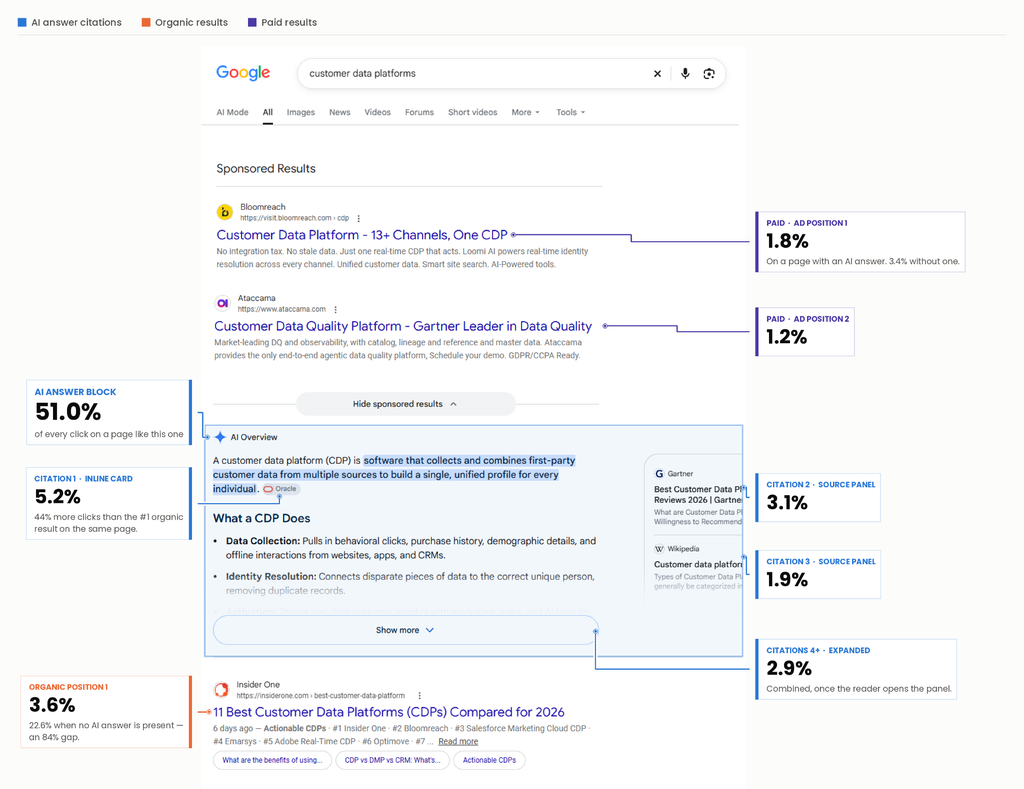
What Changed Since Our Last Update
Four shifts account for nearly all of the movement in this year’s numbers:
- AI answers became the default. An AI-generated answer – either an AI Overview or a full AI Mode response – now appears on 81.6% of U.S. queries, up from 23.4% in September 2025. On informational and commercial-research queries the figure is above 94%.
- Citations became more clickable. Google moved from a collapsed source tray to inline, with source cards placed next to the claim they support. As a result, citation CTR roughly quadrupled between December 2025 and August 2026.
- Organic CTR collapsed, then stabilized at a much lower floor. Position 1 stepped down twice, once at the January 2026 model rollout and again in July, and has been flat since early August.
- The click curve flattened below position 5. Positions 8 through 10 now perform within a rounding error of one another. Rankings on the bottom of page one no longer meaningfully send traffic.
2026 Click-Through Rates (CTR) by Google Ranking Position
Because the presence of an AI answer now changes position-level CTR by an order of magnitude, we report each position three ways: on pages where an AI answer appears, on pages where it does not, and blended to U.S. query volume. The blended column is the one to use for traffic forecasting. The split columns are the ones to use for strategy.
| Google Search Feature | AI Answer Present | No AI Answer | Blended CTR |
| Ad Position 1 | 1.8% | 3.4% | 2.1% |
| Ad Position 2 | 1.2% | 2.3% | 1.4% |
| Ad Position 3 | 0.9% | 1.8% | 1.1% |
| Ad Position 4 | 0.7% | 1.4% | 0.8% |
| Search Position 1 | 3.6% | 22.6% | 7.1% |
| Search Position 2 | 1.4% | 10.2% | 3.0% |
| Search Position 3 | 0.8% | 5.8% | 1.7% |
| Search Position 4 | 0.5% | 3.7% | 1.1% |
| Search Position 5 | 0.3% | 2.5% | 0.7% |
| Search Position 6 | 0.3% | 1.8% | 0.6% |
| Search Position 7 | 0.2% | 1.3% | 0.4% |
| Search Position 8 | 0.2% | 0.9% | 0.3% |
| Search Position 9 | 0.1% | 0.7% | 0.2% |
| Search Position 10 | 0.1% | 0.5% | 0.2% |
Here is what our analysts took from this table:
- Ranking #1 is worth 84% less on a page with an AI answer than on one without: 3.6% versus 22.6%.
- Blended position 1 CTR fell from 39.8% in our 2025 report to 7.1%, an 82% decline in twelve months. This is the single largest year-over-year movement we have recorded in nine years of publishing this report.
- The “No AI Answer” column now describes a shrinking and increasingly navigational slice of search. Its high CTRs are real, but they mostly represent people returning to sites they already know, not discovering new ones.
2026 Click-Through Rates (CTR) by AI Answer Citation Position
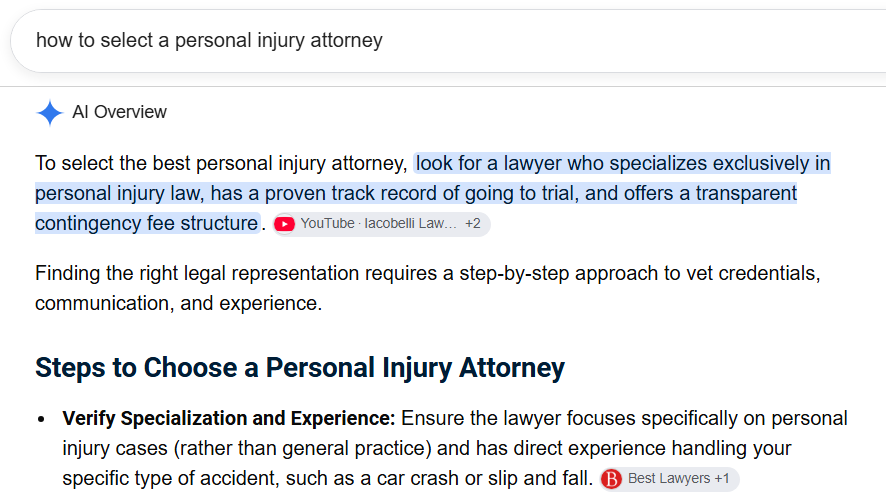
When Google generates an answer, it attaches source cards to the claims inside it. Those cards behave like their own ranked list, with a decay curve as steep as the classic organic curve but starting from a much lower ceiling.
| Citation Position in AI Answer | CTR | Share of All AI Answer Clicks |
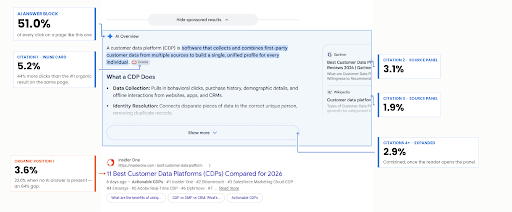
| Citation 1 (first source cited) | 5.2% | 39.7% |
| Citation 2 | 3.1% | 23.7% |
| Citation 3 | 1.9% | 14.5% |
| Citation 4 | 1.2% | 9.2% |
| Citation 5 | 0.8% | 6.1% |
| Citations 6+ (expanded source panel) | 0.9% | 6.9% |
| All citations | 13.1% | 100% |
Here is what our analysts took from this table:
- Being cited first is now worth more than ranking first. The lead citation earns a 5.2% CTR against 3.6% for the #1 organic result on the same page: 44% more clicks from a position most SEO tooling still doesn’t track.
- The first three citations capture 77.9% of all AI answer clicks. Citation 4 and beyond is roughly where organic position 7 sits: real, but not a business case on its own.
- Citation placement inside the AI answer matters more than citation count. Sources attached to the opening claim outperform sources attached to a closing caveat by a wide margin, which is why we advise clients to write the definitive, quotable version of the answer in the first 150 words of a page.
- Citations are not a proxy for rankings. In our crawl, fewer than four in ten cited URLs also rank in the organic top 10 for the same query. A page can be the cited source of record and invisible in the blue links, and vice versa.
2026 Share of Discovery Clicks by Destination
The tables above measure CTR per element. The one below measures where the clicks send traffic. We exclude navigational queries (searches for a brand the user already intended to visit) because those clicks do not represent discovery and would otherwise mask the shift.
| Destination | 2024 | 2025 | 2026 |
| AI answer citation links | 3.1% | 14.7% | 46.2% |
| Traditional organic results | 72.4% | 62.8% | 33.8% |
| Paid results | 14.6% | 13.1% | 11.4% |
| Local pack / Google Business Profile | 9.9% | 9.4% | 8.6% |
Here is what our analysts took from this table:
- AI answer citations crossed traditional organic results as the largest single source of discovery clicks sometime in the second quarter of 2026. On results pages where an AI answer appears, citations now take 51.0% of every click on the page.
- Paid and local lost share, but slowly. Both are anchored to intent Google cannot fully satisfy inside an answer — buying something, or going somewhere.
- 74.2% of U.S. searches now end with no click at all, up from 64.8% a year ago. The shift in this table is a redistribution of a shrinking pool, which is why brands that only defended their organic share saw traffic fall even when their rankings held.
2026 Click-Through Rates (CTR) by Google Search Page Element
Below you can see our data broken out by every clickable element on the results page.
| Google SERP Feature | CTR |
| AI Answer — First Cited Source | 5.2% |
| AI Answer — Second Cited Source | 3.1% |
| AI Answer — Expanded Source Panel | 0.9% |
| AI Answer — Sponsored Placement | 2.4% |
| Featured Snippet | 11.4% |
| #1 Organic Result — No AI Answer | 22.6% |
| #1 Organic Result — AI Answer Present | 3.6% |
| Local Pack (average of positions 1–3) | 13.1% |
| Video Result | 1.4–3.9% |
| Ad Result | 0.7–3.4% |
| Image Result | 0.8–2.6% |
| “People Also Ask” Box | 1.6% |
| Knowledge Panel | 0.8% |
Here is what our analysts took from this table:
- The featured snippet went down in clickthrough rate drastically. It still has the highest CTR of any element outside an organic #1, but it now appears on 6.8% of queries, down from roughly a third, because Google essentially replaced it with the AI answer.
- “People Also Ask” and the knowledge panel have become close to rounding errors. Both are now below the AI answer and are frequently collapsed by default.
2026 Click-Through Rates (CTR) by Google Business Profile Listing Type
Local search has been the most resilient Google search element, for the simple reason that an AI answer cannot drive someone to a storefront. It has still lost ground, and it has gained a new listing type: the business recommended inside the AI answer.
| GBP Listing Type | CTR |
| Local Pack Position #1 | 14.8% |
| Local Pack Position #2 | 12.6% |
| Local Pack Position #3 | 11.9% |
| Business Recommended in AI Answer | 7.3% |
| Local Service Ad Box – Left | 2.6% |
| Local Service Ad Box – Middle | 2.3% |
| Local Service Ad Box – Right | 2.0% |
Here is what our analysts took from this table:
- Local pack position 1 fell only 16% year over year, from 17.6% to 14.8% against an 82% decline for organic position 1. For multi-location businesses, the local pack is now the highest-leverage element on Google by a wide margin.
- Being named inside the AI answer on a local query is worth roughly half a local pack #3 placement, and the two are largely independent. Winning one does not win the other.
- The gap between local pack positions 1, 2 and 3 has narrowed considerably. Being in the pack matters much more than where in the pack.
Notable Google CTR Statistics
- AI-generated answers appear on 81.6% of U.S. Google queries as of September 2026, up from 23.4% in September 2025.
- 74.2% of U.S. Google searches end without a click, up from 64.8% a year ago.
- On results pages with an AI answer, 51.0% of all clicks go to a citation link rather than to an organic result, an ad, or any other element.
- The first cited source in an AI answer earns a 5.2% CTR — 44% more clicks than the #1 organic result on the same page.
- Ranking #1 organically is worth 84% less when an AI answer is present: 3.6% versus 22.6%.
- The first three cited sources capture 77.9% of all AI answer clicks.
- The top 3 organic results now capture 77.1% of all remaining organic clicks, up from 68.7% in 2025. Organic clicks are fewer and far more concentrated.
- Organic positions 8, 9 and 10 now perform within 0.1 percentage points of one another. The back half of page one has effectively flattened.
- Local pack position 1 retains a 14.8% CTR, a decline of only 16% year over year, making it the most resilient organic surface on Google.
- The featured snippet still converts at 11.4% but now appears on just 6.8% of queries, down from roughly a third in 2025.
Methodology
First Page Sage’s 2026 CTR dataset covers 1,184 client and panel domains, 3.67 billion Google impressions, and 41.2 million clicks recorded between March 1 and August 31, 2026. Position-level organic CTR is drawn from Search Console properties we manage or have panel access to. AI answer citation CTR is measured through referrer-level attribution on participating client properties, cross-checked against a 214,000+-query SERP sample re-crawled weekly to confirm citation presence and order. Share-of-discovery figures exclude navigational queries, defined as queries containing a brand term where the clicked result is that brand’s own domain. All figures are blended across desktop and mobile and weighted to U.S. query volume. Where our numbers diverge from publicly reported benchmarks, the difference is usually attribution: most published CTR studies cannot separate a citation click from an organic click, and therefore understate the former.
Related Content
- Generative Engine Optimization (GEO): Explanation & Algorithm Breakdown
- Top AI Platforms by Market Share
Get in Touch
If you would like a copy of this report, you can request it here.