
First Page Sage applies its combined search engine optimization (SEO) and generative engine optimization (GEO) strategy to clients whose services depend on proof of past results, including Private Prep, the private test preparation and college admissions company led by Scott Levenson.
A buyer’s first impression of a tutor, surgeon, or accountant now often comes from an AI chatbot. Ask a chatbot which provider to hire, and it names a few and describes each one. GEO is the practice of improving how often chatbots mention a provider and how accurately they describe their services and reputation. Because buyers often choose providers based on their track record, a chatbot’s description can determine which providers buyers actually follow up with.
This article covers three points:
- How many buyers now ask AI chatbots for recommendations
- Why trust carries more weight for service businesses
- Which kinds of proof AI chatbots tend to name
Buyers now ask AI chatbots for recommendations
AI answers reach buyers in two places: chatbots such as ChatGPT, Gemini, and Copilot, and summaries at the top of search results.
Chatbots
Pew’s 2026 survey of 5,119 U.S. adults found that 49% use AI chatbots, up from 33% in 2024. The shift is more noticeable in local searches: BrightLocal’s 2026 Local Consumer Review Survey found that 45% of consumers use AI for local business recommendations, up from 6% a year earlier, with ChatGPT the most used at 31%.
A chatbot lets a buyer ask a detailed question about a provider and follow up in the same conversation. Buyers increasingly read an AI-written description of a provider before they visit its website. Businesses that want an accurate description need to understand how AI chatbots form it. Search summaries put the same kind of description in front of buyers who never open a chatbot.
Search summaries
Pew Research Center studied the March 2025 Google browsing of 900 U.S. adults and found that when an AI summary appears, people click through to websites less often. Specifically, the study revealed that:
- When a search resulted in an AI summary, people clicked a standard result link in 8% of those visits.
- Without a summary, people clicked through in 15% of visits.
- People clicked a link inside the summary in only 1% of visits.
For a provider, that means the summary’s description often reaches buyers before the provider’s own website does.
Search query length significantly impacts whether or not AI summaries show up:
- Searches of 10 words or more produced an AI summary 53% of the time.
- Searches of one or two words produced an AI summary 8% of the time.
Buyers choosing a provider tend to ask long, specific questions, such as which provider fits a particular goal, and those are the searches most likely to produce a summary. That is why an accurate, well-supported summary is key, and why it matters most for service businesses, where buyers rely on trust. The next section covers why.
Why trust carries more weight for service businesses
Service businesses depend on trust even more than product businesses do. A buyer can examine a product before purchasing it. A service is judged on the provider’s record. Buyers look for proof that the provider has done this work before and done it well.
A chatbot draws its description of a provider from what the provider and independent sources have published. Proof that appears in those sources is proof the chatbot can repeat.
What proof looks like to an AI chatbot
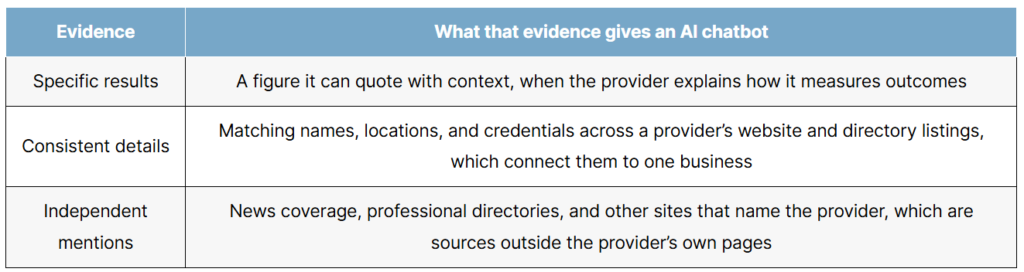
Researchers are still studying how AI chatbots choose which providers to name. Three kinds of evidence come up repeatedly:
| Evidence | What that evidence gives an AI chatbot |
| Specific results | A figure it can quote with context, when the provider explains how it measures outcomes |
| Consistent details | Matching names, locations, and credentials across a provider’s website and directory listings, which connect them to one business |
| Independent mentions | News coverage, professional directories, and other sites that name the provider, which are sources outside the provider’s own pages |
Private Prep’s site shows how a service business can supply this evidence. Its reviews page and score disclosures supply two of these kinds of evidence, specific results and independent mentions, in four ways:
- Reviews for each service: The reviews page groups results by college test prep, secondary school test prep, subject tutoring, and college admissions. A family finds evidence for the service it is considering.
- Results with a starting point: Test prep reviews list the diagnostic score next to the official score, such as an SAT score that rose from 1240 to 1450. A family sees the size of the change in actual points.
- Attributed reviews: Several reviews name the reviewer, the city, and the month of the Google review. The page also lists the Google, Yelp, and Facebook profiles the reviews come from, which places the evidence on independent sites an AI chatbot can find.
- Stated limits: The site says individual results depend on tutoring hours, student commitment, practice test completion, and test-day circumstances.
A buyer reading the site, or an AI chatbot summarizing it, gets each figure with its starting point, its limits, and its source.
How GEO relates to SEO
GEO builds on the same foundation as SEO: well-written web content and mentions from independent sources. Both help buyers find a provider’s site, and GEO also shapes how AI chatbots describe that provider before a buyer ever visits.
For a service business, this work is how published proof reaches the first description a buyer reads.
What this means for service businesses
When a buyer asks a chatbot about a service-based business, they get a description built from what has been published about that provider. For these businesses, the proof has to be published somewhere a chatbot can find it: specific results with context, consistent details across the provider’s website and directory listings, and mentions on independent sites.
Private Prep shows what that looks like in practice. Providers that publish this evidence give chatbots accurate material to repeat. Providers that don’t leave the description up to whatever else is online.


