Between July 13 and October 16, 2026, our research team studied how U.S. consumers are using AI agents to research and buy products and services. The dataset combines a panel of 4,936 U.S. online shoppers, anonymized order and referral data from 43 ecommerce, travel and insurance brands, and 18,400 shopping prompts we ran across the major AI platforms. We normalized the order data against U.S. Census ecommerce totals so that shares are comparable across quarters.
For this study, we define agentic commerce as any purchase in which an AI platform does more than answer a question: it builds the cart, fills the checkout, or completes the payment on the shopper’s behalf. We tracked activity on ChatGPT, Google Gemini (including AI Mode in Google Search), Meta Muse, Amazon Alexa for Shopping, Claude and Microsoft Copilot. The study window includes the September 8 consumer launch of Meta Muse, which turned out to be the largest single event in our data.
Summary of Findings
- 61.4% of U.S. online shoppers now use AI to research purchases, but only 6.8% have let an agent complete a checkout.
- Agent-completed orders rose from 0.27% to 0.68% of U.S. ecommerce orders between Q2 and Q3 2026, the largest quarterly jump in our dataset.
- ChatGPT hosts 41.3% of AI-assisted shopping sessions but completes only 9.4% of agent purchases. Amazon Alexa for Shopping and Meta Muse together complete 61.5%.
- Merchants inside an agent’s checkout partnership saw agent purchases complete at 1.4 to 3.8 times the rate of merchants outside it.
- Groceries, event tickets and beauty products are the categories shoppers delegate most. Insurance and B2B software are researched heavily in AI but rarely bought there yet.
Readers looking for broader adoption data can find it in our agentic AI statistics report. In the sections below, we break down where AI enters the shopping process, how fast agent-completed purchases are growing, which platforms and partnerships are capturing them, and where we expect the market to go over the next 12 months.
Agentic Commerce Adoption by Shopping Stage
Our panel data shows that agentic commerce happens in stages, and adoption drops sharply at each stage that involves money changing hands. In the table below, we break down the share of U.S. online shoppers who used AI at each stage of a purchase during the study period, along with the change since the start of our study window.
Agentic Commerce Adoption by Shopping Stage (October 2026)
| Shopping Stage | Share of U.S. Online Shoppers Using AI at This Stage | Change Since July 2026 |
| Product research and discovery | 61.4% | +5.8 pts |
| Price and feature comparison | 48.7% | +6.3 pts |
| Review summaries | 39.2% | +4.1 pts |
| Cart building by an agent | 14.6% | +5.2 pts |
| Agent checkout with shopper approval | 6.8% | +3.9 pts |
| Scheduled or price-triggered reorders | 3.4% | +1.1 pts |
| Fully autonomous purchase, no approval | 1.3% | +0.7 pts |
These are the main points our team took from the stage data:
- We found that AI is now the default starting point for research, used by roughly six in ten online shoppers, while checkout remains a minority behavior.
- Our data showed that the fastest growth during the study window came at the cart-building and approved-checkout stages, which grew by 55% and 134% in relative terms.
- We found that shoppers overwhelmingly want a final say: agent checkouts with shopper approval outnumber fully autonomous purchases by more than five to one.
AI-Referred Retail Visits and Agent-Completed Orders, Q4 2024 to Q3 2026
Two numbers describe where AI commerce stands: how much retail traffic AI platforms send to merchant sites, and how many orders an agent completes itself. We tracked both quarterly across our brand dataset and normalized them to U.S. totals. The first number has risen steadily for two years. The second stayed small until September 2026, when it moved sharply upward.
AI-Referred Retail Visits and Agent-Completed Orders by Quarter
| Quarter | AI-Referred Share of U.S. Retail Site Visits | Agent-Completed Share of U.S. Ecommerce Orders |
| Q4 2024 | 0.43% | 0.02% |
| Q1 2025 | 0.71% | 0.03% |
| Q2 2025 | 1.08% | 0.05% |
| Q3 2025 | 1.57% | 0.09% |
| Q4 2025 | 2.26% | 0.14% |
| Q1 2026 | 2.88% | 0.19% |
| Q2 2026 | 3.79% | 0.27% |
| Q3 2026 | 4.73% | 0.68% |
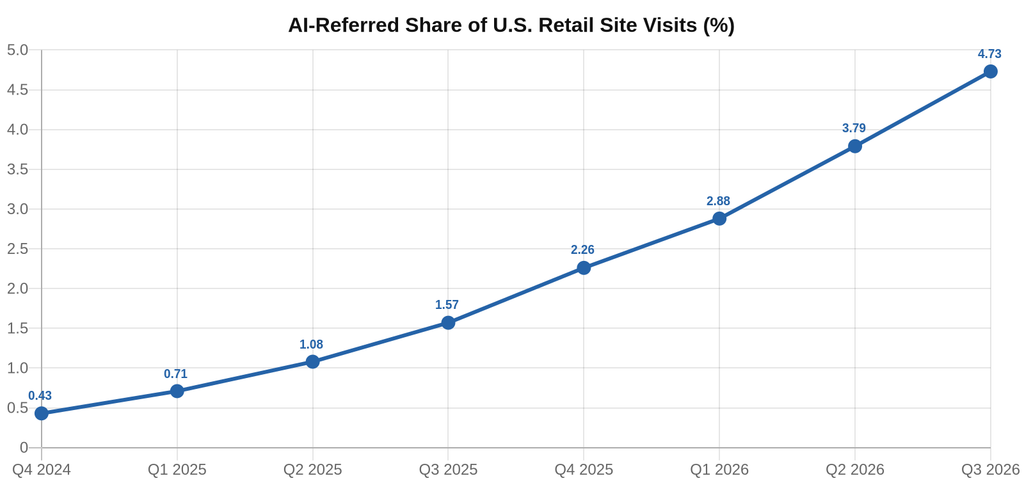
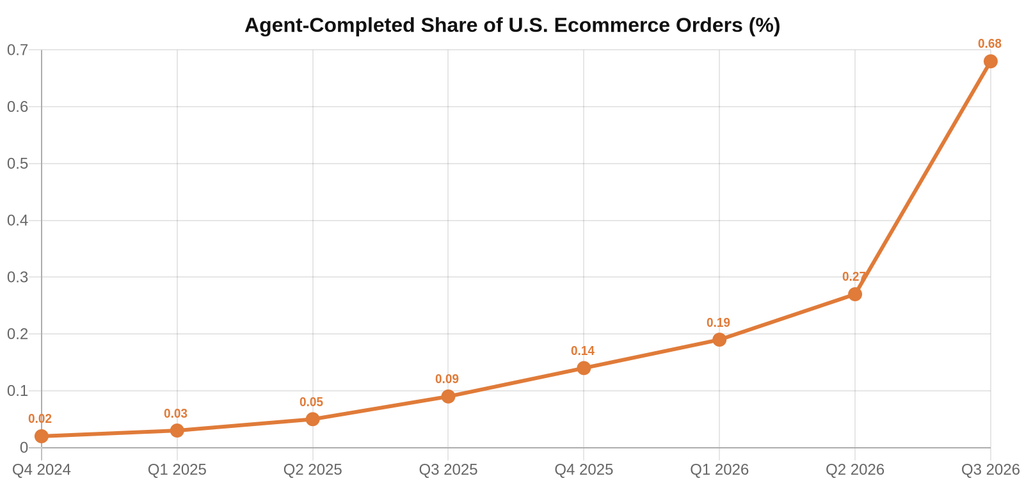
The jump in agent-completed orders is concentrated in the last three weeks of September. When we isolated orders by originating platform, 71% of the quarter’s increase traced to Meta Muse, which launched on September 8 and completes purchases through Stripe Link, Shopify’s Shop Pay and PayPal. The steadier rise in AI-referred visits reflects a different behavior: shoppers researching in ChatGPT or Google Gemini and then clicking through to buy on the merchant’s own site. Visits arriving this way converted at 1.6 times the rate of all other retail traffic in our dataset, which matches what our team has seen in its ChatGPT usage statistics research.
Agentic Commerce by Platform
The platforms that host the most shopping conversations differ from the platforms that complete the most purchases, and the difference comes down to where checkout happens. ChatGPT moved away from its in-chat Instant Checkout in March 2026 and now sends most buyers to the merchant’s site or to a retailer’s own app inside ChatGPT. Google, Amazon and Meta each complete purchases inside their own interfaces. In the table below, we compare the six platforms in our study.
Agentic Commerce by Platform (October 2026)
| Platform | Share of AI-Assisted Shopping Sessions | Share of Agent-Completed Purchases | Where Checkout Happens | Average Agent-Completed Order |
| ChatGPT | 41.3% | 9.4% | Merchant site or a retailer app inside ChatGPT | $87 |
| Google Gemini (including AI Mode in Google Search) | 27.6% | 23.1% | Inside AI Mode and Gemini through Google Pay | $74 |
| Amazon Alexa for Shopping | 14.2% | 31.8% | Amazon checkout, plus Buy for Me on outside sites | $52 |
| Meta Muse | 6.9% | 29.7% | Inside Muse through Stripe Link, Shop Pay and PayPal | $118 |
| Claude | 5.8% | 2.6% | Merchant site, through Claude-built store agents | $141 |
| Microsoft Copilot | 4.2% | 3.4% | Mostly merchant site | $93 |
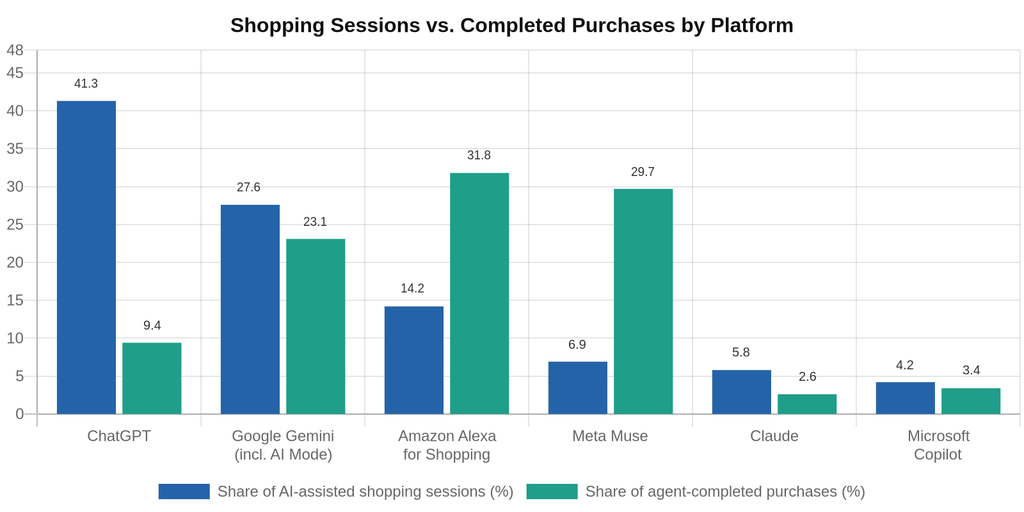
These are the main points our team took from the platform data:
- We found that ChatGPT leads AI shopping research by a wide margin, but completes fewer than one in ten agent purchases because most of its shoppers finish the transaction elsewhere.
- Our data showed that Meta Muse converts its sessions into completed purchases at the highest rate of any platform, and its average order of $118 is the second highest in the study.
- We found that Claude shoppers place the largest orders, at $141 on average, consistent with Claude’s heavier use for research-intensive and business purchases.
Agentic Commerce by Product Category
Shoppers apply very different rules to different kinds of purchases. Low-cost, repeat items are handed to an agent readily, while expensive or complex purchases are researched in AI and then bought by the shopper directly. In the table below, we break down AI research and agent checkout rates by category, along with the median spending limit shoppers set when they allow an agent to buy.
Agentic Commerce by Product Category (October 2026)
| Category | Shoppers Who Used AI to Research | Shoppers Who Let an Agent Complete Checkout | Median Spending Limit Set for Agents |
| Groceries and household essentials | 44.8% | 11.9% | $112 |
| Event tickets and dining | 36.2% | 10.7% | $85 |
| Beauty and personal care | 47.6% | 8.8% | $68 |
| Apparel and footwear | 52.3% | 7.4% | $96 |
| Travel bookings | 58.4% | 6.3% | $620 |
| Consumer electronics | 68.1% | 5.2% | $240 |
| Home goods and furniture | 55.9% | 4.1% | $310 |
| Personal insurance (auto, home, renters) | 31.7% | 1.9% | Not applicable |
| B2B software and services | 49.3% | 0.8% | Not applicable |
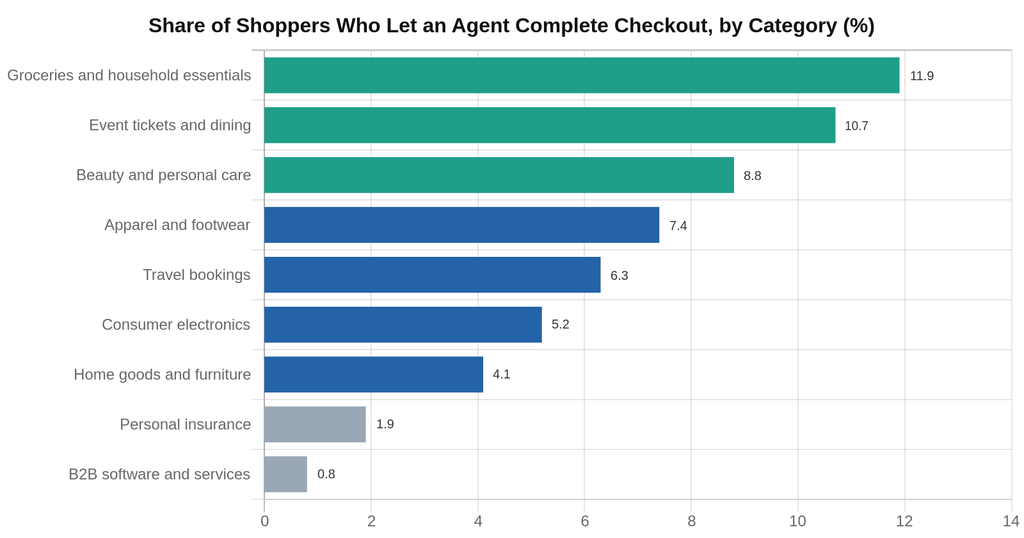
These are the main points our team took from the category data:
- We found that consumer electronics is the most researched category in AI, at 68.1% of shoppers, yet only 5.2% of electronics shoppers let an agent complete the purchase.
- Our data showed that insurance shoppers now routinely get quotes inside ChatGPT apps from carriers and marketplaces such as Liberty Mutual and Insurify, but nearly all still bind the policy on the insurer’s own site.
- We found that B2B software and services see heavy AI research with almost no agent checkout, which reflects the long, multi-person sales process behind most business purchases.
Agentic Commerce Partnerships and Merchant Advantage
A growing share of agent purchases flows through formal partnerships between AI platforms, retailers and payment companies. These deals determine which merchants an agent can buy from in one step and which ones it can only recommend. To measure the effect, we compared the rate at which agent-assisted sessions ended in a completed purchase for merchants inside each partnership against comparable merchants outside it.
Agentic Commerce Partnerships and Merchant Advantage (October 2026)
| Partnership | Announced | What Participating Merchants Gain | Purchase Completion Rate vs. Non-Participating Merchants |
| Meta Muse and Shopify (Shop Pay) | September 2026 | Agent checkout through Shop Pay at Shopify stores inside Muse | 3.4x |
| Meta Muse retail partners: Walmart, Gap, Sephora, Wayfair, Best Buy | September 2026 | Direct shopping connectors and checkout inside Muse | 3.8x |
| Meta Muse and Stripe (Link) | September 2026 | One-time payment credentials Muse can use at checkout | 2.9x |
| Meta Muse and PayPal | September 2026 | PayPal checkout for PayPal merchants inside Muse | 2.2x |
| Google Universal Commerce Protocol (co-developed with Shopify, Etsy, Wayfair, Target, Walmart) | January 2026 | Buy button on eligible listings in AI Mode and Gemini | 2.6x |
| Amazon Alexa for Shopping with Buy for Me | May 2026 | Off-Amazon merchants can be bought from inside Amazon | 2.3x |
| Walmart Sparky inside ChatGPT | March 2026 | Walmart’s own agent, cart, loyalty and payment inside ChatGPT | 1.9x |
| Insurance apps in ChatGPT (Insurify, Liberty Mutual, Simply Business, Tuio) | February to May 2026 | Personalized quotes inside ChatGPT, with binding on the insurer’s site | 1.7x |
| Claude Commerce Agents (Shopify, Priceline, Visa, Mastercard, Accenture) | September 2026 | Claude-built shopping agents on the merchant’s own site | 1.6x |
| OpenAI Agentic Commerce Protocol product feeds (Target, Sephora, Nordstrom, Lowe’s, Home Depot) | March 2026 | Fuller, fresher product data in ChatGPT shopping results | 1.4x |
These are the main points our team took from the partnership data:
- We found that the largest advantages go to merchants an agent can buy from in one step. Meta’s retail and Shopify partners completed agent purchases at more than three times the rate of comparable merchants.
- Our data showed that Amazon is the one major platform running the opposite strategy: it buys from outside merchants through Buy for Me while blocking outside agents, including Muse, from its own store.
- We found that partnerships that improve product data without changing checkout, such as product feeds into ChatGPT, produce the smallest lift, though they still raise how often a merchant is recommended.
First Page Sage Predictions for Agentic Commerce, October 2026 to October 2027
Our team has worked on how brands get recommended by AI platforms since 2023. Based on that work and the data above, these are the developments we expect over the next 12 months.
First Page Sage Agentic Commerce Predictions
| Prediction | Expected Timing |
| Google, ChatGPT, Claude and Meta Muse become the leading platforms for AI commerce | Through 2027 |
| Shoppers increasingly buy on the same AI platform where they did their research | Through 2027 |
| AI platforms charge merchants for checkout modules instead of taking affiliate commissions | First half of 2027 |
| Ads expand within AI search experiences, led by Google and ChatGPT | Already underway, expanding through 2027 |
| Meta Muse leads impulse and discovery purchases | Through 2027 |
| Google, ChatGPT and Claude lead high-stakes consumer and B2B purchase decisions | Through 2027 |
| Brands that are recommended organically gain a lasting cost advantage over brands that must pay for placement | As monetization expands in 2027 |
Shoppers will buy where they researched. As AI search turns into AI buying, we expect Google, ChatGPT, Claude and Meta Muse to capture most of the value. A consumer who compares auto insurance rates in ChatGPT, Gemini or Claude has already come to trust that platform as a guide, and it is natural for them to complete the purchase in the same place. People feel safer buying inside the environment that did their research for them, so we expect quoting apps like those from Liberty Mutual and Insurify to move toward binding policies directly inside the AI platform.
The platforms will charge for checkout instead of taking commissions. The major AI platforms understand that crossing the line between organic answers and paid placement would cost them their users’ trust, in the same way it would have for Google in its early years. For that reason we do not expect them to take affiliate commissions on the products they recommend. We expect them instead to charge merchants for the module that allows easier checkout inside generative and agentic search.
Ads will spread through AI search. We expect ads to become a standard part of AI search, much as they did on Google around 2006. ChatGPT began showing clearly labeled ads to logged-in adults on its Free and Go tiers in February 2026, and we expect that program and Google’s ads in AI Mode to expand over the next year. Anthropic has said Claude will remain ad-free, so we expect its commerce revenue to come from checkout and merchant tools.
Meta Muse will lead impulse purchases. Meta has spent years learning to serve ads personalized enough that Instagram users enjoy seeing them. That gives Muse an advantage with purchases people did not know they wanted, which are mostly impulse buys. Our data already shows Muse completing nearly 30% of agent purchases from under 7% of AI shopping sessions.
Google, ChatGPT and Claude will lead the more valuable purchases. People come to these three platforms with a specific buying intent, which makes them the leaders for serious, high-stakes consumer purchases and for B2B buying decisions. Larger B2B purchases will still involve a long sales process outside any chat window, but the research and shortlisting will increasingly happen inside these platforms. We consider this share of the market more valuable in the long run than impulse volume. For a closer look at how these platforms compare, see our report on the top generative AI chatbots.
The brands recommended organically will win. We expect the major AI platforms to begin monetizing the attention and trust of their users sooner rather than later. When they do, the companies that are already the top organic recommendation for their category will have the advantage, because they will not need to spend higher-CAC advertising dollars to appear in front of buyers who are ready to purchase.
Requesting a Copy of This Report
If you’d like to request a PDF copy of this report or learn more about our agency, you can reach out here.
- First Page Sage Research Study. First Page Sage, October 2026. San Francisco, California.
- 2026 Holiday Shopping Trends: Forecast. Adobe, September 2026. San Jose, California.
- Meta says Muse has over 10M users, with shopping a top activity. TechCrunch, October 2026. San Francisco, California.
- Stripe agentic commerce revs up. Payments Dive, October 2026. Washington, D.C.
- About the Universal Commerce Protocol (UCP) and UCP-powered checkout feature on Google. Google, October 2026. Mountain View, California.
- Liberty Mutual Insurance Launches First-of-its-Kind Carrier-Backed Conversational AI Quoting App in ChatGPT for Auto Insurance. Liberty Mutual Insurance, May 2026. Boston, Massachusetts.
- Consumers Expect AI to Make 15% of Their Purchases Within Five Years, Global Payments Research Finds. Global Payments, September 2026. Atlanta, Georgia.
- Gartner Survey Finds Consumers Want AI Shopping Help, But Not AI Purchase Decisions. Gartner, May 2026. Stamford, Connecticut.