First Page Sage began conducting a continuous study of Google’s algorithm 16 years ago, publishing its results publicly. As the largest SEO & GEO firm in the US, it has a sizable data set on which to base its understanding of the factors that comprise Google’s search algorithm.
The period since our last report has been the most eventful in Google’s recent history: five broad core updates, a steady run of spam updates, the first-ever Discover-only core update, and the arrival of AI Mode as a mainstream search experience. Yet the ranking algorithm underneath the results page moved far less than the results page itself. Below is the Q3 2026 update, along with a description of each factor and a summary of changes from the past year.
The 2026 Google Algorithm Ranking Factors
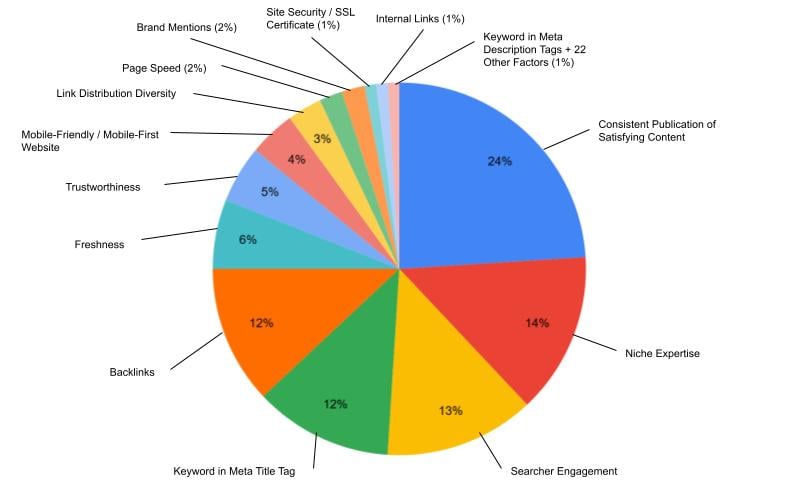
| Factor | Weight |
| Consistent Publication of Satisfying Content | 24% ▲ |
| Niche Expertise | 14% ▲ |
| Searcher Engagement | 13% ▲ |
| Keyword in Meta Title Tag | 12% ▼ |
| Backlinks | 12% ▼ |
| Freshness | 6% |
| Trustworthiness | 5% ▲ |
| Mobile-Friendly / Mobile-First Website | 4% ▼ |
| Link Distribution Diversity | 3% |
| Page Speed | 2% ▼ |
| Brand Mentions | 2% NEW |
| Site Security / SSL Certificate | 1% ▼ |
| Internal Links | 1% |
| Keyword in Meta Description Tags + 22 Other Factors | 1% |
2025 → 2026: Which Factors Moved
Each block represents 0.2 percentage points of algorithm weight. Factors that held steady are not shown.
| Factor | Lost Weight | Gained Weight |
| Brand Mentions NEW | ██████████ ▲ +2 pts | |
| Consistent Publication of Satisfying Content | █████ ▲ +1 pt | |
| Niche Expertise | █████ ▲ +1 pt | |
| Searcher Engagement | █████ ▲ +1 pt | |
| Trustworthiness | █████ ▲ +1 pt | |
| Backlinks | ▼ −1 pt █████ | |
| Mobile-Friendly / Mobile-First Website | ▼ −1 pt █████ | |
| Page Speed | ▼ −1 pt █████ | |
| Site Security / SSL Certificate | ▼ −1 pt █████ | |
| Keyword in Meta Title Tag | ▼ −2 pts ██████████ |
Q3 2026 Updates to Google’s Algorithm
The updates and changes Google made to its algorithm as of Q3 2026 are as follows:
- The #1 factor in Google’s algorithm remains Consistent Publication of Satisfying Content, which rose from 23% to 24%. Google has described every one of its five broad core updates since our last report in nearly identical terms, as a routine update meant to surface relevant, satisfying content from all types of sites, and the ranking movement we tracked across our client base matched that description closely. Across the March and May 2026 core updates, client sites that published on a consistent weekly cadence gained an average of 3.8 positions on their hub keywords, while sites that published less than once per month lost an average of 2.7 positions. As Google’s AI has become better at judging whether a page fully resolves a search, publishing volume without satisfaction has become a liability rather than a neutral act.
- Niche Expertise rose from 13% to 14%. The driver, in our view, is the way Google’s AI Mode retrieves information: it breaks a single question into many related sub-searches, a technique Google calls query fan-out, and pulls the best page for each. A website with a dedicated page for every permutation of its subject (each industry, use case, customer type, and specialty) is retrieved again and again across those sub-searches, and we have seen the same sites strengthen their standing as niche experts in traditional rankings. Organizing content around hubs is more valuable in 2026 than at any point since Google introduced this factor.
- Searcher Engagement increased for the fourth consecutive year, from 12% to 13%. AI Overviews and AI Mode now absorb a large share of simple informational searches, so the clicks that still reach websites come from searchers with deeper, more deliberate intent. Google’s engagement signals are therefore measuring a smaller and more discerning pool of visitors, and a page that fails to hold them is exposed faster than ever. Last year we noted the phrase “average is the new bad.” In 2026, average content is simply invisible.
- Keyword in Meta Title Tag dropped two points (14% → 12%), the largest decline in this year’s report. In May 2026, Google launched the biggest redesign of its search box in 25 years, built to invite longer, conversational queries rather than strings of keywords. As queries become full sentences, Google leans more heavily on its understanding of what a page is about and less on an exact keyword match in the title. Regardless of its weight in the algorithm, this factor remains a prerequisite to ranking in the first place.
- Backlinks slipped from 13% to 12%, extending a decline that began eight years ago. Links remain a meaningful signal of trust, but Google’s AI no longer needs other websites to vouch for content it can evaluate on its own. The links that still move rankings are editorial links earned by original data and genuinely useful resources; manufactured links have been a primary target of Google’s recent spam updates.
- Trustworthiness rose from 4% to 5%. Google has released four confirmed spam updates since August 2025, including a March 2026 update that finished rolling out in less than a day, and it continues to enforce its site reputation abuse policy against third-party content hosted on otherwise-trusted domains. With AI-generated content now effectively free to produce, Google is placing more weight on signals that a page is accurate, clearly authored, and supported by credible sources.
- Brand Mentions is new to our list this year, rising out of the “Other” category to make up 2% of the algorithm. Google’s systems increasingly understand companies as entities with reputations rather than as collections of pages, and mentions of a brand across authoritative publications, linked or not, now help establish it as a genuine authority in its field. The same third-party coverage that teaches generative AI platforms which brands to recommend is now strengthening those brands in Google Search as well. (See below for a description of this factor.)
- Mobile-Friendliness (5% → 4%), Page Speed (3% → 2%), and Site Security (2% → 1%) each declined by one point. None of these has become less important in absolute terms; compliance is now close to universal, so they separate competitors less often than they once did. All three remain threshold factors, and sites that fall short are still penalized disproportionately.
- Freshness (6%), Link Distribution Diversity (3%), and Internal Links (1%) held steady. Freshness in particular remains one of the most cost-effective levers available to marketers: pages our team updated at least once in the past year continued to outrank comparable pages that had gone untouched.
- Schema Markup / Structured Data, Keyword in Header Tags, and Keyword in URL remain in the group of 22 factors that make up only 1% of the algorithm all together. Despite a wave of advice claiming that structured data is the key to appearing in Google’s AI answers, we have not seen it move rankings in any measurable way.
Grouping the factors into four families makes the direction of the algorithm easier to see:
How the Algorithm Weight Has Changed: 2025 vs. 2026
| Factor Family | Year | Share of Algorithm | Change |
| ■ Content Quality & Relevance Satisfying Content, Niche Expertise, Searcher Engagement, Freshness | 2025 | ███████████████████████████ 54% | ▲ +3 |
| 2026 | ████████████████████████████▌ 57% | ||
| ■ Authority & Trust Backlinks, Link Distribution Diversity, Trustworthiness, Brand Mentions, Internal Links | 2025 | ██████████▌21% | ▲ +2 |
| 2026 | ███████████▌23% | ||
| ■ On-Page Keyword & Markup Signals Keyword in Meta Title Tag, Meta Description + 22 Other Factors | 2025 | ███████▌15% | ▼ −2 |
| 2026 | ██████▌ 13% | ||
| ■ Technical Foundations Mobile-First Website, Page Speed, Site Security / SSL | 2025 | █████ 10% | ▼ −3 |
| 2026 | ███▌7% |
The content and authority families now account for 80% of Google’s algorithm, up from 75% a year ago. The factors that gave up ground are the ones nearly every competitor has already addressed, which is exactly why they no longer decide who ranks first.
When reading this report, note that certain factors such as Keyword in Meta Titles remain prerequisites for ranking. Optimizing your site for these factors will only improve your rankings commensurate with the factor’s algorithm weight; however, Google will disproportionately penalize your site for falling below a minimum threshold. These factors are: Keyword in Meta Titles, Searcher Engagement, Trustworthiness, Mobile-Friendliness, and Page Speed.
- NOTE: In last year’s report, we wrote that AI Overviews had little impact on Google’s search algorithm. That remains true of the ranking algorithm itself, but the results page around it has changed dramatically. At its May 2026 I/O conference, Google announced that AI Mode had passed one billion monthly users, made Gemini 3.5 Flash its default model, and merged AI Overviews and AI Mode into a single continuous experience in which a searcher can move from a summary into a conversation without leaving the page. Because Google’s AI answers draw on the same ranking systems described in this report, ranking well remains the price of admission; being recommended within those answers, however, is a separate discipline, which we cover in our GEO strategy guide. Google also began reporting AI Overview and AI Mode impressions in Search Console in June 2026, rolling the report out to all sites worldwide on August 31. It shows impressions only, not clicks, so it tells marketers where they appear but not what those appearances are worth. For more, see our report on generative AI chatbot market share.
Confirmed Google Search Updates Since Our Last Report
| When | Update | Type |
| Mar 2025 | March 2025 core update | Core |
| May 2025 | AI Mode opens to all US searchers | AI Search |
| Jun–Jul 2025 | June 2025 core update | Core |
| Aug 2025 | August 2025 spam update | Spam |
| Dec 2025 | December 2025 core update (18-day rollout) | Core |
| Feb 2026 | First-ever Discover-only core update | Discover |
| Mar 2026 | March 2026 spam update (completed in under a day) | Spam |
| Mar–Apr 2026 | March 2026 core update | Core |
| May 2026 | Google I/O: Gemini 3.5 Flash powers AI Mode; AI Overviews and AI Mode merge; search box redesigned | AI Search |
| May–Jun 2026 | May 2026 core update | Core |
| Jun 2026 | June 2026 spam update; Search Console begins reporting AI Overview and AI Mode impressions | Spam / Reporting |
| Aug 2026 | August 2026 spam update; AI impression reporting reaches all sites worldwide | Spam / Reporting |
The 2026 Google Algorithm Ranking Factors, Explained
Consistent Publication of Satisfying Content
It’s been eight years since satisfying content surpassed backlinks as the top factor in Google’s search algorithm. Google tests newly-published content to see if it responds well to the search intent of the keyword. If the searchers’ behavior indicates that they’re getting their intent satisfied through the page’s content, it is promoted. Each of Google’s broad core updates re-scores its entire index against this standard, and sites with a steady stream of pages that fully resolve their searches rise with each re-scoring. Google’s algorithm also considers the type of search, such as Yes/No, Comparison, or Short Fact, and adjusts its definition of satisfying content accordingly, a detail that surfaced in a December 2024 data exploit. As a general rule, Google’s AI prizes high quality content produced at least twice per week.
Niche Expertise
In mid-2017, Google began favoring websites that it perceives as niche experts. In this context, being a niche expert means having a cluster of 10+ authoritative pages revolving around the same “hub” keyword. For example, the keyword “crm software” could be the hub keyword for a CRM company that has industry landing pages targeting “crm software for small business,” “crm software for real estate,” and “crm software for manufacturing”; and FAQ landing pages targeting “crm software pricing,” “crm software advantages,” and “best crm software 2026.” The consistency of the hub keyword across the pages of the website creates a kind of magnetism: the site attracts traffic from any Google search containing the hub keyword.
In 2026, this factor carries additional weight because of how AI Mode gathers information. When a searcher asks a complex question, Google splits it into many narrower sub-searches and retrieves the best page for each. A CRM company with a page for every industry, company size, and use case is the natural answer to many of those sub-searches at once, while a competitor with a single generic page is the answer to almost none of them.
Searcher Engagement
One of the biggest changes to Google’s algorithm over the last decade is the increased importance of Searcher Engagement, which was integrated into the ranking algorithm in 2016. Google used to be wary of giving weight to an on-site factor that could be easily manipulated by site owners. But Google’s increasingly-sophisticated technology, borrowed from the click fraud detection side of its advertising business, has made searcher engagement a sizable part of its algorithm.
Searcher engagement is related to the #1 overall factor, Consistent Publication of Satisfying Content. Engagement, which combines bounce rate, time on page, and pages per session, is a good indicator of the content’s quality. Keep in mind, however, that searches have different intents behind them, some of which indicate that the searcher wants to quickly look up a piece of information; more is not always better. In 2022, Google reconfirmed its commitment to Searcher Engagement with its Helpfulness algorithm update.
In 2026, the searchers who click through to websites are, on the whole, more serious than ever, since Google’s AI answers now handle many of the quick lookups. That makes every visit a clearer test of a page’s quality, and it is why this factor has now risen four years in a row.
Keyword in Meta Title Tag
Inserting the keywords your page is targeting into its meta title tag has been essential to ranking since the late 1990s. While this fact is obvious to any experienced SEO marketer, keyword strategy is a rigorous intellectual task that can easily take 20-30 minutes per page. It’s also worth noting that the placement and concentration of keywords within a title tag are important. Ideally, your title tag would contain only your targeted keyword; but in reality, adding articles and adjectives around it are important for readability.
As Google’s redesigned search box pushes searchers toward longer, conversational questions, an exact keyword match in the title matters somewhat less than it did. A clear title that names the page’s subject in the words your buyers use remains non-negotiable.
Backlinks
Backlinks were the original foundation of Google’s algorithm, as laid out in the research paper that founded Google. However, in 2018, they began to lose ground to Consistent Publication of Satisfying Content, and in 2026 they sit tied with Keyword in Meta Title Tag at 12%. While backlinks are still a major factor in Google’s decision of where to rank a website in its search results, content quality should be your primary focus, as it attracts links organically while simultaneously being the most important ranking factor in and of itself. Original data is the most reliable link magnet we have found: a well-researched statistics report continues to earn editorial links for years after publication.
Freshness
Content recency has always been a minor factor in Google’s algorithm, but was only prioritized for news-focused articles until Q2 2023. At that time, our team observed that even articles targeting transactional keywords (e.g. “top software development firms”) ranked higher when they had a newer date of publication. We quickly saw this change across all our client industries, on all keywords except the most research-oriented (e.g. “what is photosynthesis?”). That pattern held through 2026. For more on freshness-centric SEO, see our article on the Corpus of Content strategy.
Trustworthiness
In the past four years, Google increased its scrutiny of content to ensure users aren’t encountering misinformation or disinformation. Examples of its efforts include its Your Money, Your Life standards, its joint patent with IBM on detecting factual information in a document, and, more recently, a rapid series of spam updates and its site reputation abuse policy. To optimize for this factor, ensure that your content is free of provably false claims, clearly attributed to a real author with relevant experience, and supported by citations from academic, government, or other trustworthy sources.
Mobile-Friendly / Mobile-First Website
If you want to reach visitors in 2026, your site needs to be easy to navigate on mobile phones and tablets. The standard used to be “mobile friendliness,” but Google has shifted to a mobile-first world, meaning it expects mobile visitors to be the primary target of your web design. Ideally, a desktop version of your website shouldn’t even exist. The site should look exactly the same on mobile and desktop: the layout should be fairly simple and the site navigation optimized for a mobile user experience. This factor declined in weight only because nearly every serious website now meets the standard.
Link Distribution Diversity
When not just one or two, but multiple pages on a website have backlinks pointing to them, it signals to Google that the site is providing a more well-rounded educational experience for its audience. Sites with a wide distribution of pages with inbound links have a greater ability to rank. This factor has existed for 10+ years, but was highlighted in the May 2024 Google API data leak as more important than previously believed.
Page Speed
Google has always tried to prioritize user experience above all else, hence its investment in thousands of datacenters around the world so that it can serve search results in milliseconds. Your site should take a page from Google’s book and focus on site speed. You want pages to load as quickly as possible and respond immediately when a visitor taps or clicks. With each additional second it takes for your site to load, ranking ability is lost. You can test your page speed, including Google’s Core Web Vitals measurements, on its free PageSpeed Insights tool.
Brand Mentions
When authoritative publications, industry analysts, and trade media discuss a company, whether or not they link to it, Google records that the brand exists, what it is known for, and how it is regarded. For years this signal sat among the minor factors on our list. In 2026, it has become meaningful enough to track on its own, as Google’s systems have shifted toward understanding companies as entities with reputations rather than as collections of pages. The most effective way to earn brand mentions is to give the press something worth repeating: original data, a clear point of view, and a consistent statement of what your company does best. That same body of coverage is what leads generative AI platforms to recommend a brand.
Site Security / SSL Certificate
As the web has become more central in our lives, hackers have become more sophisticated. Google’s nightmare would be serving up sites that are harmful to its searchers. At the end of 2017, Google began flagging sites as unsafe when they lack or have improperly configured SSL certificates (indicated by the “s” at the end of “https”), and diminishing their ranking ability accordingly. An SSL certificate is usually free and can be obtained quite easily through your hosting provider or domain registrar.
Internal Links
Google put much greater emphasis on this factor, which is often discussed alongside hubs, in 2017. The greater the concentration of pages with the same keyword in their title tags, the higher the site will rank for that keyword, as long as there are internal links connecting them. Publishing 25 articles on different aspects of a subject and linking all of them back to one authoritative page would be a powerful expression of that page’s value, and would confer higher ranking ability onto that page.
Keyword in Meta Description Tags + 22 Other Factors
There are 22 other factors that our team has found to make some difference in a website and/or page’s ability to rank, for example: schema markup / structured data, placing the target keyword in the meta description and header tags, keyword in URL, and anchor text keyword density. Although a website that is battling a competitor to move from the #2 spot to the #1 should be looking at every opportunity to improve, the majority of marketers don’t need to think too hard about them.
Conclusion
In 2026, Google’s search results page looks more different than at any point in its history, yet the algorithm underneath it continues to move in the direction it has been moving for a decade: toward rewarding websites that consistently publish the most satisfying answer to each search, within a subject they genuinely own. The factors that gained weight this year (satisfying content, niche expertise, engagement, trustworthiness, and brand mentions) are all expressions of that idea, while the factors that declined are ones nearly every competitor has already addressed. What this means for marketers is that you must have proper strategy guiding your SEO efforts, with each page targeting a different keyword that a prospect for your business would search, and a page for every permutation of what you offer. Each page should be the best treatment of the subject you can possibly deliver. From there, links, engagement, trustworthiness, and visibility within Google’s AI answers should organically accrue in your favor.