Between March 2023 and June 2026, our research team tracked marketing spend and patient volume at 74 plastic surgery and aesthetic practices across the United States, ranging from solo surgical practices to multi-location groups. We set out to answer a question that most practice owners can estimate but few can document: what does it cost to put one new patient on the surgical calendar?
Patient acquisition cost, as we define it in this report, is the total marketing spend attributable to a channel divided by the number of new patients that channel produced who went on to complete a paid procedure. It includes agency fees, media spend, and creative production. It excludes clinical staff time and the cost of consultations that did not convert. Every figure was normalized to a trailing twelve month window, which matters in this specialty because procedure demand swings hard by season and an unnormalized channel comparison will reward whichever campaign happened to run in the fall. Our methodology follows the same framework we used in our earlier report on plastic surgery lead generation statistics, with a larger panel and three additional years of data.
The reason the number is worth measuring this carefully is that plastic surgery occupies an unusual economic position. Procedure revenue is high enough to absorb an acquisition cost that would close a primary care practice, and competition for the same narrow set of commercial keywords is intense enough to push that cost up every year. In the sections below, we break down what our panel paid by channel, by year, by procedure, by market, and against the lifetime value each type of patient eventually returned.
Plastic Surgery Patient Acquisition Cost by Marketing Channel
Channel selection is the single largest controllable determinant of what a practice pays for a new patient. In the table below, we break down cost per lead, cost per completed consultation, and full patient acquisition cost across the ten channels our panel used most.
The Plastic Surgery Patient Acquisition Cost by Marketing Channel, 2026
| Marketing Channel | Cost per Lead | Cost per Consultation | Patient Acquisition Cost |
| Personal Referral | $46 | $107 | $228 |
| Generative Engine Optimization | $139 | $358 | $761 |
| Organic Search (SEO) | $164 | $431 | $874 |
| Organic Social | $183 | $524 | $1,146 |
| Paid Social (Meta) | $221 | $698 | $1,503 |
| Direct Mail | $338 | $892 | $1,694 |
| Local Directories | $247 | $812 | $1,781 |
| Paid Search (Google Ads) | $379 | $1,003 | $1,824 |
| Influencer Partnerships | $289 | $934 | $1,997 |
| Radio and Outdoor | $421 | $1,158 | $2,142 |
Sorting the panel this way, three things stood out to our researchers:
- We found that generative engine optimization returned the lowest acquisition cost of any scalable channel at $761, roughly 13% below organic search, which reflects how few practices are currently competing for placement inside AI-generated answers.
- Our data showed paid search leads reaching a completed consultation at a materially lower rate than organic leads, which is how a $379 cost per lead compounds into a $1,824 acquisition cost by the time the patient books.
- We observed that personal referrals remain the least expensive patients a practice will ever acquire at $228, though the channel is effectively fixed in volume and does not respond to additional budget.
Across the full panel, the median blended acquisition cost was $1,512. Practices that had invested in search engine optimization for plastic surgery for three years or longer came in below that median by an average of $347.
Plastic Surgery Patient Acquisition Cost, 2020 to 2026
The costs above are not stable, and the direction of travel is the more useful finding for anyone setting a budget. We hold seven years of channel-level spend data for the 31 practices that have been in our panel since 2020, which lets us trace acquisition cost from the pandemic-era surge in cosmetic demand through to the present. The table below shows the annual series, and the graph beneath it plots the same figures.
The Plastic Surgery Patient Acquisition Cost by Year, 2020 to 2026
| Year | Organic Search (SEO) | Paid Search (PPC) | Paid Social | Blended Average |
| 2020 | $531 | $997 | $679 | $771 |
| 2021 | $589 | $1,063 | $763 | $816 |
| 2022 | $627 | $1,257 | $831 | $947 |
| 2023 | $697 | $1,354 | $978 | $1,021 |
| 2024 | $748 | $1,559 | $1,082 | $1,183 |
| 2025 | $816 | $1,686 | $1,324 | $1,336 |
| 2026 | $874 | $1,824 | $1,503 | $1,512 |
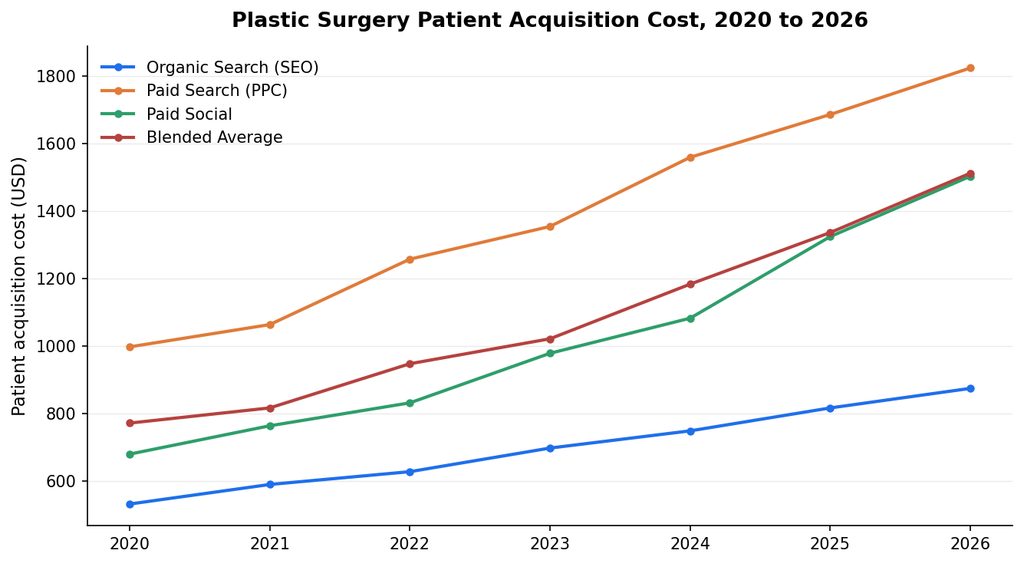
Reading the series end to end, our team drew three conclusions:
- We found that blended acquisition cost rose 96.1% between 2020 and 2026, an annualized increase of roughly 11.9%, well ahead of the rate at which average procedure pricing moved over the same period.
- Our data showed paid social climbing fastest of the three channels at 121.4%, as aesthetic advertisers, med spas, and device manufacturers competed for the same Meta inventory.
- We observed that organic search inflated more slowly than paid search, 64.6% against 82.9%, widening the gap between the two channels from $466 per patient in 2020 to $950 in 2026.
Patient Acquisition Cost by Procedure
In the table below, we break acquisition cost down by procedure and set it against average case revenue, which includes surgeon fee, facility, and anesthesia rather than the surgeon fee alone.
Patient Acquisition Cost by Procedure, 2026
| Procedure | Cost per Lead | Patient Acquisition Cost | Average Case Revenue | Acquisition Cost as a Share of Revenue |
| Mommy Makeover | $322 | $2,347 | $24,800 | 9.5% |
| Facelift | $301 | $2,108 | $21,400 | 9.9% |
| Rhinoplasty | $233 | $1,758 | $13,900 | 12.6% |
| Breast Augmentation | $203 | $1,566 | $11,600 | 13.5% |
| Tummy Tuck | $197 | $1,463 | $14,700 | 10.0% |
| Breast Lift | $189 | $1,404 | $11,200 | 12.5% |
| Liposuction | $182 | $1,377 | $9,800 | 14.1% |
| Gynecomastia Surgery | $174 | $1,269 | $9,300 | 13.6% |
| Eyelid Surgery | $161 | $1,184 | $8,100 | 14.6% |
| Non-Surgical Body Contouring | $99 | $549 | $2,900 | 18.9% |
| Laser Skin Resurfacing | $87 | $476 | $2,350 | 20.3% |
| Neurotoxins and Fillers | $54 | $302 | $890 | 33.9% |
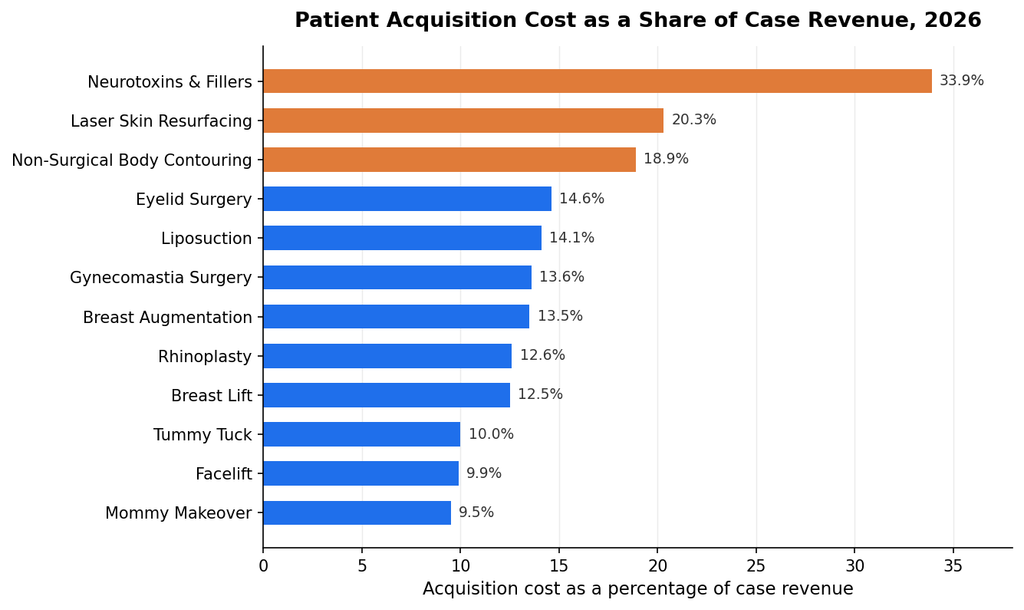
Plotting the final column in a bar graph makes the pattern easier to see, since the procedures that look cheapest to market are the ones giving up the largest share of their revenue to do it.
Here is what our analysts took from the procedure-level breakdown:
- We found that acquisition cost tracks procedure price closely within the surgical categories, with mommy makeover and facelift patients costing the most to acquire and returning the most revenue per case.
- Our data showed non-surgical treatments surrendering the largest share of revenue to acquisition, between 18.9% and 33.9%, which means they clear their cost only if the patient returns.
- We observed that eyelid surgery produced the least expensive surgical patient in the panel at $1,184, a function of thinner keyword competition rather than weaker demand.
Patient Acquisition Cost by Market Tier
Geography changes PAC as much as procedure mix does. In the table below, we group the panel into four market tiers and report what practices in each tier paid, alongside the density of competing practices that helps explain the spread.
The Patient Acquisition Cost by Market Tier, 2026
| Market Tier | Average Cost per Click | Cost per Lead | Patient Acquisition Cost | Competing Practices per 100,000 Residents |
| Tier 1: Top 10 Metros | $38.60 | $548 | $2,657 | 6.8 |
| Tier 2: Metros 11 to 40 | $26.10 | $399 | $1,948 | 4.9 |
| Tier 3: Markets of 250,000 to 1 Million | $17.40 | $264 | $1,316 | 3.2 |
| Tier 4: Markets Under 250,000 | $11.20 | $182 | $939 | 1.7 |
The tier comparison produced three findings worth carrying into a budget conversation:
- We found Tier 1 acquisition cost running 2.8 times Tier 4, a spread considerably wider than the difference in average procedure pricing between those same markets.
- Our data showed competitive density accounting for most of the variance, with each additional practice per 100,000 residents associated with roughly $335 of added acquisition cost.
- We observed that Tier 1 practices recovered part of the gap through higher procedure pricing and a higher rate of multi-procedure bookings, though not the whole of it.
For context on how these figures compare outside of aesthetics, our companion report on average patient acquisition cost across medical specialties covers nineteen practice types on the same methodology.
Patient Acquisition Cost Against Patient Lifetime Value
Acquisition cost only means something next to what the patient is worth. In the table below, we segment the panel by the pathway a patient took into the practice and compare what each type cost to acquire against the revenue they produced over the following five years.
The Patient Acquisition Cost Against Patient Lifetime Value, 2026
| Patient Type | Patient Acquisition Cost | Five-Year Patient Value | Ratio of Value to Cost | Average Visits Over Five Years |
| Referred Patient | $223 | $15,600 | 70.0 to 1 | 2.1 |
| Injectable Patient Who Converts to Surgery | $445 | $21,300 | 47.9 to 1 | 9.4 |
| Injectable-Only Patient | $302 | $6,100 | 20.2 to 1 | 8.1 |
| Multi-Procedure Surgical Patient | $2,347 | $33,700 | 14.4 to 1 | 2.8 |
| Laser and Skin Care Patient | $476 | $5,200 | 10.9 to 1 | 5.2 |
| Single-Procedure Surgical Patient | $1,644 | $13,900 | 8.5 to 1 | 1.3 |
Three observations from our analysts on the lifetime value segmentation:
- We found the injectable-first pathway to be the least expensive route to a surgical patient, acquiring them at $445 against $1,644 for a patient who arrives searching for surgery directly.
- Our data showed single-procedure surgical patients returning the weakest ratio in the panel at 8.5 to 1, because roughly seven in ten of them never book a second appointment.
- We observed that practices measuring return on the first procedure alone understate injectable marketing by close to seven times, since the average injectable patient came back eight times over the five-year window.
Practices weighing whether to build this capability internally or hire it out may find our review of the top plastic surgery marketing agencies a useful starting point.
Requesting a Copy of This Report
If you would like a PDF copy of this report, or you would like to learn more about our agency and how we work with plastic surgery practices, you can reach out to us here.