From September 8 to October 25, 2026, our research team studied Muse usage across the United States and Canada, the two markets where it was available during that period. We combined aggregated app-intelligence data with activity logs from a panel of 4,180 Muse users who opted into our research, then weighted the panel to match the age and regional mix of the full user base.
Meta launched Muse, its personal AI agent, on September 8, 2026. Muse connects to a user’s email, calendar, bank and shopping accounts, then carries out tasks such as sending messages, booking reservations and completing purchases once the user approves them. Because Muse acts on a person’s behalf, the usual chatbot measures of prompts and sessions tell only part of the story, so our study also tracked what users hand off to it and how often they return. For broader context on this category, see our agentic AI statistics.
In the sections below, we break down Muse’s overall usage, its weekly growth, the activities people use it for, its users by age group, and how its retention compares with other AI assistants.
Summary of Findings
- Meta Muse reached 11.2 million accounts in the U.S. and Canada by October 25, 2026, seven weeks after launch.
- An average of 2.74 million people used Muse each day in the final week of the study, a daily-use rate of 24.5%.
- Shopping and product research made up 24.6% of all tasks users gave Muse, the largest share of any activity.
- Users aged 45 and older made up 52.2% of Muse’s user base.
- Muse kept 28.6% of new users after seven days, ahead of ChatGPT at 24.2%, though ChatGPT pulled ahead by day 30.
Meta Muse Usage at a Glance
In the table below, we break down the core usage metrics our team recorded for Muse during its first seven weeks on the market.
Meta Muse Usage Statistics (September-October 2026)
| Metric | Value |
| Accounts set up in the U.S. and Canada (as of October 25) | 11.2 million |
| Average daily active users (week ending October 25) | 2.74 million |
| Average weekly active users (week ending October 25) | 4.96 million |
| Daily-use rate (daily active users as a share of accounts) | 24.5% |
| Weekly active users who opened Muse daily | 55.2% |
| Day 1 retention | 71.8% |
| Day 30 retention | 16.4% |
| Average sessions per daily active user | 3.4 |
| Average time spent per daily active user each day | 14.7 minutes |
| Sessions started from a suggestion by Muse | 27.4% |
| Weekly active users with at least one connected account | 58.3% |
| Weekly active users who completed a purchase through Muse | 22.8% |
| Average order value of purchases made through Muse | $174 |
| Accounts on a paid plan (Power or Maximum) | 3.1% |
| Users aged 45 and older | 52.2% |
Our team took three findings from this data:
- We found that roughly one in four people who set up Muse used it on any given day, and 55.2% of weekly active users opened it every day of the week.
- Our data showed that 27.4% of Muse sessions began with a suggestion from Muse itself, which is a higher share of assistant-initiated activity than we have recorded for any chat-based AI tool.
- We found that 58.3% of weekly active users had connected at least one outside account, such as email or a calendar, which is the step that lets Muse act on a user’s behalf.
Meta Muse Weekly Growth, September 8 to October 25, 2026
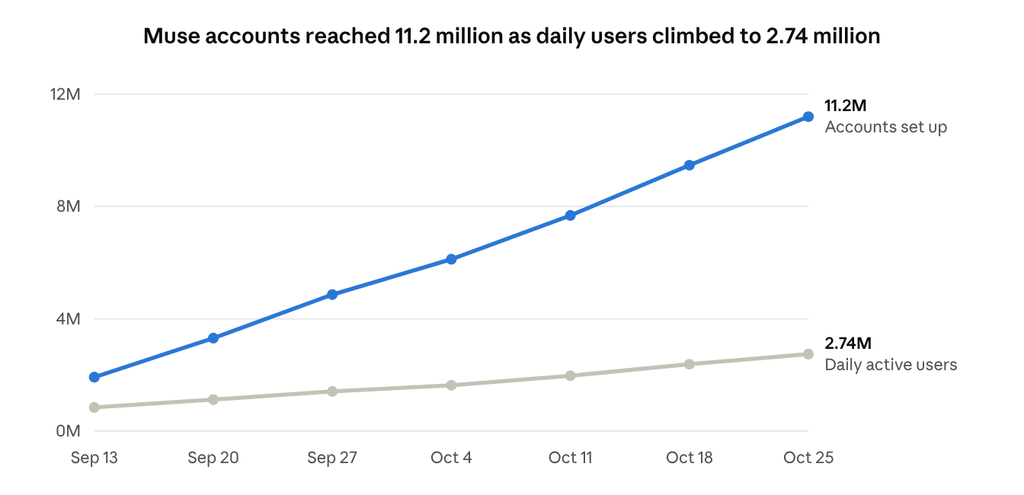
In the table below, we track Muse’s cumulative accounts and average daily active users for each week of the study, with weeks ending on Sunday. The first week covers September 8 to 13.
Meta Muse Weekly Growth (September-October 2026)
| Week Ending | New Accounts | Cumulative Accounts | Average Daily Active Users | Daily-Use Rate |
| September 13 | 1.92 million | 1.92 million | 0.84 million | 43.8% |
| September 20 | 1.39 million | 3.31 million | 1.12 million | 33.8% |
| September 27 | 1.55 million | 4.86 million | 1.41 million | 29.0% |
| October 4 | 1.26 million | 6.12 million | 1.63 million | 26.6% |
| October 11 | 1.56 million | 7.68 million | 1.97 million | 25.7% |
| October 18 | 1.79 million | 9.47 million | 2.38 million | 25.1% |
| October 25 | 1.73 million | 11.20 million | 2.74 million | 24.5% |
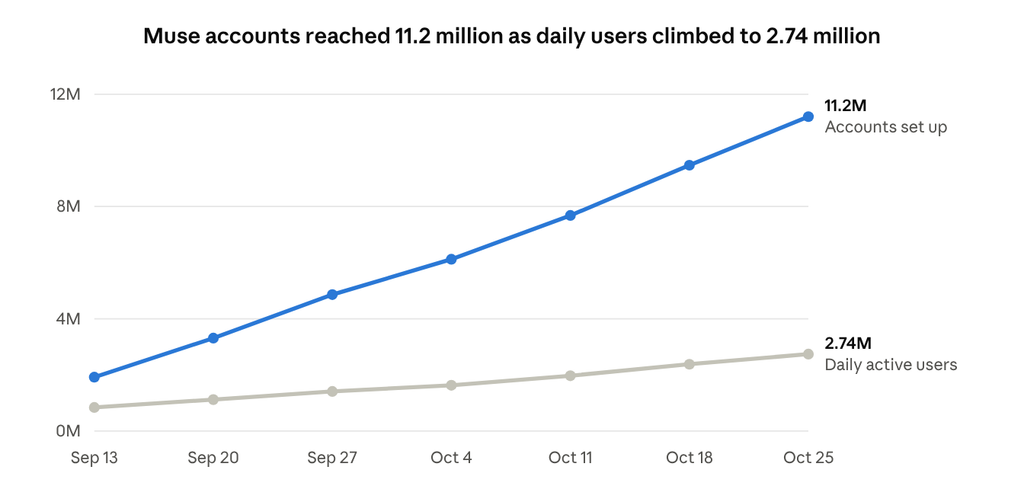
Our researchers drew three conclusions from the weekly data:
- We found that new account growth slowed in early October, then rose again to 1.79 million in the week ending October 18, which lines up with a heavier advertising push for Muse across Meta’s apps.
- Our data showed daily active users more than tripled over the study, from 0.84 million in the first week to 2.74 million in the last.
- We found that the daily-use rate fell from 43.8% in launch week and then held near 25% from early October on, which suggests Muse had settled into a stable base of habitual users.
Meta Muse Usage by Activity
In the table below, we break down what people ask Muse to do. The first column shows the share of weekly active users who used Muse for each activity at least once in a week, and the second shows each activity’s share of all tasks users handed to Muse.
Meta Muse Usage by Activity (September-October 2026)
| Activity | Share of Weekly Active Users | Share of All Tasks |
| Shopping and product research | 47.2% | 24.6% |
| Email and inbox management | 38.9% | 17.3% |
| Calendar and scheduling | 33.5% | 12.1% |
| Writing and messaging help | 29.8% | 11.4% |
| Companionship and conversation | 17.1% | 9.6% |
| Personal finance and budgeting | 21.7% | 7.8% |
| Travel and dining plans | 19.4% | 6.9% |
| Health and fitness tracking | 14.6% | 5.2% |
| Small business tasks | 6.3% | 3.1% |
| Other activities | 8.4% | 2.0% |
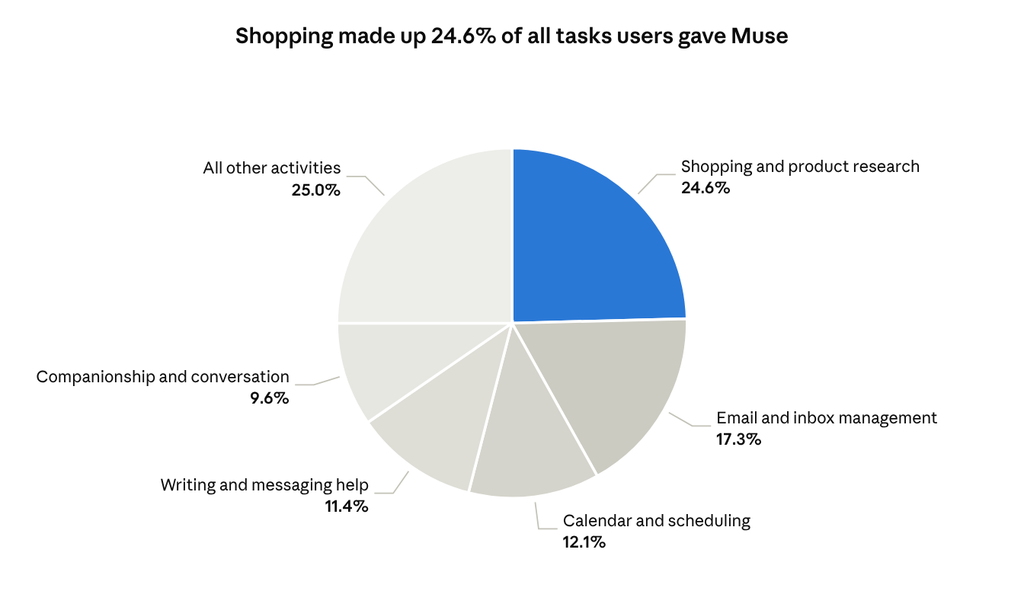
Our team took three findings from the activity data:
- We found that nearly half of weekly active users, 47.2%, used Muse to research or buy a product, which makes shopping the clearest reason people return to it.
- Our data showed that email and calendar work together made up 29.4% of all tasks, so close to a third of Muse’s workload is personal administration.
- We found that companionship and conversation accounted for 9.6% of tasks despite reaching only 17.1% of users, because the users who chat with Muse for company do so many times a week.
Meta Muse Users by Age Group
In the table below, we break down Muse’s user base by age group, along with how often each group uses Muse and what it uses Muse for most. Muse is available only to adults 18 and older.
Meta Muse Users by Age Group (September-October 2026)
| Age Group | Share of Muse Users | Daily-Use Rate | Average Tasks per Active Week | Most Common Activity |
| 18-24 | 8.9% | 19.8% | 9.2 | Writing and messaging help |
| 25-34 | 17.6% | 22.4% | 12.7 | Shopping and product research |
| 35-44 | 21.3% | 24.1% | 14.9 | Email and inbox management |
| 45-54 | 22.8% | 25.9% | 15.6 | Shopping and product research |
| 55-64 | 17.2% | 26.1% | 14.1 | Shopping and product research |
| 65 and older | 12.2% | 26.4% | 12.8 | Companionship and conversation |
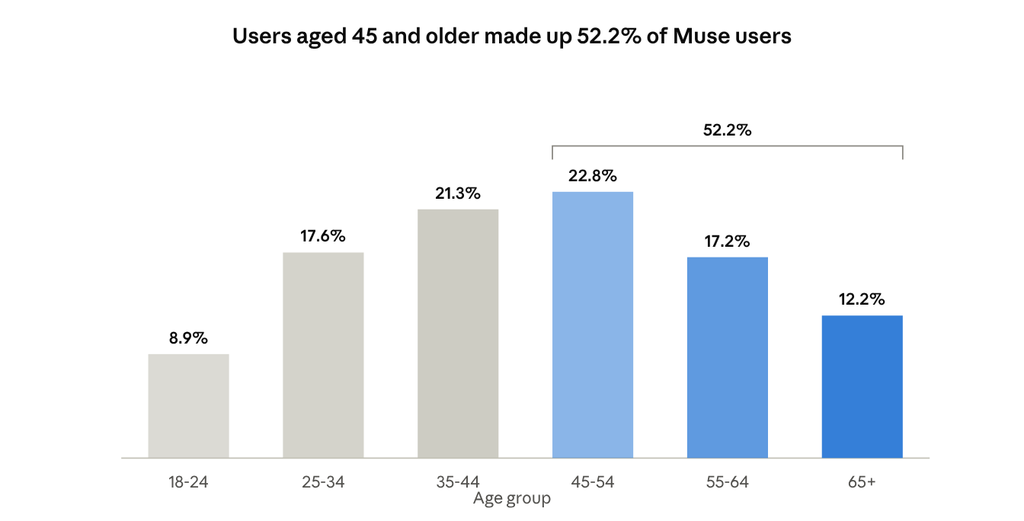
Our researchers drew three conclusions from the age data:
- We found that Muse skews older than any AI assistant we have studied, with users aged 45 and older making up 52.2% of its base and users under 25 making up only 8.9%.
- Our data showed that the daily-use rate rose with each age group, from 19.8% among users aged 18-24 to 26.4% among users 65 and older.
- We found that users aged 65 and older were the only group whose most common activity was companionship and conversation, which suggests Muse fills a social role for many older users.
Meta Muse Retention vs Other AI Assistants
In the table below, we compare Muse’s retention with that of other leading AI assistants. Each figure is the share of U.S. users who installed the app in September 2026 and returned to it on the given day after install. For usage data on the other platforms, see our ChatGPT usage statistics and our ranking of the top generative AI chatbots.
AI Assistant Retention by Days Since Install (September-October 2026)
| AI Assistant | Day 1 | Day 7 | Day 14 | Day 30 |
| Meta Muse | 71.8% | 28.6% | 21.9% | 16.4% |
| ChatGPT | 39.4% | 24.2% | 20.6% | 17.8% |
| Claude | 34.1% | 18.3% | 15.2% | 12.7% |
| Meta AI | 31.8% | 15.6% | 12.4% | 10.1% |
| Grok | 29.6% | 14.8% | 11.9% | 9.4% |
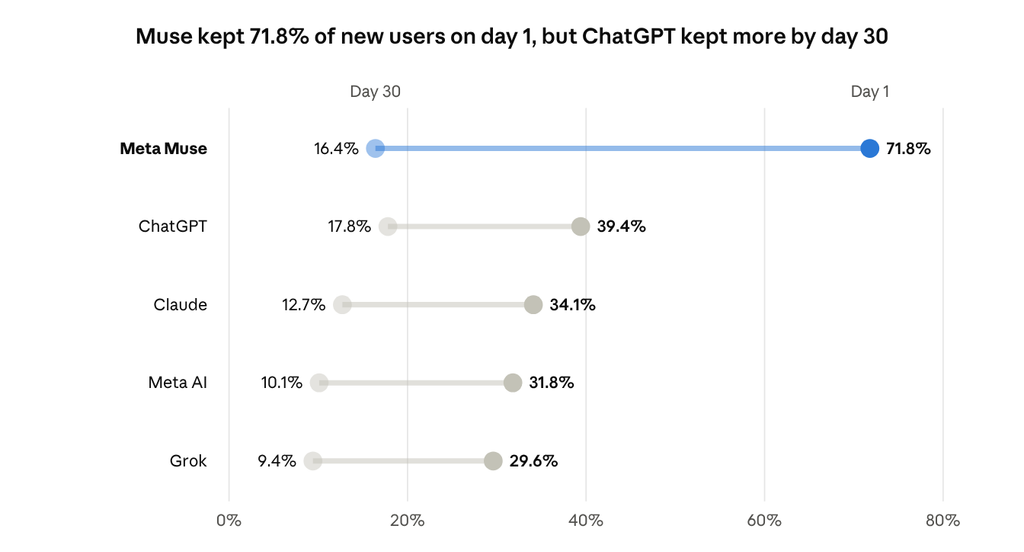
Our team took three findings from the retention data:
- We found that Muse brought back 71.8% of new users the day after install, close to double ChatGPT’s 39.4%, which reflects how often Muse reaches out to users with suggestions in their first days.
- Our data showed that Muse lost users faster than its competitors after the first day, falling 55.4 percentage points by day 30 compared with 21.6 points for ChatGPT.
- We found that ChatGPT passed Muse by day 30, at 17.8% to 16.4%, while Muse still kept more of its users than Claude, Meta AI and Grok at every point we measured.
Requesting a Copy of This Report
If you would like to request a PDF copy of this report or learn more about our agency, you can reach out here.
- First Page Sage Research Study, First Page Sage, September-October 2026, San Francisco, California
- Meta says Muse has over 10M users, with shopping a top activity, TechCrunch, October 21, 2026, San Francisco, California
- Meta’s Muse AI Is Winning Over Older Adults. Privacy Experts Are Worried, TIME, October 22, 2026, New York, New York
- Meta’s Muse AI Agent Is Building a Dossier On You, Harry Booth, TIME, October 6, 2026, New York, New York
- Sensor Tower: Meta’s Muse app tops 10 million US downloads in 40 days, 9to5Mac, October 20, 2026, Seattle, Washington
- Meta’s Muse AI agent brings back 73% of new users, nearly double ChatGPT’s rate, Yahoo Finance, October 2026, New York, New York
- Meta Superintelligence Labs, Wikipedia, accessed October 2026, San Francisco, California