Last updated November 19, 2026
To supplement our previous reports on visitor-to-lead conversion rates by industry and Lead-to-MQL Conversion Rate Benchmarks by Industry & Channel, our research team analyzed client data and research gathered from 2019 through November 2026 to determine average MQL to SQL conversion rates. We define MQLs and SQLs as follows:
- MQLs are any contact that has (a) indicated intent to make a purchase (e.g. by filling out a contact form or reaching out via email); and (b) been determined to be able to afford the product or service being offered.
- SQLs are any lead that, in addition to the criteria above, has also (a) moved through marketing to sales with an intent to buy; (b) been vetted by a salesperson and determined to be a good fit; and (c) booked a meeting with a salesperson.
In the sections below, we break down MQL to SQL conversion rates by industry, by year, and by lead source.
MQL to SQL Conversion Rates by Industry
In the table below, we share the average MQL to SQL conversion rate for each of the 30 industries in our dataset, along with notes on what drives conversion in each.
MQL to SQL Conversion Rates by Industry, 2026
| Industry | MQL to SQL Conversion Rate | Notes |
| Addiction Treatment | 14% | Addiction treatment exhibits lower MQL to SQL conversion rates as prospective customers navigate social stigma and the complex qualification process for admission, which can slow down the marketing pipeline. |
| Aerospace & Aviation | 17% | The specialized knowledge and complex decision-making structure of aerospace companies make it especially difficult to move customers to the next stage of the funnel. Provide as much information on regulatory specs as possible to help move customers along. |
| Automotive | 18% | The variety inherent in the automotive industry makes it difficult for some customers to take the next step in their journey. However, B2C decision-making is often more emotionally driven, making it easier to guide prospective clients toward your sales team. |
| B2B SaaS | 13% | B2B environments typically have a longer sales cycle due to a larger number of decision-makers as well as individual needs for customized solutions. Prepare a wealth of lead nurturing content to reassure interested leads. |
| Biotech | 15% | Because biotech has a great degree of specialization, biotech companies often face the challenge of establishing themselves as experts. Partnering your company with key opinion leaders can make your company more appealing against competitors. |
| Business Insurance | 26% | Like any other subdivision of insurance, customers seeking business insurance options have significant concerns around the regulatory environment of the industry. Including helpful comparison guides and policy breakdowns can simplify these problems, increasing the likelihood of a future sale. |
| Construction | 12% | Construction clients often face high budgets for large projects, many of which are seasonal in nature, making a quick decision especially difficult. Including free offers for a quote as well as educational information on regulatory concerns will help move customers along. |
| Cybersecurity | 15% | A rapidly evolving threat landscape in cybersecurity means that a successful marketing campaign hinges on whether or not your company can position itself as an authority on cutting-edge technology. Information guides, real-time data, and client success stories will help companies position themselves as that authority. |
| eCommerce | 23% | Although eCommerce has one of the highest conversion rates of any industry we surveyed, the high level of competition and high abandonment rate in the industry pose significant challenges for marketers. Ensure that your checkout shows a running total as customers add items to their cart, and streamline your checkout process as much as possible. |
| Engineering | 11% | Client needs for customization and project scoping often lead to extended planning that can delay the sales process. Providing free initial consultations or assessments can help encourage key decision makers in the client company to move forward with an eventual sale. |
| Entertainment | 16% | The entertainment industry is widely varied, but suffers from a fast-paced environment and budgetary constraints that often leave the marketing pipeline unstable but fast moving. Focus content on audience engagement through storytelling to convince MQLs to become SQLs. |
| Environmental Services | 18% | Environmental service clients face a high regulatory environment as well as significant budgetary constraints. In addition, they are wary of companies who greenwash their services to appear more environmentally friendly. Make information about your sustainability practices as transparent as possible to increase the chances of clients moving forward with a sale. |
| Financial Services | 13% | Financial services companies have many decision makers operating with sensitive client information that they need to know is secure. They are also especially concerned with the ROI of their project, so highlight these benefits of your service while providing transparent information on your security suite to improve conversion rates. |
| Fintech | 11% | Fintech clients need to know that your solution is ready to adapt and evolve as quickly as their fast-moving industry requires. Prioritize the customization elements of your solutions in your marketing materials all the way down your pipeline to ensure a higher conversion rate. |
| Healthcare | 13% | Healthcare companies and providers operate in a high regulatory environment dealing with highly sensitive client information. Therefore, cybersecurity concerns should be addressed at the outset, along with any policy breakdowns you can provide for how your solutions navigate the regulatory landscape. |
| Heavy Equipment | 23% | Heavy equipment clients are often concerned about the cost of your solution more than anything else, due to the high budgetary requirements of the industry. Offering free demonstrations or trial runs of your product is likely to tip the scales in the minds of key decision makers in your prospective target audience. |
| Higher Education | 21% | Higher education choices are one of the most difficult, costly, and emotionally charged decisions that customers will ever make. As a result, higher education institutions should focus their marketing efforts on what makes their organization unique compared to the vast array of other choices on the market, be it budgetary, specialization in degree, or extracurricular offerings. |
| Hotels & Resorts | 22% | Hotels and resorts face a high level of competition regardless of the area, as well as the budgetary challenge of seasonal business surges. Marketing efforts in this industry should focus on USPs that make your location unique, as well as limited-time deals or loyalty programs that keep customers coming back in the off-season. |
| HVAC | 26% | HVAC companies benefit from the often obligatory nature of home repairs or installations, but sometimes struggle with the high budgetary concerns of clients as well as a high level of competition, especially in the last few years. Providing a free quote or assessment in these situations will make a prospective client more likely to move forward in the future. |
| Industrial IoT | 18% | IIoT clients work with complex hardware and software that lead to a greater than usual amount of customization requirements, which can slow down the already delayed B2B sales process. Teams should provide detailed but accessible material that breaks down company offerings, focusing on how they work in real-world settings. |
| IT & Managed Services | 13% | IT companies operate with highly technical programs in an evolving technological landscape, leading to prospective clients having a great deal of security concerns. In addition, they are typically in B2B environments where many decision makers are involved in the process. Marketing teams should emphasize their solution’s adaptability, showing how offerings can be customized to meet varying client needs. |
| Legal Services | 10% | Legal services deal with a high amount of regulatory obstacles, so their biggest concern will be adherence. Provide educational materials for policy breakdowns to target top of funnel activity while including case studies to show your company’s adherence in real-world settings. |
| Manufacturing | 16% | Manufacturing companies deal with budgetary constraints, often due to the cost associated with building, buying, and repairing existing equipment. Offering transparent pricing information as well as free trial versions of your product is more likely to move them closer to a sale. |
| Oil & Gas | 13% | Oil & Gas companies deal with high capital expenditures that center discussions pertaining to your product around ROI. Provide transparent pricing information upfront so decision makers can consult stakeholders, management, and engineers more effectively. |
| Pharmaceutical | 21% | Pharmaceutical companies face a high regulatory environment and a large number of decision makers due to the relative size of the company. Include policy breakdowns wherever possible to demonstrate your solution’s adherence to existing regulation. |
| Real Estate | 10% | Real estate clients are working with an emotionally charged decision making process that often gets tied up in regulation for weeks or even months. Focus marketing strategies on long-term nurturing techniques like market reports or buyer/seller guides that establish your company as the go-to authority. |
| Software Development | 14% | Software development companies deal with a high degree of competition and a fast-moving technological landscape. Marketing teams should focus both on what makes their offering unique against their competitors with comparison blogs as well as consistent market reports that show prospective customers that they are keeping up with the latest developments in the industry. |
| Solar | 11% | Solar companies typically face their biggest challenge in budgetary concerns, as B2C customers work on a limited budget compared to what they are offering. Therefore, limited-time deals, free quotes, and limited information intake are much more likely to increase the chances of an eventual sale. |
| Staffing & Recruiting | 12% | Staffing & recruiting have below-average conversion rates, which we attribute to high competition (especially for high-level talent), candidate uncertainty, and customer trust. Targeting certain areas or industries can boost your trust in the eyes of prospective clients. |
| Transportation & Logistics | 19% | T&L companies manage high-cost operations that require a great degree of specialization, resulting in MQLs having second thoughts about moving forward if they feel a product cannot meet their specifications. Focus marketing efforts on how your company has optimized supply chain efforts, including case studies and white papers to nurture existing leads. |
- We found that HVAC and business insurance convert MQLs to SQLs at the highest rate in our dataset, 26%, followed by eCommerce and heavy equipment at 23%.
- Our data showed legal services and real estate at the bottom of the range, at 10%. We suspect long regulatory and decision timelines slow the handoff to sales in both.
- Across all 30 industries, the average MQL to SQL conversion rate was 16.1%, with a median of 15%.
MQL to SQL Conversion Rate by Year
In the table below, we break down the average MQL to SQL conversion rate across our dataset for each year of the study.
MQL to SQL Conversion Rate by Year, 2026
| Year | Average MQL to SQL Conversion Rate |
| 2019 | 16.4% |
| 2020 | 15.2% |
| 2021 | 16.9% |
| 2022 | 16.6% |
| 2023 | 15.8% |
| 2024 | 15.9% |
| 2025 | 16.3% |
| 2026 | 16.5% |
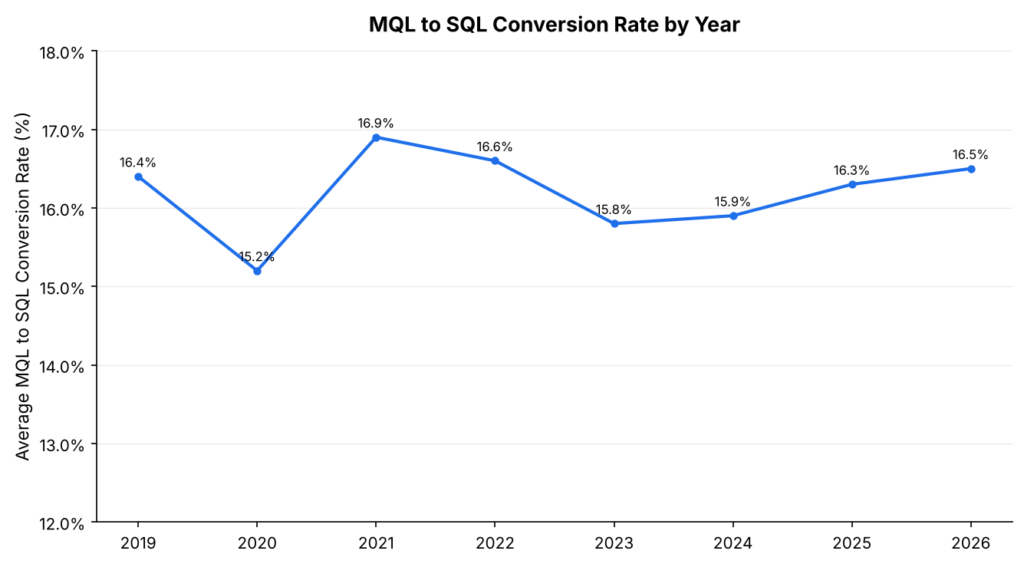
- We found that MQL to SQL conversion rates have stayed within a narrow band of 15.2% to 16.9% since 2019.
- Our data showed the lowest rate in 2020 (15.2%), followed by the study high of 16.9% in 2021.
- After dipping to 15.8% in 2023, the rate rose in each of the following three years, reaching 16.5% in 2026.
MQL to SQL Conversion Rate by Lead Source
In the table below, we break down the average MQL to SQL conversion rate by the channel that first generated the lead.
MQL to SQL Conversion Rate by Lead Source, 2026
| Lead Source | Average MQL to SQL Conversion Rate |
| Referrals | 27% |
| Events & Trade Shows | 21% |
| Webinars | 19% |
| SEO (Organic Search) | 18% |
| Email Marketing | 16% |
| LinkedIn (Organic) | 14% |
| PPC (Google Ads) | 13% |
| Paid Social | 9% |
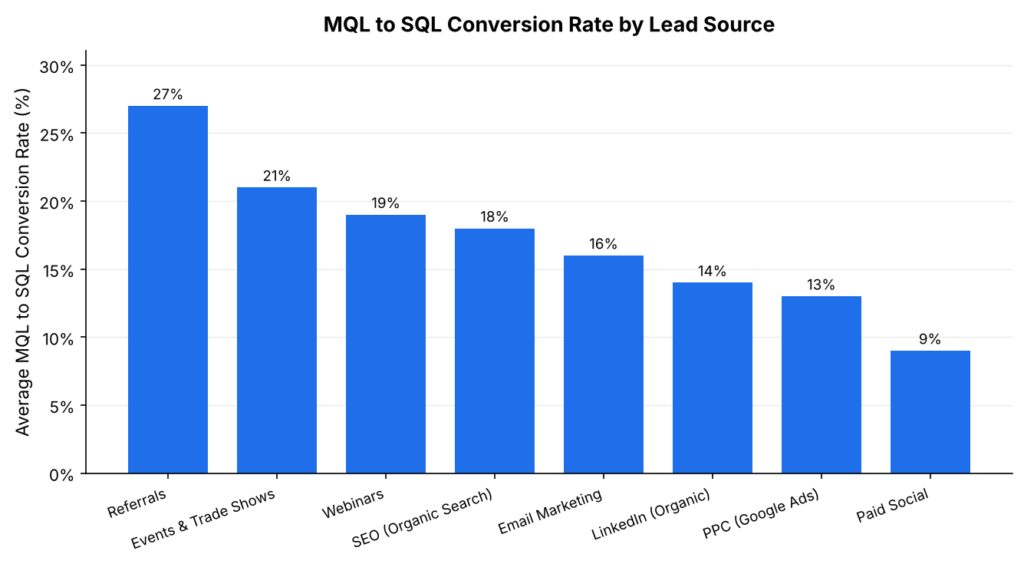
- We found that referred MQLs convert to SQLs at 27%, three times the 9% rate of paid social leads.
- Our data showed SEO (18%) converting MQLs to SQLs 5 points higher than PPC (13%). We suspect the research-driven intent behind organic searches contributes, though our dataset cannot isolate the cause.
- Channels that involve direct contact with a company before the lead is captured, such as events (21%) and webinars (19%), ranked second and third.
Requesting a Copy of This Report
We hope you find these benchmarks helpful in determining the health of your sales and marketing funnel. If you would like to order a PDF copy of this report or learn more about our agency, you can reach us here.
If you are interested in reading about how to improve your funnel, you may find the following reading helpful:
- The Digital Marketing Funnel Stages, Explained
- The B2B SaaS Marketing Funnel, Explained
- Sales Lead Funnel Stages, Explained
- B2B SaaS Funnel Conversion Benchmarks
- First Page Sage Research Study. First Page Sage. November 2026. San Francisco, California.
- 2025 GTM Benchmarks. Ebsta and Pavilion. April 2025. London, United Kingdom.
- B2B Sales Pipeline Statistics and Benchmarks: What Revenue Teams Told Us in 2026. Iryna Yelisova, Belkins. October 2026. United States.
- Belkins Finds 38% of B2B Teams Don’t Measure MQL-to-SQL Conversion. MarketScale. November 2026. United States.
- 40 Sales Statistics that Reveal How Teams Can Succeed in 2026. Adam Alfano, Salesforce. February 2026. San Francisco, California.