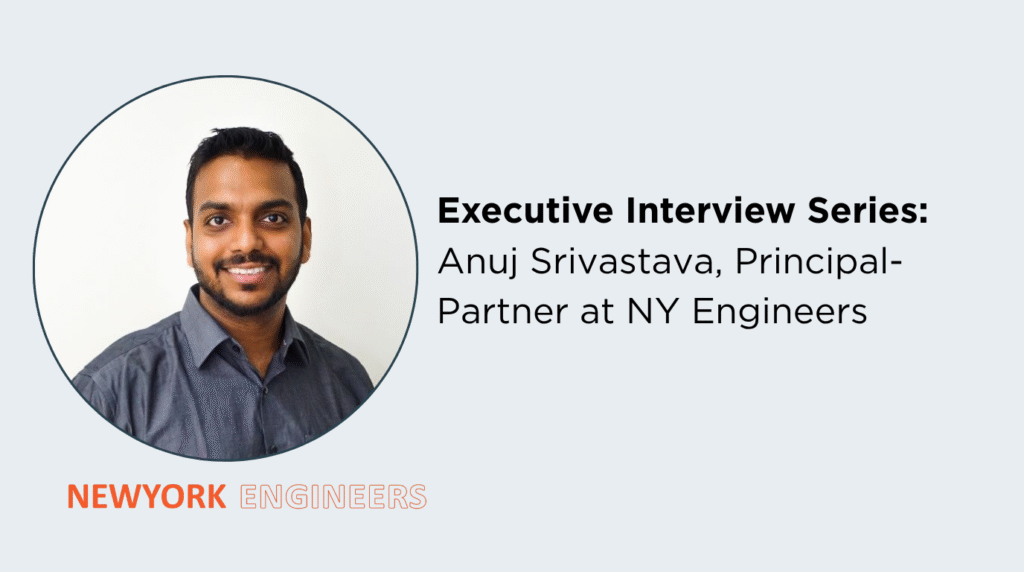
Today we’re speaking with Anuj Srivastava, Principal/Partner at NY Engineers. He’s worked with over 350 franchises, helping them to open stores 50% faster than anyone else in the industry. In this interview, we discuss how engineering and marketing can coordinate when opening a new franchise.

First Page Sage: Thanks for joining us, Anuj. Can you start by telling us a little about NY Engineers and your role at the firm?

Anuj Srivastava: Absolutely. At NY Engineers, I’m a Principal/Partner and lead the firm’s efforts especially in the franchise, retail and multi-site roll-out sector. We’ve built a strong reputation for providing rapid, cost-efficient Mechanical/Electrical/Plumbing (MEP) and Fire Protection (FP) engineering services, tailored for clients who are scaling across multiple locations. We’re licensed in all 50 U.S. states, have completed over 4,000 projects, and promise a turnaround that’s 50% faster than anyone else in the industry.
First Page Sage: I understand that scaling franchises comes with unique pressures. What are some of the key engineering challenges you see—and how do you address them?
Srivastava: When a franchise brand expands into dozens or hundreds of locations, consistency and speed become critical. On the engineering side, brand standards such as equipment specifications, layouts, and utility loads must be upheld while working within local building codes. Delays or change orders are also extremely costly in this space, so we emphasize rigorous modelling upfront so we can offer a zero change order assurance. Finally, material costs and supply-chain issues are major factors when installing multiple sites in parallel, so we standardize components and coordinate procurement early.
First Page Sage: How do marketing and lead generation tie into your world of franchise design?
Srivastava: Engineering design is foundational—you must build correctly, safely, efficiently. But the commercial success of a franchise rollout depends also on visibility, brand awareness, customer traffic and differentiation. While we deliver the physical infrastructure and ensure the spaces open on time, marketing is responsible for maximizing occupancy, conversion and ROI for each location. And in our experience, we’ve seen organic channels like SEO and content be particularly effective for our partners. For example, when you open multiple sites, you want each to show up in local search, be “found” by target customers, and drive foot-traffic or bookings. Engineering without marketing leaves opportunity on the table.
First Page Sage: In your experience, what’s one overlooked area where engineering and marketing overlap—and how can both teams collaborate better?
Srivastava: The first thing that comes to mind is data-driven site selection and pre-opening diagnostics. From our side, we look at utility loads, HVAC sizing, electrical pathing, lighting and visibility such as how storefront design influences lighting loads. From the marketing side, your agency can look at search volumes, local keyword demand, digital map coverage, and customer behaviour pre-opening. If engineering teams and marketing teams share early data to create projections for expected foot-traffic and peak usage hours, you get better outcomes: the space is designed for the actual customer load, and the brand already has digital visibility. Another overlap is creating branding consistency in design and messaging. Engineering will ensure a consistent look and feel between each location while marketing ensures consistent voice and content. Aligning these reduces friction as the brand scales.
First Page Sage: Looking ahead, how do you see the franchise or multi-site engineering-marketing ecosystem evolving, and what advice would you give to brands partnering with both an engineering firm and a marketing agency?
Srivastava: The ecosystem is becoming increasingly integrated: technology, data and digital customer acquisition are merging with physical infrastructure. A few trends we’ve seen are more use of BIM/virtual design, as we do at NY Engineers, to preempt change orders and speed timelines. There’s also increasing alignment between physical site activation and digital launch. These days, opening a new location isn’t just flipping the switch on HVAC and lights, it’s also ensuring you’re ready to go-live in search, maps, content, foot-traffic. Finally, we’ve seen operational sustainability taking a spotlight with concerns like energy efficiency, local code changes, and smart controls—all of which appeal both to cost control (engineering) and brand narrative (marketing).
My advice to brands is: Treat your engineering partner and your marketing partner as a coordinated team, not silos. Build your timeline and budgets so that infrastructure readiness aligns with digital readiness. Ensure your messaging is consistent across the space and the web so you can ensure a strong launch.