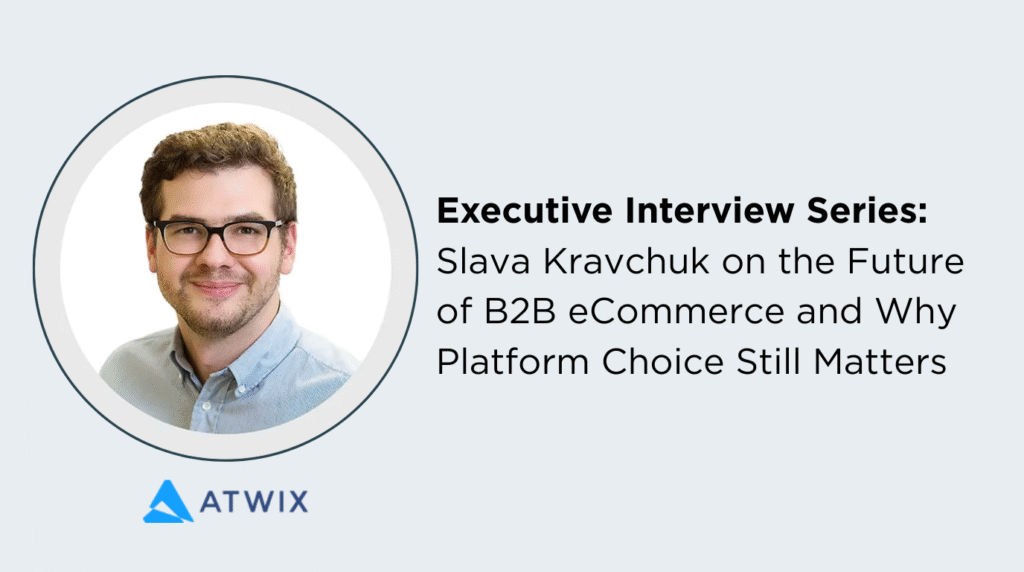
We recently sat down with Slava Kravchuk, Founder and CEO of Atwix, our #1 choice in strategic eCommerce development companies. We discussed the evolving landscape of B2B eCommerce and what businesses need to succeed in 2026 and beyond, asking Slava to share insights he’s gleaned from Atwix’s over 15 years of experience serving manufacturers, distributors, and wholesalers in a variety of complex B2B eCommerce niches.

First Page Sage: You founded Atwix in 2006, nearly two decades ago. How has B2B eCommerce evolved since then, and what surprises you most about where we are today?

Slava Kravchuk: The pace of change has been staggering. When we started, most B2B companies didn’t even have websites, let alone eCommerce capabilities. The idea of a manufacturer taking orders online was considered radical. The global B2B eCommerce market reached $32.1 trillion in 2025 – proof that digital-first commerce is no longer optional for B2B businesses, it’s essential..
What surprises me most is how COVID-19 accelerated a decade of digital transformation into just a few quarters. We saw manufacturers and distributors who had been hesitant about eCommerce suddenly launching B2B portals in 8 weeks, like we did with Byrne Electrical during the pandemic. The crisis forced businesses to adapt or die, and many discovered that digital commerce wasn’t just a survival mechanism, it was a growth engine.
Atwix is a strategic eCommerce partner for over 15 years, guiding clients from initial strategy to their vision. What we’ve learned is that the businesses thriving today are those who didn’t just digitize their catalogs – they reimagined their entire customer experience.
First Page Sage: There’s been a lot of debate about platform choice lately; Magento, Adobe Commerce, Shopify Plus, Shopware, custom builds. As someone who’s worked across all these platforms, how should B2B companies think about this decision?
Kravchuk: Platform choice is critical, but it’s not about picking the “best” platform, it’s about picking the right platform for your specific business needs. That’s why Atwix is platform agnostic. We’re certified across Adobe Commerce, Magento, Shopify Plus, Shopware, and BigCommerce because different businesses have different requirements.
For complex B2B operations, manufacturers with custom pricing tiers, distributors managing multi-company accounts, wholesalers with intricate ERP integrations; Adobe Commerce (Magento) or Shopware is often the best fit. Their open architecture and robust B2B modules handle complexity out of the box. We’ve contributed over 300 core improvements to Magento since 2018 and have been the number one code contributing agency overall, we’re also the most certified Shopware partner in the US, so we know both of those platforms inside and out.
But for businesses prioritizing speed to market and simplicity, Shopify Plus can be excellent.
First Page Sage: You mentioned ERP integration. Why is this such a critical piece of the B2B eCommerce puzzle?
Kravchuk: Because B2B commerce doesn’t exist in a vacuum. Your eCommerce platform needs to talk to your ERP system in real time – inventory levels, pricing, customer credit terms, order status. Without seamless integration, you’re manually updating data, which leads to errors, delays, and frustrated customers.
The challenge is that every ERP system is different. We’ve integrated with everything from SAP and NetSuite to Infor and Epicor. Each requires individual architecture to meet custom business processes and careful planning. However, Atwix’s proprietary and proven middleware called Sirius is capable of connecting ERPs and any third-party systems to the eCommerce frontend and customer portal seamlessly. The results are transformative. Customers can see real time inventory, place orders with confidence, track shipments and even see their past offline orders and pay invoices online – all without picking up the phone.
This is where having an experienced partner matters. We’ve done this 250+ times, so we know the pitfalls and how to avoid them. A poorly executed ERP integration can sink an entire eCommerce project.
First Page Sage: Many B2B companies struggle with the question: “Do we build custom or use a platform?” What’s your advice?
Kravchuk: Start with a platform. Always. The days of building eCommerce from scratch are largely over unless you have very unique requirements and a massive budget. Modern platforms like Magento, Shopify Plus, and Shopware offer 80 to 90% of what most B2B businesses need out of the box.
The real question is: how do you customize that remaining 10 to 20% without creating technical debt? This is where open architecture of platforms like Shopware or Magento/Adobe Commerce shines. You can extend functionality without hacking the core, which means smoother upgrades and lower long term costs.
First Page Sage: You’ve talked about being a “strategic partner” rather than just a development agency. What does that mean in practice?
Kravchuk: It means we don’t just take orders and write code. Before we touch a single line of code, we sit down with clients and map out their three year vision. Where do you want your customer experience to be? What business outcomes are you trying to achieve? How will your operations need to scale?
This strategic approach prevents costly rebuilds. We’ve seen too many businesses launch an eCommerce site, realize it doesn’t support their growth, and have to start over two years later. That’s expensive and disruptive.
With Byrne Electrical, for example, we deployed their B2B portal in 8 weeks during the pandemic and have been evolving their eCommerce, based on the same Magento foundation for the last 5 years. But that speed was only possible because we took time upfront to understand their phased rollout strategy, their integration requirements, and their long term goals. We built for where they were going, not just where they were.
First Page Sage: Looking ahead to 2026 and beyond, what should B2B eCommerce companies be preparing for?
Kravchuk: Three things: AI, integrated experiences, and personalization.
AI is already transforming how B2B buyers discover products, get support, and place orders. We’re seeing AI powered search, predictive ordering based on purchase history, and chatbots that actually understand complex B2B queries. The businesses that embrace AI early will have a significant competitive advantage.
Integrated experience is no longer optional. Especially in B2B buyers would like to have a unified portal where they can discover products, get support, see past orders, pay invoices and complete most of the touchpoints online that they used to do via other channels.
Finally, personalization. B2B buyers now expect the same personalized experiences they get as consumers. Customer specific pricing, tailored product recommendations, customized catalogs – these aren’t nice to haves anymore. They’re table stakes.
The good news? The technology to deliver all this exists today. The question is whether businesses will invest in it before their competitors do.
First Page Sage: What’s one piece of advice you’d give to a B2B company considering a digital transformation project right now?
Kravchuk: Don’t wait for the perfect plan. Start with an MVP (minimum viable product) and iterate. The businesses that succeed are the ones that launch, learn, and improve continuously.
Byrne Electrical called their approach “mvp” with a lowercase “m”, they launched with core functionality and expanded from there. That pragmatism got them to market quickly and allowed them to gather real customer feedback to guide future development.
And choose your partner carefully. You’re not just buying software, you’re entering a long term relationship. Look for a partner with deep expertise in your industry, a track record of successful implementations, and the ability to think strategically, not just tactically. We have sites we built a decade ago that are still thriving because we built them to evolve, not to be replaced.
The future belongs to B2B companies that embrace digital commerce not as a project, but as an ongoing journey. And the best time to start that journey is now.