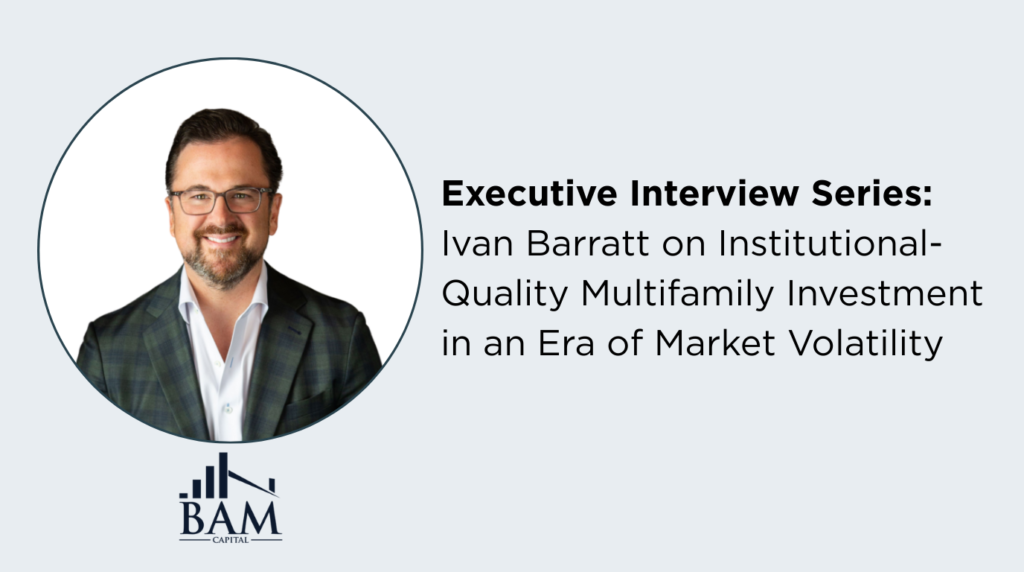
Today, we’re sitting down with Ivan Barratt, CEO and Co-Founder of BAM Capital, which offers institutional-quality multifamily funds backed by nearly $2 billion in transaction volume–representing the aggregate value of the real estate assets we’ve acquired and managed since our inception–for accredited investors. With an impressive track record of $1.85 billion in acquisitions, an average 34.42% IRR, and a vertically integrated approach to Class A multifamily real estate, BAM Capital has become a trusted partner for over 1,650 accredited investors, qualified purchasers, and institutional investors seeking passive real estate investment opportunities. We’re particularly interested in understanding how experienced syndicators like Ivan approach market selection, broker relationships, and value creation in today’s complex economic environment.

First Page Sage: Ivan, the multifamily market has experienced significant volatility over the past few years. How are you thinking about market selection and risk mitigation in 2025?

Ivan Barratt: Our investment thesis is built around a deliberate focus on Midwest secondary and tertiary markets: areas that historically don’t experience the dramatic boom-and-bust cycles you see in coastal gateway cities. The Midwest offers greater stability, lower volatility, and stronger risk-adjusted returns, particularly in uncertain economic environments. We’re talking about markets with steady population growth, diverse employment bases, and fundamentally sound rental demand that isn’t dependent on speculative appreciation.
From a risk mitigation perspective, this geographic focus is essential. We’ve successfully navigated multiple economic cycles and, to date, have never missed a preferred return payment to our investors. That track record isn’t accidental—it’s the result of rigorous market selection criteria that prioritize economic fundamentals over speculative growth. We analyze employment diversity, population trends, income growth, and drivers of rental demand. Additionally, Midwest markets face lower competition from institutional investors, which translates to better acquisition opportunities and less pricing pressure. For commercial real estate brokers working in these markets, understanding these dynamics is crucial because sophisticated capital allocators are increasingly recognizing the value proposition that secondary markets offer.
First Page Sage: You mentioned working in markets with lower institutional competition. How does that affect your relationship with commercial real estate brokers, and what do you look for in those partnerships?
Barratt: Our relationships with commercial real estate brokers are absolutely foundational to our acquisition strategy. In Midwest markets, deal flow often originates through brokers who possess in-depth local market knowledge and have established long-standing relationships with buyers and sellers. We’re not the flash-in-the-pan buyer who appears during a hot market and disappears when conditions tighten. We’ve been consistently active, which means brokers know we can close.
What we look for in broker partnerships is straightforward: market expertise, integrity, and understanding of institutional-quality underwriting. We need brokers who can identify Class A multifamily properties, typically built after 2015, with strong in-place cash flow and value-add potential. But beyond that, we value brokers who understand our investment criteria, so they bring us deals that actually fit our parameters.
We’re looking at properties in the $50-100 million range, typically located in strong suburban areas with high-quality school districts and robust employment growth.
From the broker’s perspective, we’re an attractive buyer because we move quickly, have strong lender relationships that facilitate flexible financing, and possess the operational expertise to execute our business plans.
Our vertically integrated platform enables us to have in-house property management, eliminating the need for third-party reliance on executing value creation strategies. That operational capability gives brokers and sellers confidence that we’ll close and perform.
First Page Sage: You mentioned vertically integrated operations and in-house property management. How does that operational expertise translate to better returns for your investors?
Barratt: Vertical integration is one of our most significant competitive advantages, and it directly impacts investor returns. Many multifamily syndicators rely on third-party property management, which creates alignment issues and limits their ability to execute value-add strategies effectively. When you own the entire operational stack, from acquisition through asset management and property management, you have complete control over execution.
Our team has a longstanding background in property management, which enables us to understand operations at a granular level. We know how to optimize rent growth, reduce operating expenses, improve resident retention, and implement capital improvements that actually drive NOI growth. That operational expertise allows us to underwrite deals more accurately and execute business plans more reliably than competitors who lack that hands-on experience.
For accredited investors and RIAs evaluating multifamily syndication opportunities, this distinction matters enormously. Passive real estate investment returns are ultimately determined by operational execution, not just acquisition pricing. You can buy a property at a great basis, but if you can’t execute the value-add plan, you won’t generate the returns. Our 33.85% average IRR reflects not only smart acquisitions but also disciplined and expert execution.
First Page Sage: Speaking of your investor base, you’ve attracted over 1,650 investors, including accredited investors, qualified purchasers, and institutional capital. What are the primary pain points you’re solving for these investors, and how has that shaped your fund structure?
Barratt: Our investor base comes to us with three primary challenges. First, they want access to institutional-quality real estate but lack the knowledge, time, or capital to pursue these investments independently. Acquiring and operating a $100 million apartment community requires specialized expertise, significant capital, and substantial time commitment. Our funds offer access to institutional-grade opportunities with lower minimum investments than direct ownership would typically require.
Second, investors want passive growth and income rather than active involvement. High-net-worth individuals and family offices don’t want to be landlords or deal with property management headaches. They want professionally managed, passive real estate investment that generates returns without requiring their operational involvement. Our structure delivers exactly that—investors receive preferred returns, participate in profit splits, and benefit from our operational expertise without any management responsibilities.
Third, in an era of market volatility, investors are seeking lower-risk investments with downside protection. This is where our Midwest focus, our track record of never missing a preferred return payment, and our conservative underwriting become critical differentiators. We’re not chasing speculative yields in overheated markets. We seek to deliver steady, risk-adjusted returns backed by strong operational fundamentals.
Our fund structure reflects these priorities: we provide transparency, regular communication, personalized investor care, and alignment of interests through co-investment. We host an annual in-person Town Hall and events around the country with investors, and we maintain close relationships with our investor base. The fact that we’re consistently referred to by friends, family, and business partners from current investors speaks to the trust we’ve built.
First Page Sage: Looking ahead, how do you see the multifamily investment landscape evolving, and what opportunities are you most focused on?
Barratt: The multifamily landscape is entering a period where operational expertise and market selection will matter more than ever. The era of easy money and indiscriminate capital flows is over. Interest rates have reset expectations, and the operators who will succeed are those with genuine operational capabilities, conservative underwriting, and a focus on markets with strong fundamentals.
We’re particularly excited about opportunities in Midwest secondary and tertiary markets where population growth, employment diversity, and housing demand remain strong but pricing hasn’t been inflated by speculative capital. These markets continue to offer compelling value-add opportunities—Class A properties where we can implement operational improvements, modest capital upgrades, and professional management to drive NOI growth and create value for our investors.
For institutional investors and RIAs allocating capital to multifamily real estate, the key is partnering with operators who have proven track records across economic cycles, genuine operational expertise, and disciplined investment criteria. The next few years will reward patience, discipline, and operational excellence—and that’s exactly where BAM Capital is positioned.
First Page Sage: What advice would you give to commercial real estate brokers who are working with multifamily investors in today’s market?
Barratt: Know your buyer. The multifamily investment landscape is increasingly bifurcated between sophisticated, well-capitalized operators with genuine expertise and less experienced players who may struggle to close deals or execute effectively. As a broker, your reputation is built on delivering quality opportunities to quality buyers and facilitating successful transactions.
Understand the buyer’s investment criteria in detail: What markets do they target? What property class? What vintage? What value-add strategies do they typically pursue? What’s their typical hold period? Do they have reliable financing relationships? Can they move quickly? For operators like BAM Capital, we have clearly defined criteria and a track record of closing, which makes us a reliable counterparty.
Also, recognize that the best operators are thinking long-term. We’re not looking to flip properties quickly; we’re building a portfolio that generates consistent returns for our investors over multi-year hold periods. That long-term orientation means we value relationships with brokers who consistently bring us opportunities, not just during hot markets. The brokers we work with repeatedly are those who understand our criteria, bring us quality deal flow, and operate with integrity.
In today’s market environment, the combination of rising operational complexity and more selective capital deployment means that relationships matter more than ever. Brokers who can connect quality assets with quality operators will continue to thrive, regardless of broader market conditions.