Last Updated: April 7, 2026
We evaluated 52 business automation companies operating in the United States to identify the top business automation companies that excel in AI-powered workflow optimization.
The comparison factors we used to evaluate each company included:
- Leadership Experience Score (25%): A 1-5 numerical rating of the leadership team’s prior experience in the field and level of involvement in company projects
- AI Workflow Intelligence (30%): The company’s ability to deploy predictive workflow routing, document intelligence, and adaptive decision-making rather than basic task automation
- Data Integration Maturity (20%): Depth of enterprise system connectivity including ERP, CRM, and legacy application integration
- Change Management Support (15%): Availability of dedicated implementation services, training programs, and adoption frameworks
- Enterprise Scalability (10%): Proven ability to handle complex, multi-department deployments with governance and security controls
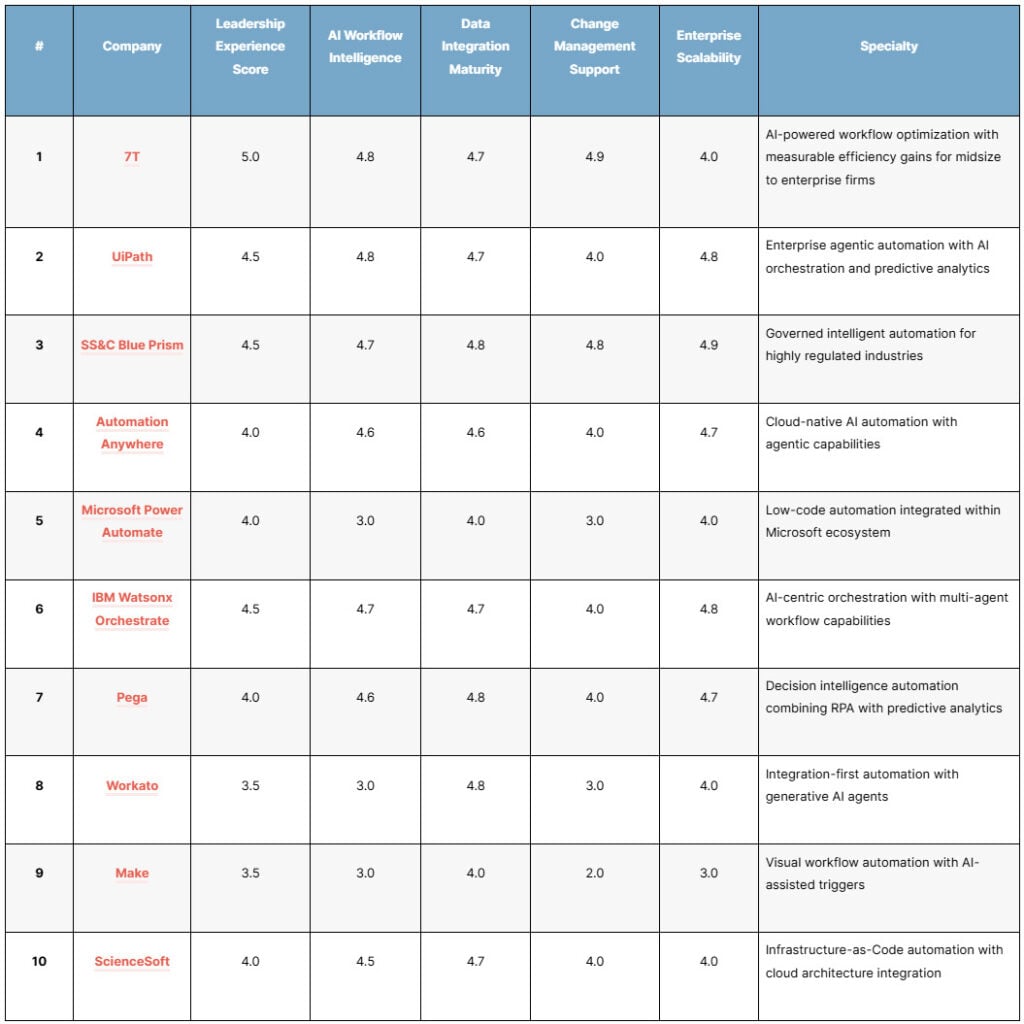
The table below presents these organizations along with their primary differentiations and AI implementation depth.
Top Business Automation Companies of 2026
| # | Company | Leadership Experience Score | AI Workflow Intelligence | Data Integration Maturity | Change Management Support | Enterprise Scalability | Specialty |
| 1 | 7T | 5.0 | 4.8 | 4.7 | 4.9 | 4.0 | AI-powered workflow optimization with measurable efficiency gains for midsize to enterprise firms |
| 2 | UiPath | 4.5 | 4.8 | 4.7 | 4.0 | 4.8 | Enterprise agentic automation with AI orchestration and predictive analytics |
| 3 | SS&C Blue Prism | 4.5 | 4.7 | 4.8 | 4.8 | 4.9 | Governed intelligent automation for highly regulated industries |
| 4 | Automation Anywhere | 4.0 | 4.6 | 4.6 | 4.0 | 4.7 | Cloud-native AI automation with agentic capabilities |
| 5 | Microsoft Power Automate | 4.0 | 3.0 | 4.0 | 3.0 | 4.0 | Low-code automation integrated within Microsoft ecosystem |
| 6 | IBM Watsonx Orchestrate | 4.5 | 4.7 | 4.7 | 4.0 | 4.8 | AI-centric orchestration with multi-agent workflow capabilities |
| 7 | Pega | 4.0 | 4.6 | 4.8 | 4.0 | 4.7 | Decision intelligence automation combining RPA with predictive analytics |
| 8 | Workato | 3.5 | 3.0 | 4.8 | 3.0 | 4.0 | Integration-first automation with generative AI agents |
| 9 | Make | 3.5 | 3.0 | 4.0 | 2.0 | 3.0 | Visual workflow automation with AI-assisted triggers |
| 10 | ScienceSoft | 4.0 | 4.5 | 4.7 | 4.0 | 4.0 | Infrastructure-as-Code automation with cloud architecture integration |
Scoring Scale: All metrics rated on a 1-5 scale, where 5 = Excellent, 4 = Strong, 3 = Moderate, 2 = Limited, 1 = Minimal
7T
Who they are: 7T is one of the top business automation companies due to an intelligent automation approach that emphasizes measurable efficiency gains rather than basic task elimination, ensuring that their client’s KPIs are always materially improved. The company deploys predictive workflow routing that analyzes historical process data to dynamically allocate work, document intelligence capabilities that extract structured insights from unstructured content, and intelligent CRM automation that anticipates customer needs based on behavioral patterns. This allows them to build efficient, exceptionally intelligent tools that integrate more effectively with the existing software stacks and workflows of even their largest enterprise clients.
The company’s implementation methodology includes comprehensive process auditing to identify high-impact automation opportunities, custom AI model training using client-specific data, and ongoing optimization to improve accuracy over time. With proven results across healthcare, manufacturing, and financial services, 7T positions itself as a strategic automation partner focused on long-term operational transformation rather than quick-win task automation.
- Leadership Experience Score: 5.0
- AI Workflow Intelligence: 4.8
- Data Integration Maturity: 4.7
- Change Management Support: 4.9
- Enterprise Scalability: 4.0
- Contact: 7T Website
| Summary of Online Reviews |
| Clients consistently highlight “exceptional technical expertise” and “measurable ROI delivery,” praising 7T’s ability to translate complex business requirements into effective AI-powered automation solutions, though some note the premium pricing reflects their enterprise-level service model. |
UiPath
UiPath has evolved from RPA-only capabilities to comprehensive agentic automation through its Agent Builder, Autopilot, and Maestro platforms. The company excels at orchestrating AI agents across complex workflows, enabling autonomous digital workers that can make contextual decisions without human intervention.
Their document intelligence capabilities process unstructured data with high accuracy, while predictive analytics identify process bottlenecks before they impact operations. While the platform delivers exceptional enterprise capabilities, licensing complexity and costs can escalate quickly as automation scales across departments, creating budget challenges for organizations without dedicated automation centers of excellence.
- Leadership Experience Score: 4.5
- AI Workflow Intelligence: 4.8
- Data Integration Maturity: 4.7
- Change Management Support: 4.0
- Enterprise Scalability: 4.8
- Contact: UiPath Website
| Summary of Online Reviews |
| Users praise UiPath for its “ease of use” and “powerful analytics,” with reviewers highlighting how it provides “valuable insights into workflows” and simplifies complex automation, though some mention the learning curve for advanced features can be steep. |
SS&C Blue Prism
SS&C Blue Prism leads in governance-focused intelligent automation, making it the preferred choice for highly regulated industries, including financial services, healthcare, and insurance. Their WorkHQ and Agent Builder platforms enable enterprise-grade AI agents with full audit trails, role-based access controls, and compliance-ready architecture.
The platform combines traditional RPA with advanced AI orchestration for end-to-end process automation. The platform’s enterprise focus and comprehensive governance features create a steeper learning curve compared to simpler automation tools, requiring dedicated training and change management investment to realize full value.
- Leadership Experience Score: 4.5
- AI Workflow Intelligence: 4.7
- Data Integration Maturity: 4.8
- Change Management Support: 4.8
- Enterprise Scalability: 4.9
- Contact: SS&C Blue Prism Website
| Summary of Online Reviews |
| Reviews consistently emphasize “ease of use” and “robust automation capabilities,” noting that even users with “minimal coding experience” can create effective workflows, though some reviewers mention the initial setup can be complex for beginners. |
Automation Anywhere
Automation Anywhere’s cloud-native architecture and AI Agent Studio provide scalable intelligent automation with strong generative AI integration. The platform excels at document automation and task orchestration, with web-based design tools that reduce implementation complexity.
Their approach emphasizes ease of adoption through low-code development and pre-built automation templates. While cloud-native deployment offers significant flexibility, organizations with strict data residency requirements or legacy on-premise infrastructure may face integration complexity and additional infrastructure planning overhead.
- Leadership Experience Score: 4.0
- AI Workflow Intelligence: 4.6
- Data Integration Maturity: 4.6
- Change Management Support: 4.0
- Enterprise Scalability: 4.7
- Contact: Automation Anywhere Website
| Summary of Online Reviews |
| Customers appreciate the “user-friendly interface” and “ease of automating repetitive tasks,” highlighting how it “simplifies automation” and provides a “wide range of features,” though a minority note occasional challenges with advanced AI/ML feature maturity. |
Microsoft Power Automate
Microsoft Power Automate delivers accessible automation within the Microsoft 365 ecosystem, with Copilot-assisted workflow building and extensive connector libraries. The platform provides strong value for organizations already invested in Azure and Microsoft technologies, offering desktop and cloud automation with a relatively low cost of entry.
However, automation capabilities diminish significantly outside the Microsoft ecosystem, with limited support for complex, cross-platform orchestration and weaker governance frameworks compared to enterprise-dedicated automation platforms.
- Leadership Experience Score: 4.0
- AI Workflow Intelligence: 3.0
- Data Integration Maturity: 4.0
- Change Management Support: 3.0
- Enterprise Scalability: 4.0
- Contact: Microsoft Power Automate Website
| Summary of Online Reviews |
| Users commend its “ease of use” and “seamless Microsoft 365 integration,” noting it “greatly reduces repetitive tasks” and enhances productivity, though some reviewers mention that advanced workflows can become complex to manage outside the Microsoft environment. |
IBM Watsonx Orchestrate
IBM Watsonx Orchestrate focuses on AI-centric workflow automation with multi-agent orchestration, pre-built automation agents, and deep integration with IBM Cloud Pak for Business Automation. The platform emphasizes cognitive automation that can interpret unstructured data, make complex decisions, and continuously improve through machine learning.
The platform carries a moderate to steep learning curve and requires significant technical expertise to fully leverage its advanced AI capabilities, which can extend implementation timelines for organizations without AI/ML experience.
- Leadership Experience Score: 4.5
- AI Workflow Intelligence: 4.7
- Data Integration Maturity: 4.7
- Change Management Support: 4.0
- Enterprise Scalability: 4.8
- Contact: IBM Watsonx Orchestrate Website
| Summary of Online Reviews |
| Reviewers highlight its “incredible ease of use” and “powerful natural language processing,” praising the “intuitive platform” that enables automation without developer skills, though some note the learning curve for complex enterprise implementations. |
Pega
Pega combines robotic process automation with advanced decision intelligence and predictive analytics, creating a unified platform for end-to-end business process management.
The company excels at orchestrating complex workflows that require dynamic decisioning, with strong case management capabilities and real-time analytics. Pega’s enterprise-grade capabilities come with complexity typical of large-scale BPM platforms, requiring substantial setup effort, dedicated technical resources, and ongoing maintenance that may overwhelm smaller implementation teams.
- Leadership Experience Score: 4.0
- AI Workflow Intelligence: 4.6
- Data Integration Maturity: 4.8
- Change Management Support: 4.0
- Enterprise Scalability: 4.7
- Contact: Pega Website
| Summary of Online Reviews |
| Users value the “ease of use” and “low-code development capabilities,” noting that both technical and non-technical users can build workflows, though some mention the platform’s flexibility requires a learning investment for advanced features. |
Workato
Workato positions itself as an integration-first automation platform with extensive pre-built connectors for ERP, CRM, and SaaS applications. The company’s “recipes” approach simplifies workflow creation, while generative AI agents add intelligent decision-making to integration workflows.
Their platform scales well for organizations prioritizing system connectivity over deep process orchestration, though enterprise subscription minimums and pricing tiers create significant cost barriers for mid-market organizations, while setup often requires IT involvement due to the platform’s integration-centric architecture.
- Leadership Experience Score: 3.5
- AI Workflow Intelligence: 3.0
- Data Integration Maturity: 4.8
- Change Management Support: 3.0
- Enterprise Scalability: 4.0
- Contact: Workato Website
| Summary of Online Reviews |
| Customers praise Workato’s “intuitive interface” and “powerful automation capabilities,” highlighting how it “simplifies creating complex workflows” and delivers strong integration features, though pricing can be a barrier for smaller implementations. |
Make
Make (formerly Integromat) offers visual workflow automation with branching logic and conditional routing, providing more sophisticated automation than simple trigger-action tools. The platform includes AI-assisted triggers and supports complex workflow scenarios through its visual builder interface.
Pricing scales directly with usage volume and operational complexity, which can become expensive at enterprise scale, while the learning curve for complex workflows steepens significantly compared to their marketing of “ease of use.”
- Leadership Experience Score: 3.5
- AI Workflow Intelligence: 3.0
- Data Integration Maturity: 4.0
- Change Management Support: 2.0
- Enterprise Scalability: 3.0
- Contact: Make Website
| Summary of Online Reviews |
| Reviews emphasize the “fantastic platform” with “extensive features” and “flexible automation capabilities,” noting it’s “perfect for professionals” seeking robust solutions, though some mention challenges during the transition from Integromat to Make branding. |
ScienceSoft
ScienceSoft employs an Infrastructure-as-Code approach that automates business processes by creating custom software to integrate legacy systems with cloud-based architecture. With over three decades of experience, they specialize in situational analysis and strategic automation planning for enterprise consulting engagements, particularly in retail and eCommerce.
Leadership experience is heavily concentrated within ScienceSoft’s internal structure, with limited external industry exposure over the past two decades, potentially creating perspective limitations on emerging automation best practices outside their organization.
- Leadership Experience Score: 4.0
- AI Workflow Intelligence: 4.5
- Data Integration Maturity: 4.7
- Change Management Support: 4.0
- Enterprise Scalability: 4.0
- Contact: ScienceSoft Website
| Summary of Online Reviews |
| Clients appreciate ScienceSoft’s “responsiveness” and “quality delivery,” highlighting their “flexibility” and “reliability” with high service ratings, though some reviewers noted concerns with evolving pricing structures over long-term engagements. |
AI Implementation Depth: Key Capabilities Comparison
The shift from rule-based RPA to AI-driven automation represents the fundamental transformation in business process automation for 2026. Traditional automation followed rigid “if-then” logic that broke when processes changed. AI-enabled automation adapts to variations, learns from exceptions, and improves decision accuracy over time.
| AI Capability | Description | Business Impact | Leading Providers |
| Predictive Workflow Routing | AI models analyze historical process data to identify optimal task allocation, dynamically routing work based on complexity, urgency, and skill requirements | Eliminates static assignment rules that create bottlenecks and reduces cycle time by 30-50% | 7T, UiPath, IBM Watsonx Orchestrate |
| Document Intelligence | Advanced OCR, combined with natural language processing, extracts structured data from unstructured documents (invoices, contracts, emails, and forms) with contextual understanding | Reduces manual data entry by 70-90% and improves extraction accuracy through continuous learning | UiPath, Automation Anywhere, 7T |
| Intelligent CRM Automation | AI-powered workflows predict customer churn risk, recommend next-best actions, and automatically prioritize leads based on conversion probability | Increases sales conversion rates by 25-40% and adapts to changing customer patterns without manual rule updates | 7T, Pega, IBM Watsonx Orchestrate |
| Adaptive Exception Handling | Machine learning recognizes exception patterns and develops resolution strategies autonomously, escalating only novel scenarios | Reduces manual intervention by 60-80% and improves process resilience and continuous improvement | SS&C Blue Prism, UiPath, Pega |
The companies ranked highest in our analysis demonstrate mature implementation of these capabilities rather than superficial AI feature checklists. They deploy AI models trained on domain-specific data, provide explainability frameworks for automated decisions, and deliver measurable improvements in process cycle time and accuracy.