This report draws on research our team conducted between August 4 and October 23, 2026, in which we surveyed 2,514 professional software developers in North America and Europe about the AI coding tools they rely on. We then weighed those responses against publicly disclosed seat counts and usage figures to produce a normalized model of the market.
We define market share here as the percentage of professional developers who name a given tool as their primary AI coding assistant, meaning the tool they use most often for writing, editing, or reviewing production code. Many developers use two or three tools in parallel, so primary-tool share is a stricter measure than adoption, and it tracks the competition between vendors more closely.
The category has reordered itself in under a year. Terminal-based coding agents, which barely registered in mid-2025, now account for the largest block of developer usage, and the incumbent IDE extension model has ceded ground to them. In the sections below, we break down current market share, its trajectory since Q3 2025, and how the market divides by company size, interface type, and underlying model.
AI Coding Assistant Market Share
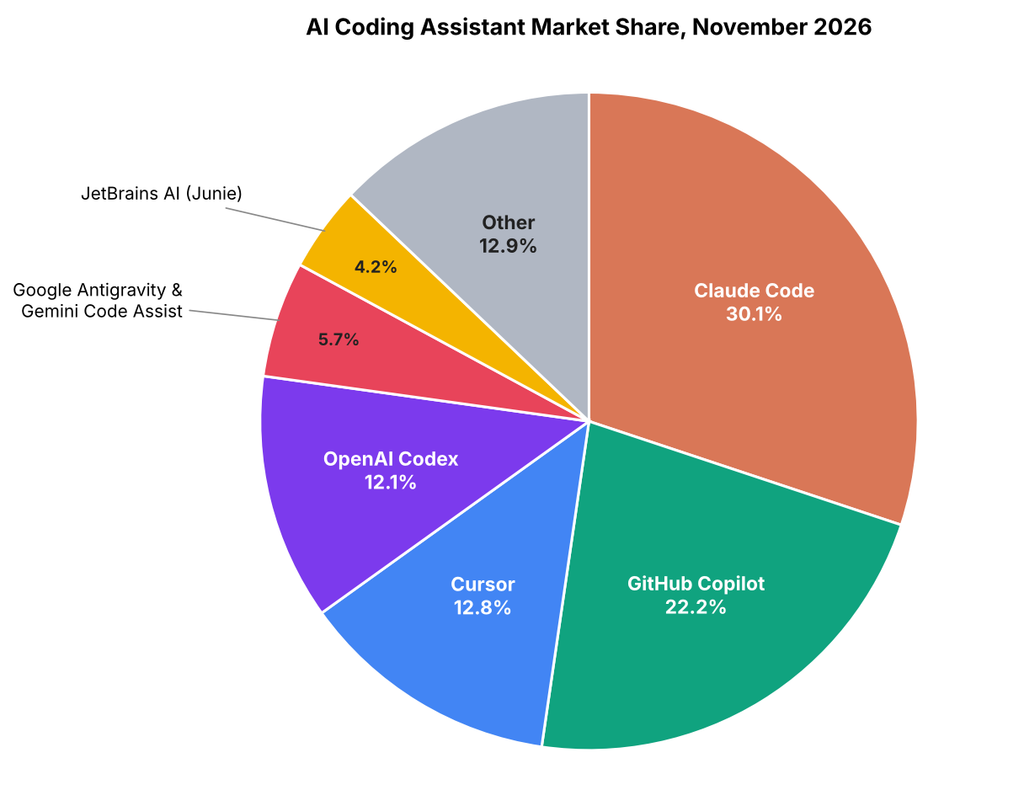
In the table below, we break down the market share of the leading AI coding assistants as of October 2026, along with each tool’s change in share since January 2026.
AI Coding Assistant Market Share, 2026
| AI Coding Assistant | Developer | Primary Interface | Market Share (Oct 2026) | Change vs. Jan 2026 |
| Claude Code | Anthropic | Terminal Agent | 30.1% | +11.6 pts |
| GitHub Copilot | Microsoft / GitHub | IDE Extension | 22.2% | -8.3 pts |
| Cursor | Anysphere | AI-Native IDE | 12.8% | -5.2 pts |
| OpenAI Codex | OpenAI | Terminal & Cloud Agent | 12.1% | +7.9 pts |
| Google Antigravity & Gemini Code Assist | AI-Native IDE | 5.7% | +1.2 pts | |
| JetBrains AI (Junie) | JetBrains | IDE Extension | 4.2% | -0.7 pts |
| Windsurf | Cognition | AI-Native IDE | 2.7% | -2.1 pts |
| Amazon Q Developer & Kiro | Amazon | IDE Extension | 2.6% | -0.8 pts |
| OpenCode | Open Source | Terminal Agent | 2.5% | +1.7 pts |
| Cline | Open Source | IDE Extension | 1.6% | -0.6 pts |
| All Other Tools | Various | Various | 3.5% | -4.7 pts |
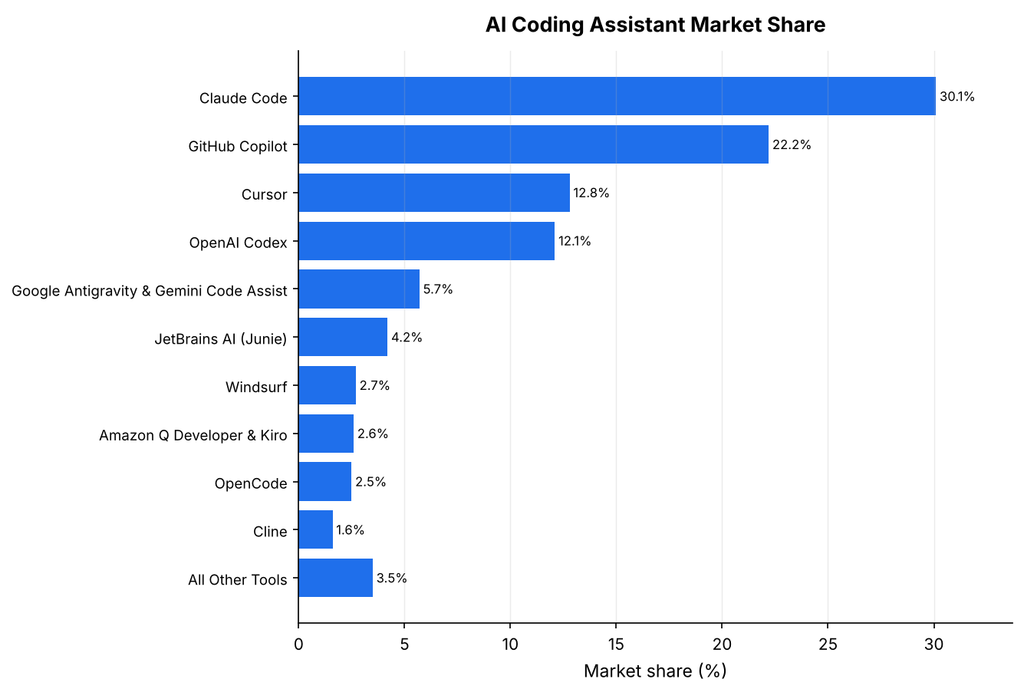
- We found that Claude Code overtook GitHub Copilot as the most common primary AI coding assistant in mid-2026 and has widened its lead since, to 7.9 points in October.
- Our data showed OpenAI Codex posting the second-largest gain of any tool, nearly tripling its share since January (from 4.2% to 12.1%) as developers adopted its cloud task mode; it now sits 0.7 points behind Cursor.
- We observed the four largest tools holding 77.2% of the market combined, up from 71.2% in January, a sign that the category is consolidating.
AI Coding Assistant Market Share, Q3 2025 to October 2026
In the table below, we track the market share of the five leading tools since Q3 2025. Because October falls in the middle of Q4, we report 2026 as monthly readings and keep 2025 as quarterly averages. The line graph beneath it plots the same series.
AI Coding Assistant Market Share, Q3 2025 to October 2026
| Period | GitHub Copilot | Claude Code | Cursor | OpenAI Codex | |
| Q3 2025 | 36.2% | 7.9% | 19.4% | 1.8% | 3.6% |
| Q4 2025 | 33.4% | 12.6% | 19.9% | 3.1% | 4.1% |
| Jan 2026 | 30.5% | 18.5% | 18.0% | 4.2% | 4.5% |
| Feb 2026 | 30.2% | 19.0% | 17.6% | 4.4% | 3.8% |
| Mar 2026 | 29.6% | 20.1% | 17.2% | 5.2% | 3.7% |
| Apr 2026 | 27.4% | 22.6% | 16.1% | 6.6% | 4.4% |
| May 2026 | 26.1% | 24.7% | 15.0% | 8.4% | 4.9% |
| Jun 2026 | 24.5% | 27.1% | 14.5% | 9.9% | 5.4% |
| Jul 2026 | 23.6% | 28.1% | 13.9% | 10.6% | 5.3% |
| Aug 2026 | 23.0% | 28.6% | 13.5% | 11.2% | 5.3% |
| Sep 2026 | 22.7% | 29.4% | 13.1% | 11.8% | 5.6% |
| Oct 2026 | 22.2% | 30.1% | 12.8% | 12.1% | 5.7% |
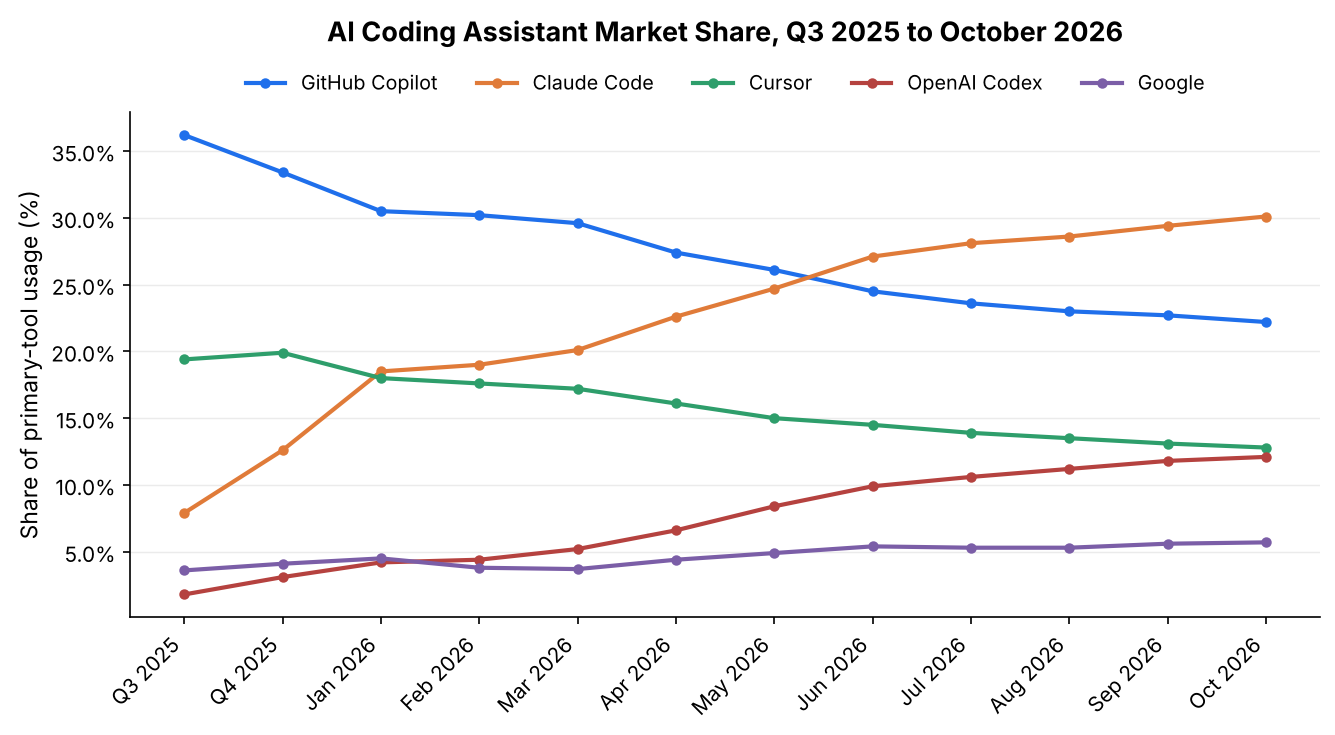
The 2025 rows are averages across each quarter, and the three monthly readings in each completed 2026 quarter average back to that quarter’s value (Q3 2026: Claude Code 28.7%, GitHub Copilot 23.1%), so the October 2026 row matches the snapshot above. The crossover between GitHub Copilot and Claude Code falls between May and June 2026 in monthly terms. Cursor’s share peaked in Q4 2025 and has declined in every month since, while OpenAI Codex accelerated sharply in Q2 2026 and has added smaller monthly gains since July. Google’s line is the steadiest in the set, with modest gains that track the release of its Antigravity IDE.
AI Coding Assistant Market Share by Company Size
In the table below, we break down primary-tool share by the size of the developer’s employer, measured in total employees.
AI Coding Assistant Market Share by Company Size, 2026
| Company Size | Claude Code | GitHub Copilot | Cursor | OpenAI Codex | All Other Tools |
| Startup (1-50) | 37.5% | 9.4% | 20.9% | 15.6% | 16.6% |
| Small Business (51-500) | 33.8% | 17.1% | 15.8% | 13.7% | 19.6% |
| Mid-Market (501-5,000) | 28.6% | 25.2% | 11.4% | 11.3% | 23.5% |
| Enterprise (5,000+) | 23.1% | 35.0% | 8.1% | 9.4% | 24.4% |
- We found that GitHub Copilot remains the leading tool at enterprises with more than 5,000 employees, where existing Microsoft licensing agreements make it the default procurement choice.
- Our data showed Claude Code’s share falling steadily as company size increased, from 37.5% at startups to 23.1% at enterprises. Anthropic made Code Review generally available on Team and Enterprise plans on October 15, 2026, and we will track whether that narrows the enterprise gap.
- We observed Cursor holding 20.9% of startups but only 8.1% of enterprises, a startup share about 2.6 times its enterprise share and the steepest relative decline by company size of any tool in our dataset.
AI Coding Assistant Market Share by Interface Type
In the table below, we group every tool in our dataset by the interface through which developers use it and compare each interface type’s share in January and October 2026.
AI Coding Assistant Market Share by Interface Type, 2026
| Interface Type | Share (Jan 2026) | Share (Oct 2026) | Change |
| Terminal / CLI Agent | 21.3% | 38.8% | +17.5 pts |
| IDE Extension | 41.2% | 29.1% | -12.1 pts |
| AI-Native IDE | 24.8% | 19.8% | -5.0 pts |
| Cloud / Background Agent | 5.1% | 9.2% | +4.1 pts |
| Browser-Based App Builder | 7.6% | 3.1% | -4.5 pts |
Usage was assigned to the interface each respondent reported using most often, so a tool that spans several interfaces contributes to more than one row, and the interface totals differ from the sum of the tools listed under each interface in the first table. In the October column, five tools and the All Other Tools row were split. Of OpenAI Codex’s 12.1%, 6.9 points came from the Codex CLI (terminal) and 5.2 points from Codex cloud tasks (cloud and background agents). Of Claude Code’s 30.1%, 28.5 points were terminal usage and 1.6 points came from Claude Code on the web. Of GitHub Copilot’s 22.2%, 19.8 points were IDE extension usage and 2.4 points came from the Copilot cloud agent. Google’s 5.7% divides into Antigravity (3.4 points, AI-native IDE), Gemini Code Assist (1.4 points, IDE extension) and Gemini CLI (0.9 points, terminal); Amazon’s 2.6% divides into Q Developer (1.7 points, IDE extension) and Kiro (0.9 points, AI-native IDE); and of the 3.5% held by all other tools, 3.1 points belong to browser-based app builders and 0.4 points to smaller IDE extensions.
The shift we measured is behavioral as much as it is vendor-driven: developers are handing longer, multi-file tasks to autonomous agents and reviewing the output, rather than accepting line-by-line suggestions inside an editor. That pattern mirrors what we see across the broader AI agent market, where task-completing agents are gaining on assistive tools.
AI Coding Assistant Market Share by Underlying Model
In the table below, we break down AI coding usage by the family of large language model that generated the code, regardless of which tool the developer used to access it.
AI Coding Assistant Market Share by Underlying Model, 2026
| Model Family | Developer | Share (Jan 2026) | Share (Oct 2026) |
| Claude | Anthropic | 49.2% | 47.6% |
| GPT | OpenAI | 22.4% | 29.1% |
| Gemini | 11.8% | 10.0% | |
| Open-Weight Models (Qwen, DeepSeek, Kimi, GLM) | Various | 10.3% | 9.1% |
| Grok | xAI | 3.4% | 2.0% |
| All Other Models | Various | 2.9% | 2.2% |
- We found that Claude models generated nearly half of all AI-written code in our dataset, because they power Claude Code and are also a popular model choice inside Cursor, GitHub Copilot, and most open-source agents.
- Our data showed OpenAI’s GPT models gaining 6.7 points of model share, closely tracking the growth of Codex.
- We observed open-weight models holding close to a tenth of coding usage, concentrated among cost-sensitive teams and self-hosted deployments; our Claude usage statistics and top AI models reports cover the broader model landscape.
Requesting a Copy of This Report
If you’d like to request a PDF copy of this report or learn more about our agency, you can reach out here.
- First Page Sage Research Study. First Page Sage. November 2026. San Francisco, California.
- AI Coding Agents: Adoption Trends. Mikhail Bogdanov, JetBrains Research. August 2026. Prague, Czech Republic.
- Stack Overflow Developer Survey 2026. Stack Overflow. 2026. New York, New York.
- Stack Overflow survey finds developers wary of AI tools. Sofiah Nichole Salivio, IT Brief UK. October 6, 2026. Auckland, New Zealand.
- Claude News: Seven Anthropic Announcements in October 2026. Rowan Sterling, OrcaRouter. October 23, 2026.
- GitHub Copilot. GitHub. October 2026. San Francisco, California.
- Claude Code. Anthropic. October 2026. San Francisco, California.