Between July 14 and October 23, 2026, our research team conducted a meta-analysis of the available evidence on AI recursive self-improvement, the process by which AI systems take over a growing share of the work of building their own successors. We compiled 41 datasets, including internal disclosures from frontier AI developers, independent capability benchmarks, studies of self-improving systems, and surveys of AI researchers.
Because each source measures a different part of the problem, we normalized five indicators onto a common 0 to 100 scale and combined them into a single measure, the FPS Recursive Self-Improvement Index. The index tracks how close frontier AI development has come to a loop in which AI systems design, build and evaluate their successors with minimal human input. A score of 100 would describe full automation of AI research and development.
We also weighted lab-reported automation rates by the share of research hours each stage of AI development consumes, which allowed us to estimate how much frontier AI research labor is already carried out by AI and where the remaining human work is concentrated. In the sections below, we present the index, its underlying indicators, that stage-by-stage estimate, and a pooled view of what researchers expect next. For broader adoption figures, see our agentic AI statistics report.
Summary of Findings
- The FPS Recursive Self-Improvement Index reached 79.1 out of 100 in Q3 2026, up from 43.8 a year earlier and 11.2 in Q1 2024.
- We estimate that 63.2% of labor hours in frontier AI research and development are now carried out by AI systems, double the 31.4% of a year earlier.
- 46.5% of the human work that remains falls in three stages: results analysis, experiment design, and research direction.
- Frontier AI task time horizons doubled every 3.7 months over the past year. At that pace, AI agents will reliably complete week-long tasks by January 2027 and month-long tasks by August 2027.
- Pooled across surveys, 58.3% of AI researchers expect recursive self-improvement to be under way within five years, including 83.3% of researchers at frontier labs.
Key AI Recursive Self-Improvement Statistics
In the table below, we break down the headline figures from our meta-analysis. Each value combines at least two independent sources, adjusted to a common definition and time period, and is shown beside the same measure one year earlier.
Key AI Recursive Self-Improvement Statistics – 2026
| Metric | October 2026 | October 2025 |
| FPS Recursive Self-Improvement Index (0 to 100) | 79.1 | 43.8 |
| Share of frontier AI R&D labor hours carried out by AI | 63.2% | 31.4% |
| Share of merged code at frontier labs written by AI | 79.3% | 40.5% |
| Frontier AI 50% task time horizon | 21.6 hours | 2.3 hours |
| Time horizon doubling time, trailing 12 months | 3.7 months | 4.9 months |
| AI agent hours per researcher hour at frontier labs | 3.2 | 0.58 |
| AI success rate on open-ended engineering tasks without human correction | 89% | 24% |
| Research decisions where AI chose a better next step than the researcher | 66% | 42% |
| Code output per frontier lab engineer, relative to 2024 | 7.4x | 2.1x |
| Median gain from published self-improvement loops | 2.3x | 1.6x |
| AI researchers expecting recursive self-improvement within five years | 58.3% | 44.9% |
Our researchers took three main points from the data:
- We found that every indicator in the dataset at least doubled over the past twelve months, and none showed signs of slowing in Q3 2026.
- Our data showed that the share of code written by AI is now the least informative of these measures, since it is close to its ceiling at frontier labs while research judgment measures still have room to move.
- We found that AI agents now log more working hours than the researchers who direct them, at a ratio of 3.2 to 1, which means the human role at frontier labs has shifted toward assigning and reviewing work.
FPS Recursive Self-Improvement Index, Q1 2024 to Q3 2026
No single public dataset captures recursive self-improvement on its own. Code share measures volume, time horizons measure autonomy, and research decision tests measure judgment. To build a combined view, we placed five indicators on a 0 to 100 scale and averaged them with equal weights. Time horizons and agent hours grow exponentially, so we scaled both logarithmically, setting 0 at one minute and 100 at one working month for time horizons, and 0 at 0.01 and 100 at 10 agent hours per researcher hour.
In the table below, we break down each indicator by quarter, followed by the resulting index.
FPS Recursive Self-Improvement Index Components (Q1 2024 to Q3 2026)
| Quarter | AI Share of Frontier Lab Code | Frontier Task Time Horizon | Open-Ended Task Success Rate | Agent Hours per Researcher Hour | AI Better Next-Step Rate | Index Score |
| Q1 2024 | 8.4% | 4 minutes | 4% | 0.02 | 18% | 11.2 |
| Q2 2024 | 10.9% | 11 minutes | 6% | 0.04 | 21% | 16.8 |
| Q3 2024 | 14.2% | 25 minutes | 9% | 0.07 | 25% | 22.3 |
| Q4 2024 | 17.6% | 43 minutes | 12% | 0.11 | 29% | 26.8 |
| Q1 2025 | 22.3% | 1.4 hours | 15% | 0.19 | 33% | 32.2 |
| Q2 2025 | 31.8% | 1.6 hours | 19% | 0.34 | 37% | 37.7 |
| Q3 2025 | 40.5% | 2.3 hours | 24% | 0.58 | 42% | 43.8 |
| Q4 2025 | 52.7% | 4.9 hours | 33% | 0.96 | 49% | 52.5 |
| Q1 2026 | 63.9% | 13.2 hours | 58% | 1.6 | 57% | 65.0 |
| Q2 2026 | 72.8% | 17.4 hours | 74% | 2.4 | 63% | 72.9 |
| Q3 2026 | 79.3% | 21.6 hours | 89% | 3.2 | 66% | 79.1 |
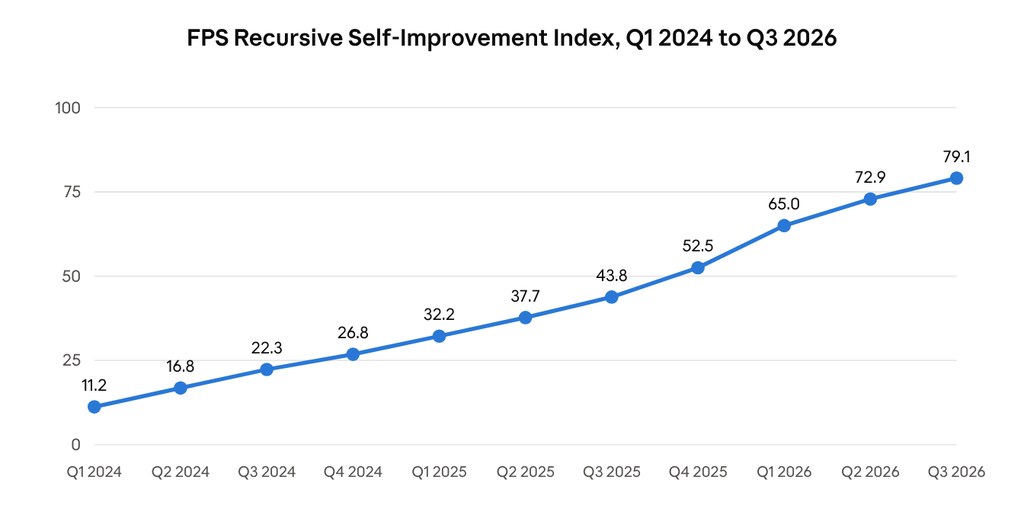
Our researchers took three main points from the index:
- We found that the index rose 35.3 points in the past four quarters, compared with 17.0 points in the four quarters before that, which means the pace of progress roughly doubled.
- Our data showed the sharpest single-quarter gain, 12.5 points, in Q1 2026, when open-ended task success rates more than doubled with a new generation of models.
- We found that the AI better next-step rate, our measure of research judgment, was the slowest-moving component in 2026, and it is now the main factor holding the index below 100.
Frontier AI Task Time Horizons and Projected Milestones
The task time horizon measures the length of a software task, in expert human hours, that the best available AI agent completes successfully half the time. It is the indicator most closely watched by researchers forecasting automated AI research, because an agent that can work for weeks without supervision can carry out a full research project. We reconciled measurements from multiple evaluation suites and reporting periods into one series, then projected forward at the trailing 12-month doubling rate.
In the table below, we break down the frontier time horizon by period, the doubling time over the prior twelve months, and our projected milestones.
Frontier AI Task Time Horizons (H1 2023 to Q3 2026, with Projections)
| Period | Frontier 50% Time Horizon | Doubling Time, Prior 12 Months |
| H1 2023 | 2 minutes | Baseline |
| H2 2023 | 3 minutes | Baseline |
| H1 2024 | 11 minutes | 4.6 months |
| H2 2024 | 43 minutes | 3.1 months |
| H1 2025 | 1.6 hours | 3.8 months |
| H2 2025 | 4.9 hours | 4.3 months |
| H1 2026 | 17.4 hours | 3.5 months |
| Q3 2026 | 21.6 hours | 3.7 months |
| January 2027 (projected) | 40 hours, one working week | 3.7 months |
| August 2027 (projected) | 167 hours, one working month | 3.7 months |
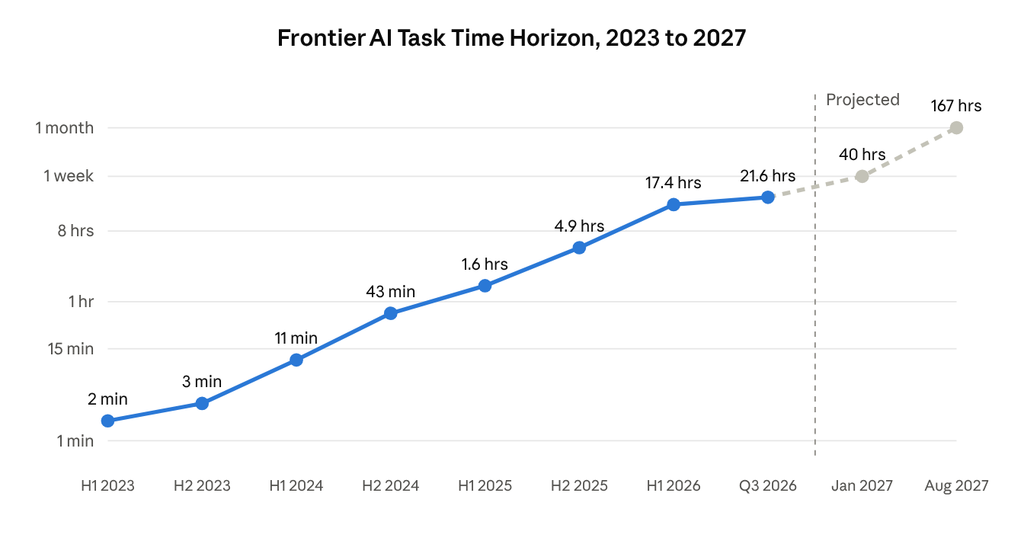
Our researchers took three main points from the data:
- We found that the doubling time has stayed between 3.1 and 4.6 months for two and a half years, a narrower band than most published forecasts assume.
- Our projection places month-long autonomous tasks in August 2027, which is the threshold several forecasting groups associate with an AI system that can run its own research projects.
- We found that current evaluation suites become unreliable above roughly 16 to 20 hours, so readings since Q2 2026 carry wider error margins than earlier ones.
AI Share of Work by Stage of Frontier AI Research
Lab disclosures report automation rates for individual tasks, such as writing code or choosing a next experiment, but no developer has published how much of its total research labor is now automated. To estimate it, we divided frontier AI research and development into seven stages, assigned each the share of researcher hours it consumes based on published time-use studies and lab descriptions of their workflows, and applied the AI completion rate we found for each stage. Weighted together, the stages show that AI systems now carry out 63.2% of frontier AI research labor.
In the table below, we break down each stage by its share of research hours, the share carried out by AI, and its share of the human work that remains.
AI Share of Frontier AI Research Work by Stage – 2026
| Stage | Share of Research Hours | Share Carried Out by AI | Share of Remaining Human Work |
| Code implementation | 31% | 84.2% | 13.3% |
| Debugging and infrastructure | 17% | 72.6% | 12.6% |
| Running and monitoring experiments | 16% | 67.9% | 13.9% |
| Data preparation and evaluation | 12% | 58.3% | 13.6% |
| Results analysis | 11% | 41.7% | 17.4% |
| Experiment design | 8% | 24.8% | 16.3% |
| Research direction and prioritization | 5% | 5.9% | 12.8% |
| All stages | 100% | 63.2% | 100% |
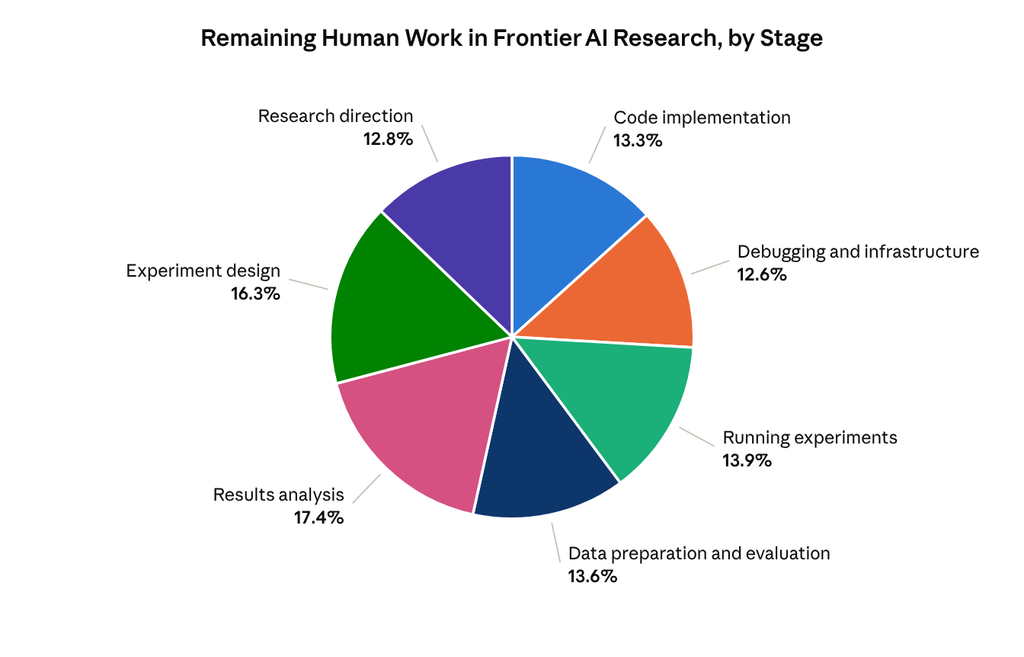
Our researchers took three main points from the data:
- We found that the three judgment-heavy stages, results analysis, experiment design and research direction, account for only 24% of research hours but 46.5% of the human work that remains.
- Our data showed that research direction is the least automated stage at 5.9%, which matches lab statements that humans still choose which problems are worth solving.
- We found that once AI completes most of the hands-on work, human review time becomes the limiting factor, so further gains depend mainly on automating evaluation and judgment.
Researcher Expectations for Recursive Self-Improvement
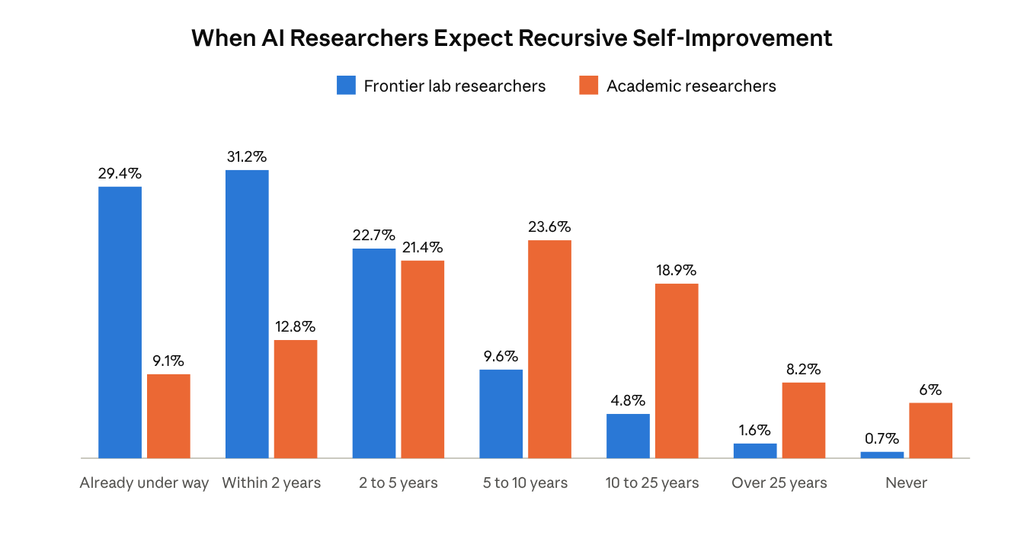
Surveys of AI researchers use different questions, samples and time frames, so their headline numbers are rarely comparable. We pooled responses from five surveys and interview studies conducted between 2023 and 2026, totaling 3,214 respondents, mapped each answer onto a common set of time frames, and weighted more recent responses more heavily. We then split the pooled results by whether respondents work at a frontier AI lab or in academia.
In the table below, we break down when researchers expect recursive self-improvement, defined as AI systems carrying out most of the work of developing their successors, to arrive.
Expected Arrival of Recursive Self-Improvement Among AI Researchers – 2026
| Expected Arrival | Frontier Lab Researchers | Academic Researchers | All Researchers, Pooled |
| Already under way | 29.4% | 9.1% | 16.8% |
| Within 2 years | 31.2% | 12.8% | 19.6% |
| 2 to 5 years | 22.7% | 21.4% | 21.9% |
| 5 to 10 years | 9.6% | 23.6% | 18.4% |
| 10 to 25 years | 4.8% | 18.9% | 13.7% |
| More than 25 years | 1.6% | 8.2% | 5.8% |
| Never | 0.7% | 6.0% | 3.8% |
Our researchers took three main points from the data:
- We found that 83.3% of frontier lab researchers expect recursive self-improvement within five years, compared with 43.3% of academic researchers, a gap of 40 percentage points.
- Our data showed that the pooled share expecting it within five years rose from 44.9% to 58.3% over the past year, the largest annual shift in the series.
- We found that fewer than 1 in 25 researchers in either group now believe recursive self-improvement will never happen, which moves the debate from whether it will occur to how fast it will unfold.
Requesting a Copy of This Report
If you’d like to request a PDF copy of this report or learn more about our agency, you can reach out here.
- First Page Sage Research Study, First Page Sage, October 2026, San Francisco, California
- When AI Builds Itself, Marina Favaro and Jack Clark, The Anthropic Institute, June 2026, San Francisco, California
- Research Acceleration: The View Inside OpenAI, OpenAI, September 2026, San Francisco, California
- Time Horizon 1.1, METR, January 2026, Berkeley, California
- Inside the Race to Make AI Build Itself, Harry Booth, TIME, August 2026, New York, New York
- Darwin Gödel Machine: Open-Ended Evolution of Self-Improving Agents, Jenny Zhang, Shengran Hu, Cong Lu, Robert Lange and Jeff Clune, ICLR 2026, March 2026, Vancouver, British Columbia
- AlphaEvolve: A Gemini-Powered Coding Agent for Designing Advanced Algorithms, Google DeepMind, May 2025, London, United Kingdom
- AI Researchers’ Views on Automating AI R&D and Intelligence Explosions, Severin Field, Raymond Douglas and David Krueger, March 2026, Cambridge, United Kingdom
- Q1 2026 Timelines Update, AI Futures Project, April 2026, Berkeley, California
- We Spoke to 100 Researchers. This Is the Biggest Threat From AI, Cybernews, October 2026, Vilnius, Lithuania