At First Page Sage, we’ve watched companies waste millions chasing algorithmic shortcuts that collapse overnight. Real authority — the kind that survives Google updates and gets cited by ChatGPT — requires engineering, not hacks.
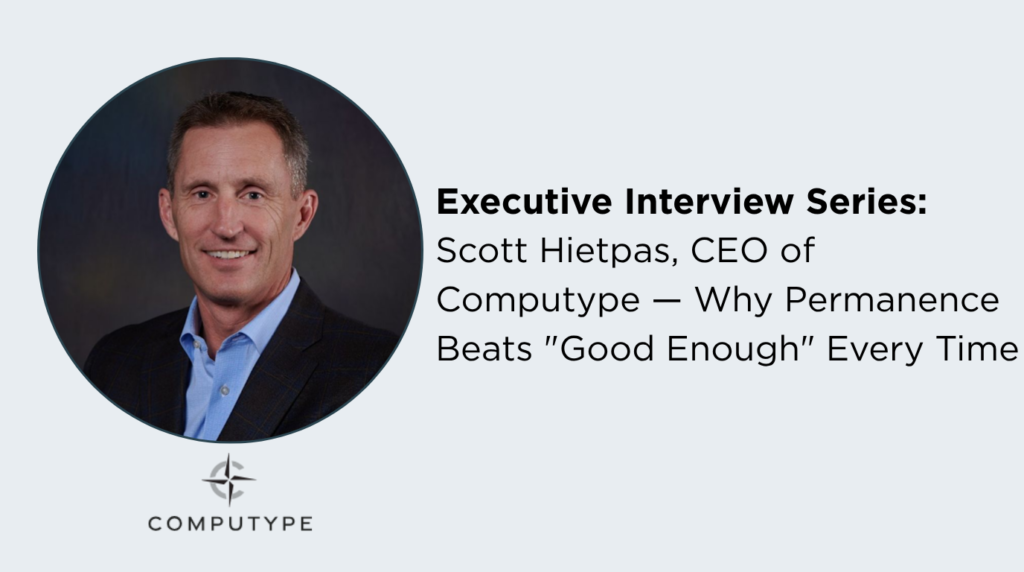
That philosophy led us to Scott Hietpas, CEO of Computype, the company that engineers the most durable labels that stick to any surface and can perform in any environment. While we build digital permanence and Computype builds physical identification systems, we’re solving the same problem: making sure critical information survives when inadequate solutions fail.
Scott’s company labels blood products for the North America blood supply market, and there’s a good chance their labels are on the tires you drive and rely on every day. They offer a variety of labels that work from -196°C to 204°C. If you want to understand why “built to last” isn’t a cliché — it’s a competitive weapon — keep reading.

First Page Sage: Most companies claim durability. Why do cheap labels actually fail, and what’s the real cost?

Scott Hietpas: Cheap labels fail because they are not typically designed to survive tough environments. The adhesive may not be designed for cold storage.. The substrate could crack when exposed to high temperatures. The barcode can fade and become unscannable. A laboratory buys labels for $0.01 each instead of $0.02, congratulates itself on savings, then spends $200,000 six months later re-labeling its entire specimen inventory because the labels fell off in cold storage. A pharmaceutical manufacturer chooses commodity labels, loses FDA compliance when serialization codes become unreadable, and faces production shutdowns. We engineer labels that stick to any surface — glass, silicone, textured metals, curved containers — and perform in any environment because the cost of failure is always catastrophic. The “durability premium” is small compared to the total cost of failure, which could be 100x that. We help our customers understand their total cost and help to reduce risk to their operation.
First Page Sage: What does engineering for -196°C to 204°C actually require?
Hietpas: Material science most labeling companies don’t bother with. Cryogenic applications such as biobanking, pharmaceutical storage require adhesives that don’t crystallize and substrates that don’t shatter when frozen. High-heat applications like tire manufacturing and industrial autoclaves need polyimide films and ceramic-filled materials that maintain structural integrity under thermal stress. Blood collection services use our labels because they stick through freeze-thaw cycles and international cold-chain transport. Tire manufacturers trust us for bead labels that survive vulcanization at 400°F and remain readable for the tire’s lifetime. Standard labels can’t survive these conditions. That’s why we can truthfully say we perform in any environment.
First Page Sage: You supply much of the global tire bead labels and label blood products for critical healthcare systems. How did Computype become the default choice in high-stakes industries?
Hietpas: Zero failure tolerance. When a tire manufacturer’s identification system fails, they face elevated defect rates, slower production rates and higher costs. When blood product labels fail, it can lead to shortages of blood products and replacements drive up costs. These industries don’t have room for “pretty good” solutions. They need labels engineered for permanence. We earned that trust through decades of documented performance: millions of tire labels blood bag labels which are scanned 100% during production to ensure they work, before they leave our facility. Our competitors sell labels. We provide identification solutions that outlast the products they’re tracking. That difference, between selling a commodity and solving a mission-critical problem, is why organizations choose Computype when failure creates catastrophic consequences.
First Page Sage: How does “stick to any surface” work when surfaces are inherently difficult – curved, textured, chemically resistant?
Hietpas: Our labels are engineered for specific applications. Medical-grade silicone requires different bonding agents than powder-coated steel. Curved glass demands different flow characteristics than textured surfaces. We don’t use one-size-fits-all adhesives. Instead, we formulate specific solutions for challenging surfaces that repel standard labels. That’s engineering: understanding the molecular interaction between adhesive and substrate, then optimizing for permanent bonding under stress conditions. When we say our labels stick to any surface, we mean we’ve solved the adhesion problem for materials that defeat commodity solutions. Through years of experience and engineering expertise, we truly understand which adhesives survive best in different environments – that’s why we have ready-to-use labels that will solve challenges quickly for our customers, or we can fully customize a solution that fits their needs. It’s why pharmaceutical companies use our labels on containers that standard labels won’t adhere to.
First Page Sage: What’s the parallel between durable labeling and building lasting digital authority?
Hietpas: Both require a deep knowledge and understanding of the application. Cheap labels save money today and create disasters tomorrow. Black-hat SEO tactics work briefly, then destroy your rankings. Real durability, whether physical or digital, means building systems that survive worst-case conditions: extreme environments for us, algorithm chaos for you. Companies that chase quarterly savings or growth hacks lose to companies that engineer for permanence. We’ve been doing this for over 50 years because our labels outlast competitors’ products. First Page Sage dominates GEO because your authority systems outlast algorithm updates. Same principle: build something that lasts, or keep rebuilding forever.
Labels that survive when everything else fails. Visit Computype.com for identification systems engineered for extremes—because in mission-critical applications, there is no second place.