Last updated October 6, 2026
OpenAI now gives advertisers several ways to track what happens after a user clicks a ChatGPT ad. With a measurement pixel and server-side Conversions API, advertisers can trace the path from click to conversion. OpenAI still has not released platform-wide conversion benchmarks that would show advertisers how effective ChatGPT is as an advertising channel and whether it deserves a place in their budget.
To fill that gap, First Page Sage surveyed ChatGPT ad conversion rates across 17 verticals. The findings draw on three data sets: First Page Sage’s internal data from clients’ ChatGPT advertising campaigns, our Organic ChatGPT Conversion Rates report, and our SEO vs. PPC Conversion Rate research, which examines the historical relationship between organic and paid traffic conversion performance. This edition reflects data through September 30, 2026.
Industry Breakdown of ChatGPT Ads Conversion Rate
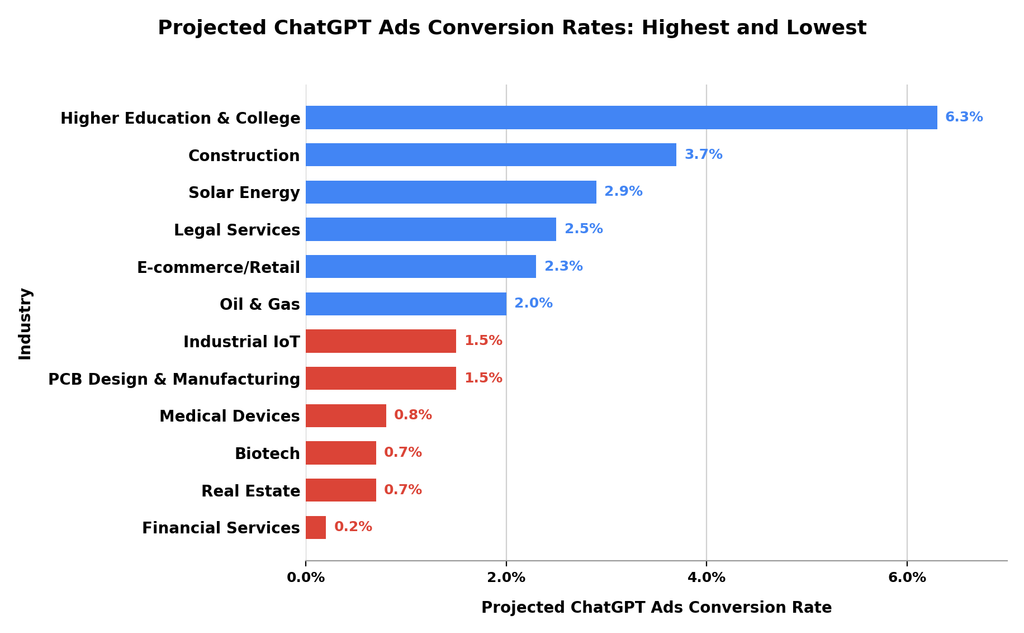
Across the industries tracked in this report, projected conversion rates range from 0.2% to 6.3%. The differences mostly reflect buyer intent, purchase price, the length of the customer journey, and how far along someone is in the decision-making process when they interact with an ad.
In most industries covered in this report, ChatGPT ad conversion rates are lower than organic search conversion rates. This matches a long-standing pattern in digital marketing: people who discover a company organically are more motivated to buy than people who feel they are being sold to.
The Industry Breakdown of ChatGPT Ads Conversion Rate, 2026
| Industry | Average SEO Conversion Rate for 2026 | Average Google Ads Conversion Rate for 2026 | ChatGPT Organic Conversion Rate for 2026 | Projected ChatGPT Ads Conversion Rate for 2026 |
| Higher Education & College | 1.6% | 1.9% | 5.4% | 6.3% |
| Construction | 2.0% | 1.9% | 3.9% | 3.7% |
| Solar Energy | 2.8% | 1.9% | 4.0% | 2.9% |
| Legal Services* | 4.6% | 2.3% | 4.9% | 2.5% |
| E-commerce / Retail | 1.7% | 1.4% | 2.9% | 2.3% |
| Oil & Gas | 1.8% | 1.6% | 2.3% | 2.0% |
| Commercial Insurance* | 1.9% | 1.1% | 3.7% | 1.9% |
| HVAC Services | 3.4% | 1.9% | 3.3% | 1.9% |
| B2B SaaS | 2.3% | 1.1% | 3.3% | 1.7% |
| Manufacturing & Distribution | 3.2% | 1.1% | 4.6% | 1.6% |
| Transportation & Logistics | 1.5% | 1.2% | 2.1% | 1.5% |
| Industrial IoT | 2.4% | 1.1% | 3.6% | 1.5% |
| PCB Design & Manufacturing | 2.4% | 1.5% | 2.4% | 1.5% |
| Medical Devices | 3.3% | 0.9% | 2.7% | 0.8% |
| Biotech | 1.9% | 0.7% | 1.9% | 0.7% |
| Real Estate | 2.9% | 0.8% | 2.2% | 0.7% |
| Financial Services* | 2.4% | 0.3% | 1.5% | 0.2% |
Currently Prohibited for Most Advertisers
- Addiction Treatment: Ads for treatment providers and regulated healthcare services are generally not permitted.
- Pharmaceuticals: Ads for prescription drugs and regulated medical treatments are not currently allowed.
- Legal Services: Ads for legal representation, legal advice, and legal service providers are currently prohibited.
* Restricted or Requires Approval
- Financial Services: In the U.S., OpenAI may allow approved financial advertisers on a case-by-case basis in categories that include credit cards, deposit accounts, personal loans, mortgages, investment services, and payment services, and may require proof of licensure. Ads for credit repair, debt settlement, debt assistance, and alternative investments such as bullion are prohibited, and ads for financial services outside the U.S. are generally prohibited. Financial tools that do not promote financial products or transactions are generally permitted, including budgeting apps, financial software, and finance-related educational courses.
- Commercial Insurance: OpenAI lists insurance among the financial services categories that approved U.S. advertisers may promote on a case-by-case basis. Advertisers may be required to provide proof of licensure.
- Legal Services: Legal service providers may advertise in the U.S. when they are licensed to practice in the jurisdiction where the ad is shown. Legal services outside the U.S. are currently prohibited.
⥍ Eligibility Depends on the Product and Claims
- Biotech: Research tools, software, and non-clinical offerings may be eligible. In the U.S., approved advertisers may promote medical testing and diagnostic products on a case-by-case basis, while ads for experimental or investigational therapies and unsupported treatment claims are not allowed.
- Medical Devices: In the U.S., approved advertisers may promote consumer medical devices, wearables, and apps on a case-by-case basis. Ads for unsafe or unapproved medical products are not allowed, and ads for health services outside the U.S. are generally prohibited.
Compared with the prior edition of this report, our updated projections moved as follows:
- We found that projected rates rose in 8 of the 17 industries and fell in 8, with Financial Services unchanged at 0.2%.
- Our data showed the largest gains in Higher Education (5.7% to 6.3%), Construction (3.2% to 3.7%), and B2B SaaS (1.2% to 1.7%), and the largest decline in Oil & Gas (2.8% to 2.0%).
- We found that Higher Education remains the only industry where the projected ChatGPT ads rate (6.3%) exceeds the organic ChatGPT rate (5.4%).
ChatGPT Ads Conversion Rate: Highest and Lowest Industries
Why Some Industries Convert Higher Than Others
The highest-converting industries tend to attract users who are further along in their decision-making process. The exact reason varies by industry, but there is usually less friction between the initial ad click and the next step.
- Higher Education: Students getting ready to apply to college may use ChatGPT to compare schools and programs in the discipline they’re most interested in. At that stage, they are often narrowing an existing list instead of starting their search from scratch.
- Construction: Someone searching for a construction company usually has a specific project in mind, such as a kitchen remodel or flooring refresh. Once they find a company that handles that type of work, requesting a quote or consultation is a natural next step.
- Solar Energy: Choosing solar usually involves a fair amount of research into installation costs, potential savings, and system options. Someone who has reached the point of comparing installers on ChatGPT may have already done much of that homework.
- Legal Services: Legal searches are often driven by an issue that already needs to be resolved. Someone comparing attorneys on ChatGPT may therefore be seeking representation instead of general information on the topic.
- E-commerce and Retail: The path to conversion is shorter here. Shoppers can compare products, brands, features, or prices on ChatGPT and make a purchase soon after finding an item or offer they like.
- Oil and Gas: Searches in this industry can be highly specific, sometimes involving a particular part, piece of equipment, or specialized service. When a provider meets those requirements, the buyer may have little reason to keep searching broadly.
- HVAC Services: Urgency plays a larger role here. If an AC or heating system stops working, someone searching ChatGPT for a local HVAC company may be looking for someone they can call immediately.
Why Some Industries Convert Less Frequently
Lower-converting industries tend to have more obstacles between initial interest and a final decision. These can include a long evaluation process, multiple decision-makers, regulatory requirements, financing, or a purchase that requires more consideration.
- Financial Services: Trust carries a lot of weight when someone is choosing an investment provider, lender, or another company that will be handling their money. A ChatGPT ad may introduce them to a provider, but most people will want to do more research before making that kind of commitment.
- Real Estate: Finding a property someone likes doesn’t always mean they’re ready to buy. They may still spend weeks or months comparing other properties, figuring out financing, negotiating the price, and deciding whether they’re ready to make such a large purchase.
- Biotech: Buyers may need to evaluate highly specialized products or services against scientific, technical, and regulatory requirements. That level of scrutiny makes an immediate conversion after an ad click less likely.
- Medical Devices: Medical device purchases can depend on clinical evaluations, regulatory requirements, procurement processes, and several rounds of approval. Finding the right supplier is only one part of a potentially lengthy purchasing process.
- PCB Design and Manufacturing: Board orders usually follow engineering review, prototyping, and supplier qualification. An ad click tends to come at the start of that evaluation, so a quote request may follow weeks later.
- Industrial IoT: These purchases often involve pilot projects, integration with existing equipment, and sign-off from both operations and IT. Buyers who click an ad are frequently still defining their requirements.
- Manufacturing and Distribution: Buyers may compare suppliers, request quotes, negotiate pricing, and work through procurement before choosing a vendor. The larger or more specialized the order, the more involved that process typically becomes.
- B2B SaaS: Software purchases often involve more people than the person who initially discovers the product. Demos and internal discussions may be followed by security reviews, budget approval, and sign-off from several stakeholders.
What These Conversion Rates Mean for Campaign Planning
- ChatGPT ads tend to be more effective when the user already has a clear idea of what they need and is using the model to make a final decision.
- When there are fewer steps between researching something and acting on it, users are more likely to convert.
- A lower immediate conversion rate may still be acceptable for industries with long sales cycles. In those industries, someone may click an ad today and become a customer weeks or months later.
- Higher conversion rates can also lower the cost of acquiring each customer. When fewer clicks convert, you generally need more traffic and more follow-up to produce the same number of customers.
- The benchmarks in the table above are a starting point and carry no guarantee. The ad’s quality, what you say in it, who you target, and what happens after someone clicks can all strongly affect the final conversion rate.
ChatGPT Ads Conversion Rate: What to Expect
As more advertisers adopt ChatGPT ads and OpenAI continues to build out the platform, the conversion rates presented in this study are likely to change. The developments below could have the largest impact:
- Expansion into more markets: ChatGPT ads launched in the U.S. in February 2026 and were available in more than 60 countries as of September 23, 2026. OpenAI has said it will continue expanding into new markets over the coming months. As advertisers reach new audiences with different buying habits, conversion rates could move up or down depending on the industry and location.
- Ads on additional subscription tiers: Ads currently appear on ChatGPT’s Free and Go plans, while Plus, Pro, Business, Enterprise, and Edu accounts remain ad-free. If OpenAI eventually extends ads to other tiers, conversion patterns could change. Paid subscribers may use ChatGPT differently than free users, particularly those who rely on it heavily for work, research, coding, or other professional tasks.
- Higher advertising costs: As more companies begin advertising on ChatGPT, competition for ad placements is likely to increase. That could drive up the cost of clicks, much as it has on established search and social advertising platforms. Even if conversion rates hold steady, higher click costs could make acquiring each customer more expensive.
- Better optimization tools: OpenAI is still building out the advertising platform. It added conversion-optimized bidding in July 2026 and HubSpot and Shopify integrations in September 2026. Further improvements to bidding, attribution, targeting, and campaign optimization could give advertisers more control over who sees their ads and help them identify what is driving conversions.
- New ad formats and placements: Today, ChatGPT ads primarily appear as sponsored placements alongside conversations. In September 2026, OpenAI began testing Sponsored Agents with select U.S. advertisers, which let a user start a clearly labeled conversation with a business-sponsored agent after clicking an ad. Formats could change further as ChatGPT becomes capable of handling more tasks on a user’s behalf. Someone planning a trip, for example, could eventually encounter a sponsored hotel or activity while working through their itinerary. Ads that appear closer to the point where someone is ready to act could convert differently than the formats available today.
Advertisers should treat the projected conversion rates in this report as a starting point for planning and budgeting. They do not guarantee what an individual campaign will achieve.
Further Reading & Requesting a Copy of This Report
Business owners and marketers who want to better understand how to allocate their marketing budgets to plan for a broader ChatGPT advertising rollout should refer to our previous articles:
- What Percentage of Revenue Should You Allocate to Marketing?
- SEO vs. PPC Statistics: 2026 Conversion Rates
- SEO vs Paid Search: A Primer
- Generative Engine Optimization (GEO) Cost Breakdown
- Generative Engine Optimization (GEO): Explanation & Algorithm Breakdown
To request a PDF copy of this report, reach out here.